






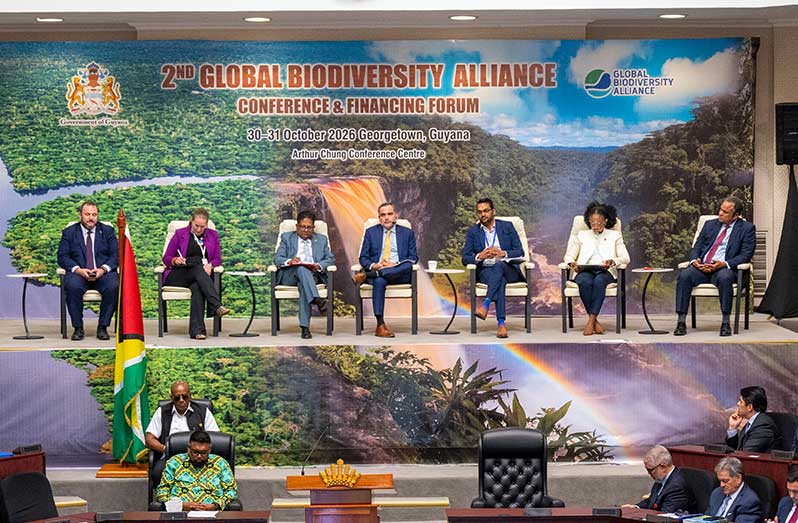
–Panel examines policy and financing measures to support conservation and sustainable growth
GUYANA’S Senior Minister within the Office of the President with Responsibility for Finance, Dr. Ashni Singh has called for biodiversity to be integrated into national economic planning, fiscal strategies and public investment decisions, as regional leaders and financial-sector representatives examine ways to position nature as an economic asset and attract greater investment in conservation.
Dr. Singh made the call on Saturday while moderating a high-level panel discussion titled “Biodiversity as an Economic Asset: Policy, Fiscal and Institutional Leadership” on the final day of the Global Biodiversity Alliance (GBA) Summit at the Arthur Chung Conference Centre.
The discussion focused on the policy and institutional reforms needed to incorporate biodiversity into national development strategies, strengthen coordination across government agencies and establish an enabling environment for nature-positive investment.
The Senior Minister said biodiversity must “remain at the central focus of all that we do”, and also as a national economic and development priority, with governments ensuring that commitments translate into practical action through their planning, budgeting and investment decisions.
In his closing remarks, the finance minister endorsed the contributions made during the discussion, noting that the panel reflected the vision of President Dr. Irfaan Ali for the Alliance to move beyond identifying challenges and concentrate on solutions.
“On this panel and during the course of the last 24 hours or so, we have done far more than simply admire the problem. And I have to say to you that that’s certainly fully in keeping with President Ali’s vision for the Global Biodiversity Alliance, that it would not be a forum for the regurgitation of the problem, but instead be a forum for determination and delivery of the solution,” Dr. Singh said.
Director of Environment at the World Bank Group, Valerie Hickey, said nature-based businesses represented significant economic opportunities, particularly in emerging markets, where nature-related industries could generate employment, attract revenue and support economic growth.
She pointed to nature-based tourism as an example, highlighting the international birdwatching market and the need to ensure that the financial benefits generated by such activities reach the communities and locations responsible for protecting natural resources.
Hickey said development strategies must place the environment at their centre, rather than treating conservation and economic development as competing priorities. “Nature-based businesses have enormous markets. They’re the markets that are growing most,” she said. Hickey said countries must demonstrate the economic value of their natural resources through credible data and natural capital accounting, noting its potential in heplinbg governments make informed decisions, “If something isn’t priced, it can’t be built. If it can’t be built, it can’t be paid for,” Hickey said.
Minister of Finance of the Commonwealth of The Bahamas, Michael Halkitis, emphasised that investment in environmental protection should be viewed as a means of reducing future economic risks. He said governments and financial institutions must recognise that protecting natural ecosystems could help countries avoid greater costs associated with environmental degradation and the consequences of failing to safeguard their natural resources. Drawing on his country’s experience, Halkitis underscored the need to recognise the economic value of preserving natural ecosystems.
“Marine protected areas should be recognised as long term investments, rather than just short-term costs,” he stated. Halkitis also reiterated that biodiversity investment was not simply an expenditure but an important consideration in building long-term resilience.
“Just to reiterate the point that investing in your environment is actually reducing risk in the future. And I think that’s an important point to take away,” he said.
Barbados’ Minister of Economic Affairs and Planning, Marsha Caddle, highlighted the importance of aligning domestic fiscal incentives with the wider international financial system to support nature-based and ecosystem-based approaches.
She explained that Barbados had already incorporated such priorities into its fiscal incentives framework, but cautioned that providing incentives also carried costs for government through reduced tax revenues. Caddle said these considerations required countries to look beyond domestic tax arrangements and examine how international financial mechanisms could help address investment risks and support their environmental priorities.
Caddle also said biodiversity goals must be included in national development and investment plans to ensure they are considered when governments allocate public resources, adding, “A target that lives in an environmental strategy is going to compete for leftovers in the national budget. And a target that lives in the national investment plan is going to compete on equal terms.”
Chief Executive Officer of the Guyana Bank for Trade and Industry (GBTI), Shawn N. Gurcharran, called for biodiversity policies and incentives to extend beyond national and macroeconomic strategies to reach households and individual taxpayers.
He said while governments must establish the necessary policy frameworks, the benefits and responsibilities associated with biodiversity protection must also be reflected throughout the wider economy. Gurcharran noted that tax incentives and other measures should encourage citizens to embrace conservation, while creating opportunities for households to generate income and economic value from nature-positive activities.
He stressed that the success of biodiversity policies would depend on their ability to influence behaviour and participation at every level of society, saying, “I think the conversations have been excellent, and the experiences that have been shared really helps us to curate a path forward as to how we can progress to really make biodiversity this economic asset that we’re talking about. But I also believe it is very important as we target macro-level policies and practices and approaches, this also must filter down across the entire spectrum, that is the economy, including the micro-level,” he said.
Head of Nature Finance at Standard Chartered, Oliver Withers, meanwhile, pointed to existing banking mechanisms that could encourage financing for projects with demonstrable societal benefits. He explained that the infrastructure supporting factor could allow banks to reduce the risk-weighted assets they are required to hold when financing qualifying infrastructure projects, potentially creating additional incentives for investment.
Withers said perceptions of the risks associated with nature-based projects also needed to be reconsidered, noting that incentives did not always have to take the form of tax concessions. “You looked at incentivisation, it is sitting on the table already from an EU perspective and a banking perspective. There is something called the infrastructure supporting factor. If we are able to demonstrate that infrastructure projects that we’re financing have a societal benefit, we can apply the infrastructure supporting factor, which reduces the risk-weighted assets that we as a bank have to hold,” he added.
Director of Relationship Management, Environmental Solutions and Commercial Strategy at S&P Global, Carlos Cordova, urged governments and financial institutions to consider the economic consequences of biodiversity loss, rather than focusing exclusively on the cost of conservation. He said forests, wetlands and other natural resources already contributed to national economies, even when those contributions were not reflected in conventional national accounts. “I want to finalise with this thought. We often talk about the cost of protecting nature, right? But perhaps we should be asking a different question. What is the economic cost of losing it? Forests, wetlands, and biodiversity are already contributing to our economies, even when the contribution doesn’t appear in our national account. Nature doesn’t need a market price to have economic value,” he siad. Cordova maintained that making nature’s economic value more visible in government and financial-sector decision-making was essential to strengthening the case for its protection. The two-day summit was held under the theme “Investing in Nature: Accelerating Biodiversity Finance for Sustainable Development.”




