






-President Ali highlights regional connectivity as Guyana advances plans for major maritime infrastructure
GUYANA’S rapidly growing economy is creating positive shifts in many other sectors, with shipping among the areas that are seeing massive growth in recent years.
However, while the sector is seeing growing investment and international attention, President Dr Irfaan Ali noted that deep-harbour infrastructure in Guyana and throughout the region remains a major challenge for the Caribbean.
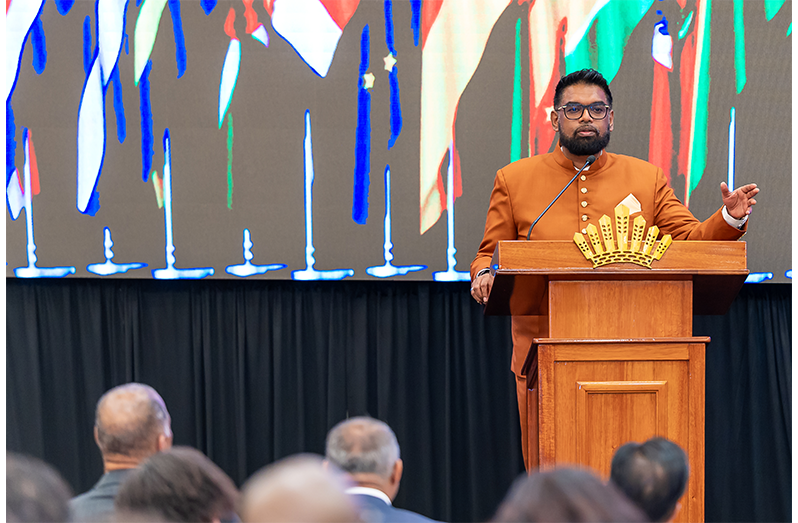
Delivering keynote remarks during Monday’s opening ceremony of the Caribbean Shipping Association’s 56th Annual General Meeting (AGM), Conference and Exhibition at the Guyana Marriott Hotel, the Head of State called for stronger public-private investment towards modernising ports across the region, highlighting ageing infrastructure, limited cargo-handling capacity and inadequate navigational depth as major challenges the region should tackle in developing regional shipping.
Citing the importance of the shipping industry to economic development, the Head of State noted that Guyana is taking steps to develop its port infrastructure. However, President Ali noted that the development of the shipping industry should be done collectively to ensure the holistic growth of the sector that both connects and empowers the region.
Giving an overview of the region’s shipping industry, President Ali highlighted high shipping costs, weak intra-regional trade, climate-related disasters, and geopolitical instability as major threats to the region.
Among the major challenges he cited is uneven port infrastructure across the region. He noted that port capacity, cargo-handling equipment, storage facilities, and navigational depth are major threats the industry is currently facing. This is why, he noted, Guyana has taken steps to develop a deepwater port connecting to Brazil and the rest of the region.
Reinforcing the scale and scope of the work being done, President Ali noted that the vast differences and lack of coherence in shipping across the region are causing major challenges. As he explained, these differences are hampering efficiency and growth in the Caribbean’s shipping sector.
“These differences affect not only the efficiency of individual ports but also the performance of the regional shipping network as a whole. An Inter-American Development Bank 2018 study of short-sea shipping in the Caribbean noted that, and I quote, ‘most Caribbean ports are 50 years old or older, and these ports were built for a completely different commercial environment,’” he said.
The Head of State was keen to note that the issue extends to policy, with projects across the region not being a priority. He noted that the region has seen the development of ports that are not efficient and were built for a completely different commercial environment.
He noted that Guyana provides a useful illustration of the investment and the challenges required. “As our economy expands and our trade volume increases, we must ensure that our maritime infrastructure is based on development and implementation,” he said, citing that almost US$1 billion has been invested in developing maritime infrastructure in the Demerara River although much more dredging works and investment need to be done.
Moreover, the President was keen to note that because Guyana sees port development as a major part of its economy, discussions continue to take place in shaping Guyana’s port and deepwater infrastructure.
Speaking to members of the media on the sidelines of the event, President Ali stated that discussions on port infrastructure for full diversification are taking place, noting, “The deepwater port is an important part of our development strategy. The deepwater port is critical for the building out of our economy, for the diversification of our economy, for our own competitiveness. As the country continues to grow and expand and continues to build out the infrastructure for a full diversification, this port is extremely critical.”
The President also addressed the matter of Chevron stepping back from additional studies for the Berbice deepwater port. He explained that the project remains on stream and the study is still a priority that the Government will work to make a reality.
“This is a study that has to be done. So, as a government and as a people, with all the development partners, we have to get the study done,” he said, adding that other agencies are also interested in supporting the study.
“The U.S. EXIM is also very keen on supporting this study,” he said, further adding, “Then we will be having a meeting with all of the potential investors, especially the large ones, to move this forward.”
President Ali noted that Guyana is continuing full force ahead with the development of its deepwater port, with feasibility studies and the initial work on examining different sites currently ongoing.
Highlighting the next steps, he said, “Then we will move into, of course, full design. But this will give us, this initial study will give us the opportunity to move towards having investors and investment ready.”
The Head of State noted that Guyana has held discussions with the United States Export-Import Bank (U.S. EXIM), UK Export Finance (UKEF), and the Qatar Investment Authority, adding, “They are all interested in coming together and being investment partners in this major window. This will be one of our most transformative infrastructures.”




