
-President Ali says, emphasises importance of ‘stronger’ trade to region’s development
MORE than 400 delegates have gathered in Guyana for the Caribbean Shipping Association’s (CSA) 56th Annual General Meeting, Conference and Exhibition, where regional leaders are calling for stronger co-operation, greater investment and modernised maritime infrastructure to address high shipping costs and strengthen trade across the Caribbean.
President Dr Mohamed Irfaan Ali, addressing the opening ceremony on Monday, identified high shipping costs, uneven port infrastructure, weak trade among Caribbean countries, climate-related disasters and geopolitical instability as five major challenges facing the region’s shipping sector.
He said these issues have direct consequences for businesses, consumers and the wider economies of Caribbean countries, making coordinated action and investment critical to the industry’s future.
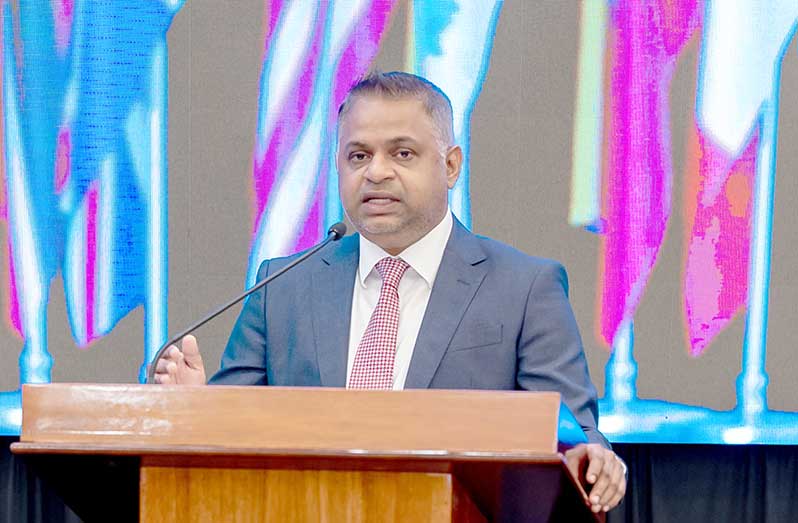
“Ultimately, high shipping costs become a cost-of-living problem for people and a competitiveness problem for businesses,” the President said, stressing that the region must examine whether enough is being done to improve shipping efficiency, consolidate costs and encourage commercially sustainable services.
President Ali called for a coordinated, investment-driven approach to modernising ports and improving regional connectivity, arguing that the Caribbean cannot remain competitive without addressing longstanding infrastructure constraints.
He noted that many countries depend on transshipment through larger regional and international ports before cargo reaches its final destination, resulting in additional handling, longer transit times, uncertainty and higher costs.
The President said containers have remained at transshipment ports for extended periods, delaying projects and increasing expenses. He also referenced an International Monetary Fund working paper published in May 2026, which found that all Caribbean countries except Jamaica incur shipping costs above the global average.
These challenges, he noted, are particularly difficult of smaller nations, adding, “For small markets, economic sub-shipping can be particularly unforgiving. Limited cargo volume can make it difficult to attract frequent direct services. Imbalances between imports and exports can mean that vessels carry substantial cargo in one direction but considerably less on the return journey. These have consequences for costs which do not disappear.”
He later cited limited direct shipping connections, small markets and the region’s geographic dispersion as factors contributing to the problem.
The President urged the conference to develop a policy document supported by regional development institutions, investors and other financing partners to help mobilise the capital required to improve port infrastructure.
He was keen to note that said investment must address port security, technology, safety, capacity, storage facilities and navigational access, while public-private partnerships could play an important role in modernisation.
Guyana’s President highlighted the country’s expanding maritime and industrial activity as an example of the investment required, noting that port facilities and related services have grown on both sides of the Demerara River.
He also highlighted private investments in the Demerara River area, including shore bases and port facilities, which he said could total close to US$1 billion over the past four to five years. “If you look at a private investment in the Demerara River, easily, when you look at the shore base investment, the radar investment and all the port investment in the last four to five years in the Demerara River, we are talking about maybe close to a billion US dollars’ worth of investment,” he said.
CREATING OPPORTUNITIES
Beyond infrastructure, President Ali called for stronger trade among Caribbean countries, noting that regional integration efforts would remain challenging unless businesses could move goods between markets affordably, reliably and efficiently.
Differences in customs procedures, regulatory requirements and documentation continue to create delays and additional expenses, even where vessels and port facilities are available. Greater co-operation among shipping operators, customs administrations, port authorities and governments, President Ali said, would help simplify procedures and harmonise documentation.
He also urged regional leaders to consider how the Caribbean’s energy and agricultural opportunities could be integrated into the shipping sector. Citing Guyana’s steps in this area, the President highlighted the development of cold-storage facilities and a food terminal capable of connecting Guyana with northern Brazil and wider regional markets.
“It is not only about the gas, but about the building out of a world-class fully cold-storage system here. It is about the building out of a world-class food terminal that is critically integrated with Northern Brazil that is designed to be the main shipping hub and logistics hub for food across the region. That brings with it important opportunities,” the head of state shared.
The transition to cleaner shipping was another major issue raised by the President, who cautioned that the Caribbean must understand the financial implications of global decarbonisation requirements.
While supporting the need to reduce emissions, Ali said the region must assess how the costs would affect smaller economies and consumers. He cited estimates by UN Trade and Development (UNCTAD) that decarbonising vessels could require up to US$28 billion annually after 2050, while complete decarbonisation could initially increase annual marine fuel expenditure by 100 per cent.
“When we present this global analysis, we must understand where we are positioned in those matters. Let me just say that UNCTAD estimates that decarbonising vessels will require $8 to $28 billion annually after 2050. $8 to $28 billion annually after 2050. I want to state that cost as a social good. That cost has to be passed on to someone. That cost has to be accommodated in a new logistics system. And complete decarbonisation can initially raise annual marine fuel expenditure by 70 to 100 per cent,” he said, highlighting the continued work needed to move towards future fuel choices, including biofuels, green methanol, green ammonia, hydrogen and battery electricity and arguing that decisions must be based on realistic assessments of production, availability and cost.
STRATEGIC POSITION
Meanwhile, Minister of Public Utilities and Aviation Deodat Indar underscored Guyana’s ambition to become a regional logistics hub, with the aim of linking the Caribbean, South America and international markets through a network of ports, transportation corridors, industrial facilities, warehouses and digital logistics systems.
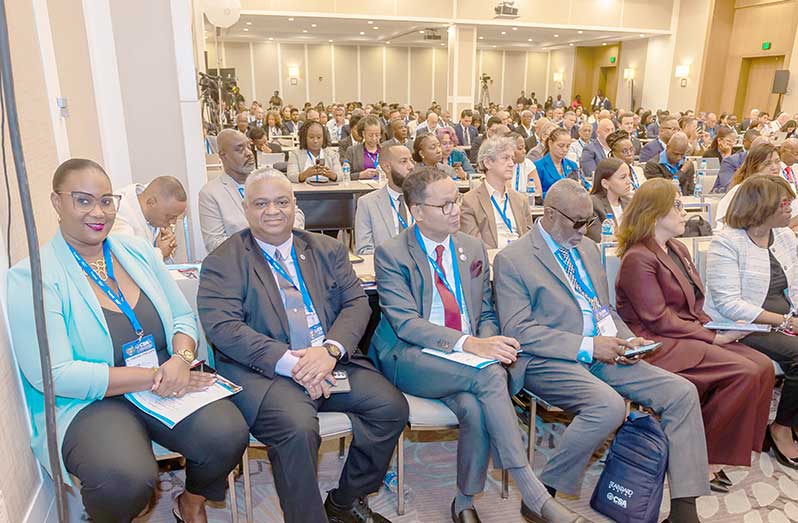
He said the country’s geographical position, expanding agricultural production, energy sector and infrastructure investments provide opportunities to increase cargo movement and diversify trade.
“Guyana occupies that strategic position between the Caribbean and South America,” he added, “We intend to leverage this position to create an integrated network of ports, transportation corridors, industrial facilities, warehousing centres and digital logistics platforms. Our objective is not simply to increase the volume of cargo passing through Guyana, but is fundamentally to transform how goods, services and commercial information move between our economies,” he said.
Minister Indar also pointed to the need to modernise port facilities and improve navigational access, while reducing production and transportation costs that affect the competitiveness of goods exported from the region.
The minister warned that shipping delays and additional charges, including demurrage, ultimately place a burden on consumers and families. He also called for regional co-operation to address so-called dark fleet operations, in which vessels and flags may be used for illicit activities, including the movement of sanctioned products and people smuggling. Indar said countries must work together to protect their maritime administrations and prevent criminal activity from damaging their economies and shipping industries.
“We envisage Guyana to be a centre of cargo consolidation, regional distribution, agriculture exports, energy logistics and international trade facilitation,” he said adding, “We need to get that done by making sure that the improvements and the modernisation of our port facilities are done quickly. We need to make sure that our navigational access is there and within reach. Just like every other country that is raised globally, we do not want to be left behind.” The CSA’s 56th Annual General Meeting, Conference and Exhibition runs from October 25 to 28, bringing together more than 400 delegates, including shipping executives, port operators, policymakers and logistics professionals.
Discussions are focused on building a more connected, resilient and competitive Caribbean shipping sector, with regional leaders emphasising that coordinated investment, improved trade links and stronger partnerships will be essential to reducing costs and expanding economic opportunities.