







-explores human rights, inequality, responsible governance of emerging medical technologies
THE growing use of artificial intelligence (AI), machine learning and automation in medicine and public health is the focus of a recently released book that examines the ethical challenges and human rights concerns that come with the adoption of these modern technologies.
Titled ‘Ethics and Governance of AI in Healthcare: A Social Science Framework,’ the publication by Guyanese scholar Prem Misir explores how healthcare systems can benefit from technological advances, while ensuring that ethical considerations remain at the core of their development and use.
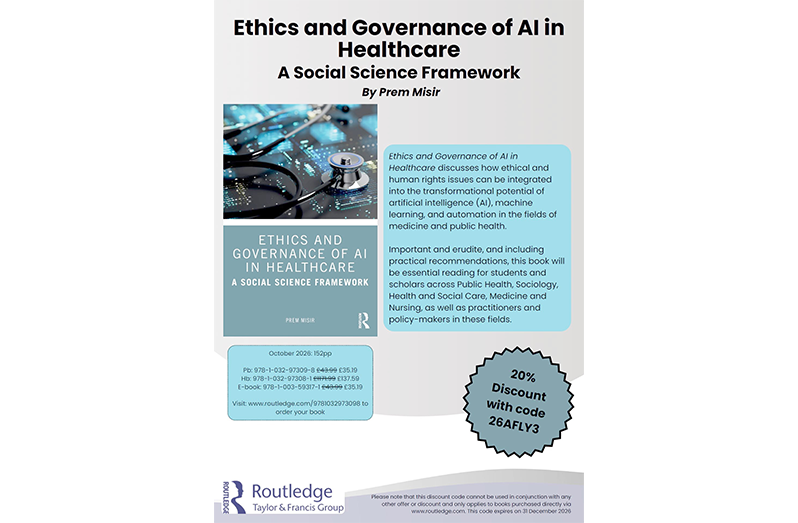
Published by international academic publisher Routledge, Taylor & Francis Group, the book examines the implications of AI-driven changes in healthcare and the need for appropriate governance structures to guide their implementation.
The book considers how AI and related technologies are transforming the delivery of medical services and public health, while raising questions about accountability, fairness, and the protection of patients. Although these tools offer opportunities to improve healthcare processes, their use can also create challenges that extend beyond their technical capabilities.
Further, the publication examines the importance of integrating ethical principles and human-rights considerations into the development of such technologies, rather than treating these considerations as issues to be addressed only after systems have been introduced and implemented. The book places particular emphasis on the need to consider how decisions are made, who are affected by them and what safeguards are required to ensure that technological progress does not come at the expense of people’s rights.
A central aspect of the book is its social-science approach to understanding the relationship between technology and inequality. The work considers how social factors, including class, race, gender and existing power structures, can influence the development and use of AI in healthcare. These considerations are important because technology does not operate independently of the societies in which it is designed and deployed. If the data used to develop AI systems are incomplete or unrepresentative, or if the systems are introduced without sufficient oversight, existing inequalities may be reinforced rather than reduced. The book therefore examines the importance of understanding the wider social consequences of AI alongside its potential medical applications, particularly where automated systems could influence decisions affecting patients and access to healthcare.
Misir also examines ethical standards and regulatory approaches that can help guide the use of AI in medicine and public health. The publication proposes a governance framework rooted in the social and behavioural sciences, with the aim of embedding ethical- and human-rights considerations throughout the development and implementation of these technologies. This approach places responsibility on practitioners, policymakers, and other stakeholders to consider the possible consequences of AI systems and establish appropriate safeguards. The discussion is relevant as healthcare institutions explore ways to incorporate automated processes and machine learning into their operations, creating a need for clear principles governing their use, oversight, and accountability.
The book is intended for students and scholars in public health, sociology, health and social care, medicine, and nursing, as well as healthcare practitioners and policymakers.
Its focus on the social and ethical dimensions of AI provides a unique framework for examining questions that come as emerging technologies become increasingly integrated into healthcare systems.
The book is available in paperback, hardback, and electronic formats, with further information and ordering details available at www.routledge.com/9781032973098.




