






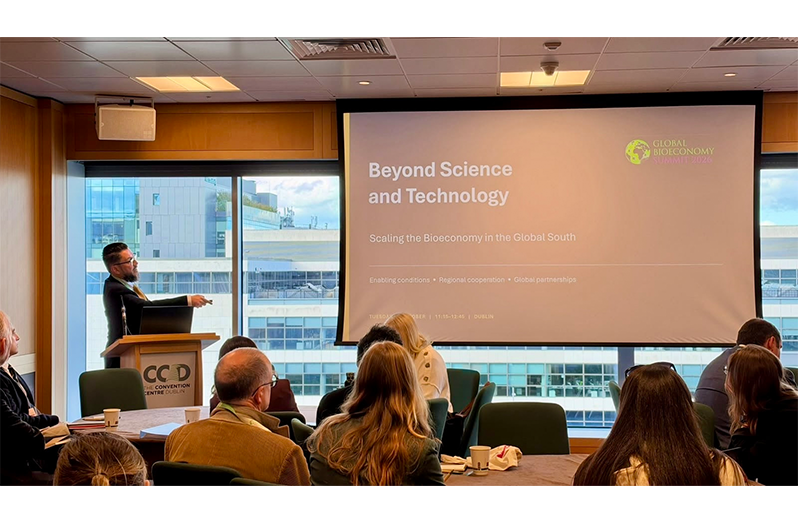
–at the Global Bioeconomy Summit 2026
THE Inter-American Institute for Cooperation on Agriculture (IICA) and the Latin American Bioeconomy Network outlined the priorities and perspectives of the Latin American and Caribbean (LAC) region within the framework of the global agenda on this issue during the Global Bioeconomy Summit (GBS) 2026, one of the main international discussion forums on the future of the sector.
Held as a face-to-face event in Dublin, Ireland, the meeting welcomed more than 1,300 representatives of governments, science, innovation, and international organisations, to discuss how to harness large-scale bioeconomy solutions to mobilise policies, markets, financing, and the partnerships needed to tackle challenges such as climate vulnerability and food security.
During the event, the Institute and the Network took part in three strategic processes, namely, the development of Global Bioeconomy Vision 2040, spearheaded by the International Advisory Council on Global Bioeconomy (IACGB); the preparation and review of the LAC chapter of the Global Bioeconomy Policy Report 2026; and the process to create and launch the Global Bioeconomy Alliance.
Hugo Chavarría, IICA specialist and Executive Secretary of the Latin American Bioeconomy Network stressed that, “Latin America and the Caribbean has not come to Dublin simply as a region rich in biodiversity, but as one that has made great strides in the areas of policy, science, innovation, business, and concrete experiences.
The region also has other fundamental assets: networks, partnerships, and collaboration. The Latin American Bioeconomy Network is a clear expression of this new regional capacity to connect countries, institutions, and knowledge.”
He noted that, “Our challenge now is to transform this biological wealth and collective capacity into knowledge, productivity, and value addition, in the form of new companies, jobs, income, and rural well-being, while also preserving and regenerating the natural capital on which this bioeconomy development depends.”
A REGIONAL VISION WITH GLOBAL REACH
As part of the process to develop Global Bioeconomy Vision 2040, IICA and the Latin American Bioeconomy Network consulted stakeholders in LAC, which incidentally was the only regional effort of this nature in the global process.
Through this canvassing exercise, more than one hundred institutions from eighteen countries were asked to submit proposals on economic growth, equity and inclusion, and on climate and nature.
The submissions proposed that the bioeconomy should harness biodiversity and biological resources to spur development, while providing more knowledge, innovation, employment, and value addition in rural areas. The objective is to expand opportunities to enable the region not only to export biomass, but also bioproducts, services, knowledge and solutions that deliver greater value.
Peter Wehrheim, Head of Unit for Bioeconomy and Food Systems at the European Union’s General Directorate of Research and Innovation, stressed that, “We must recognise that there is no single pathway to build a global bioeconomy. LAC offers a unique combination of biodiversity, agrifood systems, innovation, and rural experiences. Integrating these varying perspectives into a shared vision with a view to 2040, enhances the quality and legitimacy of the global agenda.”
The region also provided input for the preparation of the Global Bioeconomy Policy Report 2026 – one of the main publications presented during the Summit, and one that is considered an internationally recognised reference source on the status of bioeconomy policies in the world.
The report compares the evolution of bioeconomy policies around the world, based on 220 documents from 76 countries and macro-regions, and using a common framework to analyse perspectives, priorities, sectors, governance, implementation, and financing.
The work carried out by IICA and the Network allowed for incorporating official information into the document and contextualising national progress, including the strategies and roadmaps of Brazil, Ecuador, Panama, Peru, Costa Rica, Colombia, Argentina, Mexico, and Uruguay, as well as efforts to implement the Amazon Bioeconomy Strategy that was agreed upon by the eight member countries of the Amazon Cooperation Treaty Organization (ACTO).
The report notes that, since 2024, the centre of gravity of the bioeconomy in the Americas has moved towards Latin America and that this new phase in the region places greater emphasis on implementation, financing, and capacity building.
“Panama is working to transform its bioeconomic potential into a concrete agenda for policy, science, technology, innovation, and investment. We are developing a national strategy and strengthening partnerships with IICA, the Latin American Bioeconomy Network, and other partners that enable us to connect capabilities, funding, and experiences. The value of these regional forums lies precisely in the fact that no country has to move forward alone and that we can bring a stronger, more coordinated Latin American voice into the global conversation,” said Sandra Sharry, Technical Secretary of the National Research System of the National Secretariat for Science, Technology and Innovation (SENACYT) of Panama.
PARTNERSHIP TO TRANSFORM STRATEGIES INTO ACTIONS
The Global Bioeconomy Alliance, a new global network of networks spearheaded by the IACGB, was also launched during GBS 2026.
Its purpose is to connect the world’s leading bioeconomy platforms to strengthen advocacy, exchange, and collective action; position the bioeconomy within the post-2030 agenda; and accelerate investment, financing, markets, and implementation.
The Latin American Bioeconomy Network has been involved since the initial planning stages, incorporating the region’s visions, knowledge, and stakeholders into the process. IICA serves as the Network’s Executive Secretariat, representing a community that brings together more than 100 institutions from 18 countries.
During the Summit, IICA also led the workshop “Beyond Science and Technology: Scaling the Bioeconomy in the Global South” and co-organised sessions on the bioeconomy as a pillar for cooperation and on the role that metrics and standards play in sustainably scaling up bioeconomic innovations.
The Institute also served as a bridge between LAC and stakeholders from the United States, Canada, Europe, and Africa during discussions of key issues such as agriculture, biomanufacturing, biorefineries, biomass, markets, and investment.
The activities brought together partners from across the region, Africa, and Europe, including ACTO, the Inter-American Development Bank through Amazonía Siempre, BEAM Circular, the International Bioeconomy Forum (IBF), SENACYT of Panama, the Department of Science, Technology, and Innovation of South Africa, the European Commission, the Government of Catalonia, the Government of Kenya, BioInnovate Africa/icipe, BioHubCat, SPRING (Italian Circular Bioeconomy Cluster), the Irish Bioeconomy Foundation, the Stockholm Environment Institute, Flanders’ FOOD, the European Bioeconomy Clusters Alliance, Landscape Alliance, Jaffe Policy Consulting, NatureFinance, ISC3, GIZ/Euroclima, and the Bioeconomy Challenge, among others.
The sessions provided an opportunity to share experiences, identify concrete opportunities for collaboration between regions, and discuss how to strengthen regional and international cooperation.
They also helped identify mechanisms for improving conditions related to financing, regulation, market access, capacity building, and investment, with the aim of scaling up bioeconomy solutions and generating greater economic, social, and environmental benefits in the regions. (IICA)




