






By Vanessa Narine
GENERAL Secretary of the People’s Progressive Party (PPP), Bharrat Jagdeo, has warned that the country’s two traditionally dominant political parties risk becoming irrelevant unless they move beyond decades of racial division and political mistrust, delivering an unusually candid assessment of the country’s political history, during a tribute to a former opposition leader.
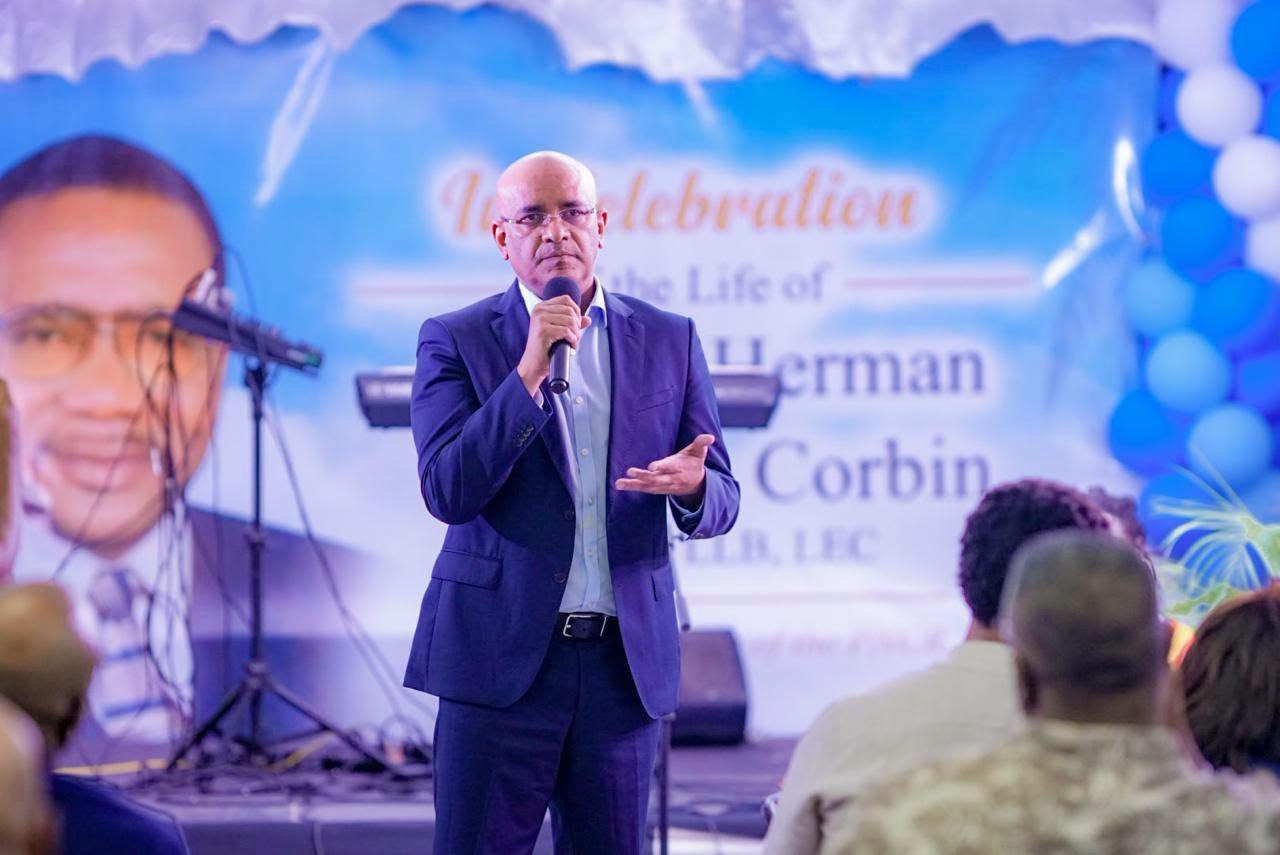
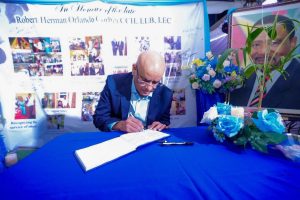
Speaking Wednesday (October 14, 2026) at a wake for Robert Corbin, the former leader of the People’s National Congress (PNC), Jagdeo noted that the political divisions that have shaped Guyana since the 1960s were increasingly incompatible with the expectations of a younger generation.
“What I’m saying is, unless our parties, these two parties, change today – the era of binary thinking of old things is long gone – we will face extinction. We will face extinction,” Jagdeo declared.
Jagdeo, a former president, portrayed Corbin as a pragmatic leader who understood the limitations of political confrontation and was prepared to risk criticism from within his own party to explore cooperation with the PPP.
His comments also offered a rare public account of discussions between the two parties that Jagdeo said had been derailed by accusations of political betrayal.
Jagdeo disclosed that during his presidency he had sought the backing of senior PPP officials to begin formal discussions with the PNC about Guyana’s political future.
“We spoke of it. I went to my Executive, Janet Jagan was alive, and I said it is time for us to start engaging the People’s National Congress on the future of Guyana. I had unanimous support from the Party, the leadership of the party,” he recalled.
According to Jagdeo, the initiative led to meetings at the Office of the President involving Corbin, other senior PNC officials, presidential adviser Roger Luncheon and representatives of the PPP.But the discussions ended after Corbin faced allegations within his own party that he was becoming too closely aligned with the government.
“We started working. I met with Mr. Corbin and some of the senior leaders of the PNC at the Office of the President, with Roger Luncheon and some of the other leaders of our Party. We had a first meeting, and we had a second meeting, and then there was the PNC’s Congress, and he was accused of selling out to the PPP and Jagdeo. And that was the end of the discussions,” he recalled.
He said, “And that stereotype led to paralysis in our thinking and in our actions, and a fear that if we were to step out of the groupthink – the thinking of our party, there will be consequences at a personal level and career level.”
A QUESTION OF TRUST
Jagdeo also revisited constitutional reforms introduced in 2001, arguing that they had created opportunities for greater political inclusion but had not produced the level of cooperation envisioned by their architects.
“We knew that the changes that we made in the Constitution of Guyana in 2001; these were far-reaching changes. I dare say, no other country in this hemisphere, or in the Commonwealth, has a constitution that is so inclusive,” he said. He acknowledged that the reforms had not resolved the mistrust that complicated cooperation between the parties. “Even at that level, at the parliamentary level, we continue to experience friction in implementing many of the new features of the Constitution that would have led on us to a legislative form of power sharing.”
Jagdeo cautioned that extending such distrust into the executive branch could undermine the government’s ability to function.
“If we were to bring the same mistrust that harmed us from accomplishing things at the legislative level into the Executive, at the Cabinet, we would have had it as a paralysis. And the worst thing can happen to government, any government in the world, is policy paralysis,” he said.
LOOKING AHEAD
Although Jagdeo directed his broader warning at both the PPP and PNC, he offered particularly pointed advice to the opposition party about its place in Guyana’s changing political landscape.“The PNC, has to make its own decision on where it’s going to go in terms of that the new world and the new challenges and the new Guyana and what role they want to play in it and how they’re going to adjust their philosophy or thinking to be part of that role.”
He contrasted that challenge with what he described as his own efforts to make the PPP more receptive to changing public expectations and people from outside its traditional political base.
“In the People’s Progressive Party, as General Secretary, every day I try very hard to understand the changes of our country and the world, and try to adjust my Party’s thinking as well as the inclusion – making sure that we remain receptive to inclusion of new ideas, new approaches, and people who may have even just a day before stood against us,” he said.Jagdeo acknowledged that his party had made mistakes, while maintaining that its political identity remained grounded in patriotism and a commitment to serving the entire population.
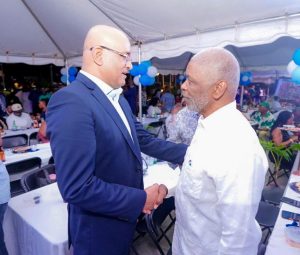
Jagdeo defended Corbin against suggestions that he had compromised his party’s independence, describing him as a formidable advocate for the PNC who nevertheless recognised the need for compromise.
“And let me say to you today, for those who may have been in the public domain, either to get at him personally or to downplay the achievements we had working together, and continue to accuse him of being a sellout and a puppet – I heard over just a couple days ago a puppet of Jagdeo – that is the furthest thing from the truth. Robert Corbin defended his party fiercely in every engagement we’ve had. He always defended his party. He was the strongest advocate for the People’s National Congress,” he said.
Jagdeo said Corbin’s experience in government enabled him to distinguish between legitimate political demands and proposals that could not realistically be implemented.
“He had a bigger vision for the country, and he understood government. And that is what made it easy for me to work with him, unlike so many other leaders because they don’t understand government and how governments work,” he said.
HISTORICAL DIVISIONS
The former president suggested that Corbin’s willingness to engage across party lines reflected a political maturity that was too often discouraged by the expectations of partisan supporters.
According to him, Guyana’s two oldest political parties had more in common than their history of confrontation suggested, pointing to their ideological origins, working-class constituencies and stated commitment to national development.“So, there were not many things dividing us, separating us, except this old boogie of race and racial politics,” he said.
The PPP General Secretary traced much of Guyana’s political mistrust to the upheavals of the 1960s, when the struggle for independence unfolded against the backdrop of Cold War competition and intensifying ethnic tensions.
“Many of us grew up in different parties in a very troubled history in our country. And much of it was caused by the need for external powers to maintain control over our country,” he said.Jagdeo argued that the divisions of that period had hardened into political identities that successive generations struggled to escape.
“Our people were actively divided. There was a campaign to divide them along racial lines in the 1960s, and many of us lived with that hurt – the hurt of the 60s-and we never overcame it because we either lived in ethnic enclaves; or, within our circles, we promoted stereotypes of each other.” he said. Those stereotypes, Jagdeo said, had affected not only relations between communities but also the willingness of political leaders to challenge established party positions.
“We in the PPP were not perfect. We never claim to be perfect. We make mistakes, but we keep a couple of things in focus all the time, every time.”
He presented cooperation as an unavoidable requirement for Guyana to realise its ambitions, including those of citizens who have remained in the country and those who left in search of opportunities abroad.
“We believe that the future of Guyana would involve, at some level and some fashion, whatever that framework may be, these parties working together. They have to, of necessity,” he said.
Looking ahead, Jagdeo pointed to technological change, including developments in artificial intelligence and quantum computing, as evidence of a world in which political organisations must adapt more quickly.
“The young people of today see things differently in shades of grey and multiple thinking,” he said.
He suggested that younger citizens were increasingly willing to support different political parties on different issues rather than adhering to fixed partisan loyalties.
“Unless we understand that that period and how it was foisted on us and how it harmed us for such a long time, we will not be able to give true leadership and realise the full potential of this country,” Jagdeo warned.




