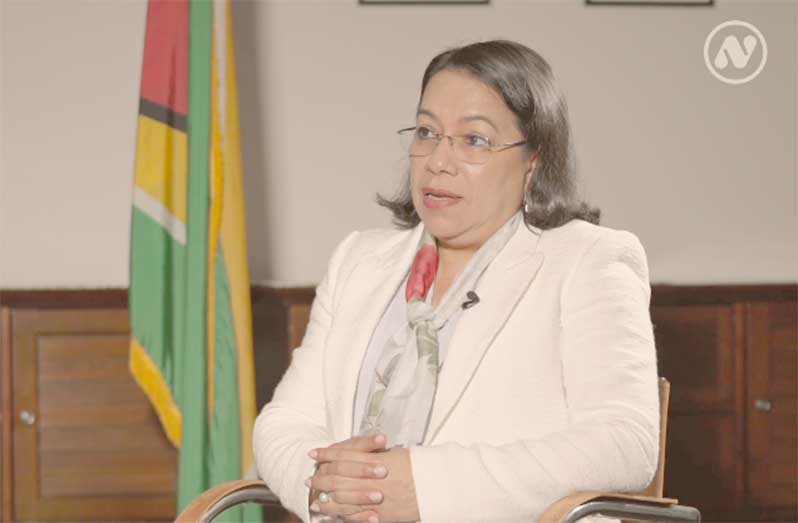
GUYANA’S candidate for United Nations Secretary-General, Ambassador Carolyn Rodrigues-Birkett, has warned that the world is experiencing its highest number of conflicts since World War II, arguing that the organisation must become more effective in delivering tangible peace outcomes.
Rodrigues-Birkett made the observation during an interview with The Exchange as she outlined her vision for the United Nations and her candidacy to become the organisation’s next Secretary-General.
Her comments come against the backdrop of growing criticism of the UN over its inability to prevent or end several major conflicts, with the organisation celebrating its 80th anniversary.
“I would start by saying that we need a UN that learns from the past, that is fit for today, and that is ready for the future,” Rodrigues-Birkett said.
She acknowledged that the UN has faced significant criticism in recent years, particularly over its performance in addressing armed conflicts.
She said, “What I’ve seen during these last years is lots of criticism being directed to the UN, particularly because we have not been able to end and prevent conflicts.”
Rodrigues-Birkett pointed to the number of conflicts currently taking place globally, noting that the situation has reached levels not seen since the Second World War.
She argued that the UN’s founding mandate makes peace and security a critical measure of its effectiveness.
Given that the organisation’s Charter begins with a commitment “to save succeeding generations from the scourge of war,” Rodrigues-Birkett said it was understandable that the public would judge the UN largely by its ability to promote peace.
“So, to be effective, we have to work to have peace outcomes,” she said.
While acknowledging the difficult geopolitical environment in which the UN currently operates, Rodrigues-Birkett said she believes progress remains possible even during periods of intense international tension.
She added, “I am well aware of the geopolitical times in which we live, but I believe that even in great distress geopolitically, we can make movements.”
The ambassador pointed to the UN’s survival through the Cold War and other periods of international tension as evidence that the organisation can still achieve meaningful results despite divisions among major powers.
“This organisation has gone through the Cold War. It has gone through very difficult times, and even then, you had successes,” she said.
If appointed Secretary-General, Rodrigues-Birkett said she would approach the position with a clear focus on finding opportunities for peace.
“And as Secretary-General, should I be appointed, I would use all the tools at my disposal.”
She said her approach would involve working through different mechanisms available to the UN, including close engagement with the Security Council.
“I would wake up every day looking to how we could find peace outcomes through different means, using the tools, but also the Security Council, working very closely with the Security Council,” she said.
Rodrigues-Birkett also argued that failures should not necessarily mean abandoning the organisation’s mechanisms.
For Rodrigues-Birkett, reforming and strengthening the UN is not simply about preserving an international institution but also ensuring that it remains capable of delivering for countries and people on the ground.
She said her own experience working with the UN had allowed her to see both the organisation’s limitations and the commitment of its personnel, including staff who put themselves at risk while providing assistance in difficult environments.
The ambassador said, “I’ve seen people working on the ground, UN staff, committed people, putting themselves at risk to bring help to people.”
Rodrigues-Birkett said this experience has reinforced her belief that there are compelling reasons to seek the position despite the challenges associated with it.
She described the Secretary-General’s position as possibly “the most thankless job in the world” but said she has never approached public service expecting thanks.
“I’ve never approached service from a position of thanks, always from service,” she said.
She also described Guyana’s candidacy as significant for the Caribbean, stating the region’s opportunity to produce a UN Secretary-General is rare.
According to Rodrigues-Birkett, the Caribbean has never held the position and may not have another opportunity for decades.
She said this makes the current contest a significant opportunity not only for Guyana but for the wider Caribbean, while maintaining that her broader objective is to help make the UN more effective for countries around the world.
Her résumé includes service as Guyana’s Minister of Amerindian Affairs; Minister of Foreign Affairs, Foreign Trade and International Co-operation; Director of the UN Food and Agriculture Organization (FAO) Liaison Office in Geneva; and Permanent Representative to the United Nations since 2020.
Academically, she holds a Master’s degree in International Affairs and Diplomacy with distinction from the Universitat Oberta de Catalunya and a degree in Social Work, also with distinction, from the University of Guyana.
If successful, Rodrigues-Birkett would make history as the first woman and the first Guyanese national to lead the United Nations.
The Government of Guyana has been actively engaging member states across the world in support of her candidacy as the campaign for the UN’s top post gathers momentum.