






– meteorologist warns of below-normal rainfall in coming months
GUYANA’S hinterland could face below-normal rainfall in the coming months as a strengthening El Niño pattern increases the likelihood of drier conditions, with meteorological data already showing a decline in rainfall following a period of near-normal to above-normal precipitation.
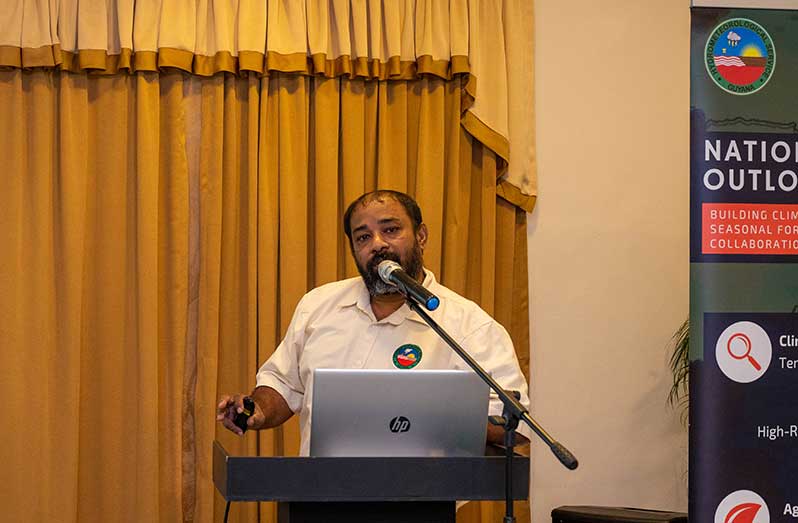
Meteorologist Kelvin Samaroo issued the assessment on Tuesday during the 21st National Climate Outlook Forum (NCOF), where he examined recent temperature and rainfall trends, with particular focus on inland areas such as the Rupununi, Essequibo and Region 10.
Samaroo stressed that El Niño does not mean an absence of rainfall, but rather a suppression of the amount of rainfall normally expected.
“It is interesting to know what is going to happen, because, like we said, the El Niño event usually means a suppression of the normal amount of rainfall. It does not mean absence of rainfall,” he said.
The outlook could have implications for hinterland communities that depend heavily on consistent rainfall for water accumulation and supply, particularly as the country moves through periods when rainfall would normally be expected to be more regular.
Samaroo said the rainfall data show a relationship between El Niño conditions and reduced rainfall in Guyana, although he cautioned that the relationship is not absolute.
“I want to point out that it is not a one-to-one mapping, but there is good correlation that in instances of an El Niño event, we have a dip in the rainfall,” he said.
According to the meteorologist, rainfall during the earlier part of 2026 was near normal to slightly above normal, broadly in keeping with the forecast for that period.
However, as the El Niño episode strengthened, rainfall began to decline.
“This one here is 2026. We can see that, like we said, during the forecast period, we have forecasted near normal to slightly above normal, which proves that we are doing something right. We are just above the normal,” Samaroo said. “But after the El Niño season has intensified, we can see the rainfall start dropping off here to 2026.”
HINTERLAND TEMPERATURES RISING
The rainfall concerns are being accompanied by elevated temperatures in several hinterland locations.
Samaroo said meteorological observations from Lethem and Ebini have recorded temperatures exceeding climatological averages on numerous occasions, with readings in some instances surpassing the 95th percentile.
“Going to look mostly at the inland regions, that is the Rupununi, Essequibo, and part of Region 10. So here we have a plot of temperature in Lethem,” he said.
“We can see that during 2024, we had a lot of times where the temperature exceeded the 95th percentile.”
Samaroo said similar conditions have been observed in 2026, while temperatures recorded at Ebini have been even higher than those observed at Lethem.
“And again, we have exceeded the 95th percentile temperature on even more occasions,” he said.
He noted that Guyana experienced periods of below-normal temperatures earlier in 2026, particularly during the previous rainy season, when rainfall had been forecast to remain near normal to slightly above normal.
However, the pattern changed as the El Niño episode became more pronounced.
“Now, we are getting into this season where the El Niño has been developed more. And we can already see that we have already exceeded the 95th percentile most of the days here,” Samaroo said.
The Department has also examined temperature records dating back to 1991 to determine whether there has been a shift in the distribution of temperatures.
“We have seen that we have had a shift in the number of higher temperatures that we have been recorded, in 2026,” Samaroo said.
WATER CONSERVATION URGED
The developing rainfall pattern has prompted renewed emphasis on water conservation as Guyana prepares for hotter and potentially drier conditions.
While lower rainfall is expected during the dry period, Chief Meteorological Officer Dr Garvin Cummings has said Guyana continues to have a good supply of water.
Collaboration among the relevant agencies is also being undertaken to assist communities with preparations and planning for the hotter months ahead.
The climate outlook therefore points to the need for continued monitoring of rainfall and temperature patterns, particularly in hinterland areas where changes in precipitation can have direct implications for water availability and community needs.




