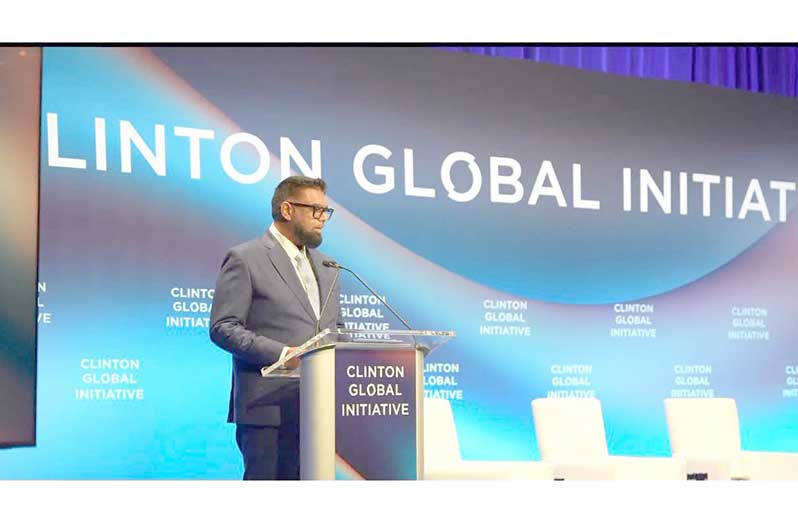
– President Ali tells Clinton Global Initiative that partnerships give developing countries better access to technology, finance and human capital
PARTNERSHIPS give developing countries better access to technology, finance and human capital to build capacity in health, education, climate security and other key services, according to Guyana’s President Dr. Irfaan Ali, who on Wednesday addressed the Clinton Global Initiative event, “Powering Scientific Breakthroughs”, at the Hilton Midtown Hotel in New York.
“It gives us the quickest pathway to technology, to people, to human assets, and of course to finances,” the Head of State said.
He reminded his audience that small developing countries face limited financial and human-resource capacity while navigating the same global systems as larger nations.
Scientific advancement and technology were identified as critical to energy security, food security, affordable healthcare, climate and biodiversity services, equitable artificial intelligence (AI) and digitisation, pandemic preparedness, infrastructure and human-capital development.
“I believe that small countries do not possess the ability or the capacity to address global challenges and provide global solutions,” he stressed.
However, Guyana has championed several global initiatives.
He pointed to a five-year extension with the Mount Sinai Health System, which is intended to transform Guyana’s public health system by 2030 through modernised care, human-capital development, electronic health records, telemedicine, diagnostics and data-driven decision-making.
Guyana has reported a long-distance robotic cardiac surgery between Guyana and India, the establishment of primary-school medical baselines, expanded secondary-school tracking, and increased training for nurses, patient-care assistants, laboratory technicians and doctors.
He also pointed to partnerships in infrastructure, technology and local human capacity that have helped to reduce the need for medical evacuations from a remote hinterland location by almost 95 per cent in less than three years.
“Guyana is indeed a small state, but we are learning that the power of a country is not measured only by size and population. Power can also be measured by the partnership a country builds, and we believe that the best way to navigate the challenges of our world is through partnership, and that is the proposition I bring to the Clinton Initiative. Partnership is a great equaliser of our age,” he said, adding:
“For many small states, the challenge is obvious. We do not have the enormous resource budget of the larger economies. We cannot independently finance every advanced laboratory, every medical technology, every innovation, or every agricultural research programme.”
Dr. Ali also highlighted the country’s energy partnerships, the 140-member Global Biodiversity Alliance, jurisdictional-scale forest certification, its carbon-credit market, and plans to expand technology-enabled food security across the Caribbean and beyond.
He positioned Guyana as a potential pilot for research.
“We can be the perfect sample size or pilot size for much research, but we do have something equally important: We have political will, human resources, and, most importantly, the ability to bring the right people around the same table,” he said, adding:
“The question, therefore, is not whether a small state can do everything itself. The question is: Can we build partnerships that allow us to do what we could never do alone?”
Notably, through existing partnerships, Guyana intends to build capacity in health, energy, food security, climate and digitisation, which he said are perhaps the clearest examples of the benefits of collaboration.
Forthcoming initiatives, he said, include a national payment platform, expanded hinterland Wi-Fi, the digitisation of government services, and the development of the My Guyana single-platform app.
Additionally, Guyana is positioning itself as a food-security centre for the Caribbean and beyond through its arable land, freshwater resources, technology and partnerships, including with the Brazilian Agricultural Research Corporation (EMBRAPA).