







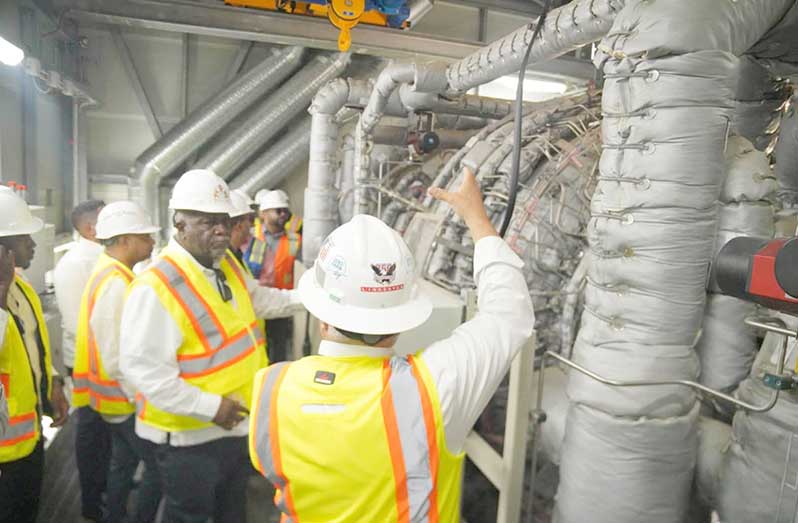
—as ‘first fire’ testing on turbines set for December
WITH a target “first fire” date of December 4 for testing its turbines, the Government’s flagship gas-to-energy project (GtE) is being pushed as an urgent response to Guyana’s growing electricity demand, Minister of Public Utilities and Aviation, Deodat Indar, has said.
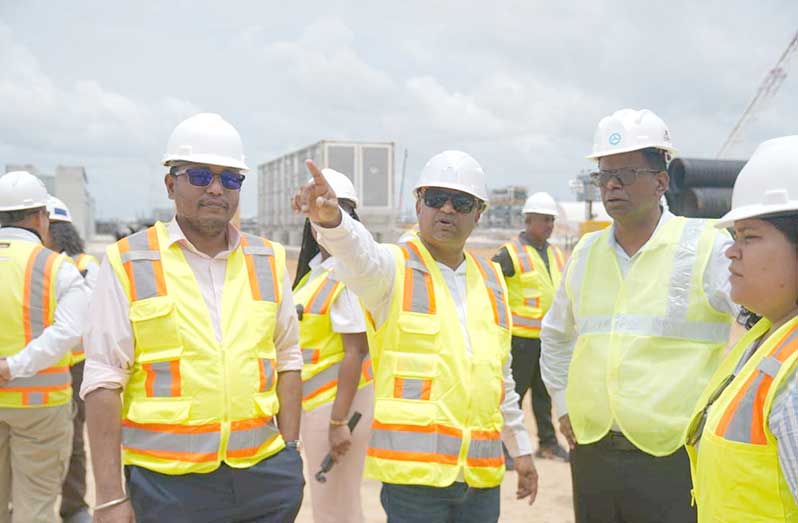
Speaking during a Tuesday walkthrough of Phase One of the project, Minister Indar said the initial phase is designed to deliver 300 megawatts of power to the national grid, a major boost aimed at stabilising supply amid soaring demand driven by El Niño conditions.
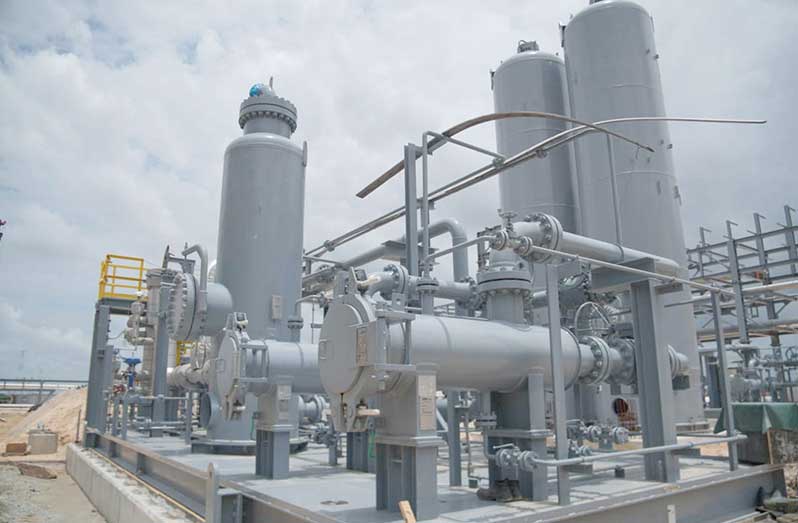
The site is already outfitted with bullet tanks, foundations, hot water and dry water tanks, four gas turbines and two steam turbines. A substation is also being constructed to step up power from 13,800 volts to 69,000 volts, forming a crucial link between the new generating capacity and the wider grid.
The immediate goal is to get 57 megawatts from the first turbine into the grid following the “first fire” test.
“So, we are trying to get 57 megawatts into the grid. One of the first turbines is trying to get that. That entails the setting up of a natural gas liquefaction plant, a sludge catcher … and piping that gas into the turbine so that they can start generating power,” he explained.
The Minister further disclosed that approximately 1,300 workers are currently on site as part of an “all- hands-on-deck” operation involving Siemens Energy, Lindsayca and Engineers India Limited (EIL).
“There are 1,300 workers on this site right now, and they’re working to get us to first fire, which is sometime around December 4, to have the first fire, meaning that gas will come through and start the fire for testing of the first turbine before they put it online and give it to the Government,” he added.
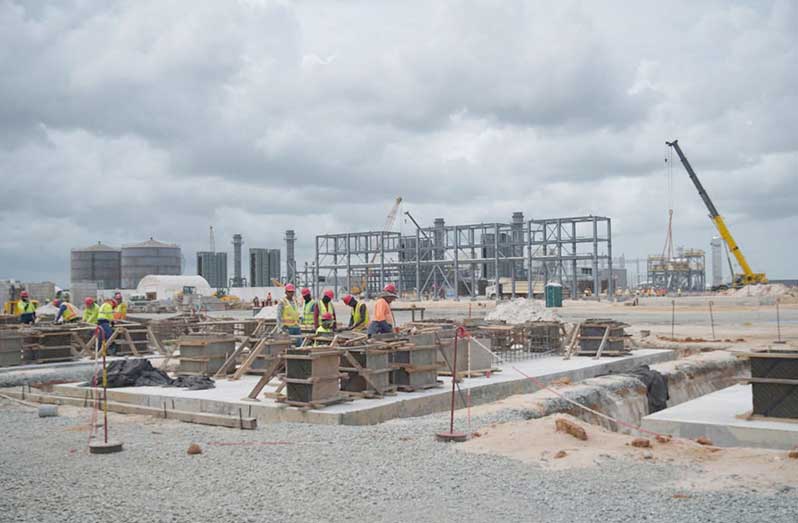
As the largest investment in electricity generation in Guyana’s history, the Wales gas-to-energy project is expected to double national generation capacity, improve reliability, reduce fuel imports, stabilise energy costs and support a 50 per cent reduction in consumer electricity tariffs.
Lower energy costs are expected to provide financial relief for households while improving industrial and commercial competitiveness across the economy.
Once completed, the gas-to-energy project is expected to deliver approximately 600 MW of generation capacity.
Tuesday’s walkthrough was led by Prime Minister Brigadier (Ret’d) Mark Phillips. The Ministry’s Director General, Alfonso De Armas, and a Guyana Power and Light Inc. (GPL) team led by Kesh Nandlall, Team Leader of GPL’s Executive Management Committee, were also on the ground.
Following a briefing and site inspection, Prime Minister Phillips noted that, since his last inspection in June, works had advanced substantially, with several major components now installed and critical infrastructure progressing across key areas of the facility.
DISTRIBUTION LINES
Minister Indar stressed that the urgency is being driven by a sharp spike in electricity use, as households and businesses increase consumption to cope with higher temperatures. He noted that demand is surging at particular times of the day and is expected to remain elevated from September through February.
“The grid needs the power,” he emphasised.
According to Indar, recent blackouts are not merely the result of generation shortfalls but are also being caused by transmission lines being pushed beyond their design capacity due to rapid housing and commercial expansion.
He cited a case where a line designed to carry eight megawatts was carrying 10.1 megawatts, placing intense stress on conductors and transformers and triggering system trips. In another incident, four transformers caught fire in a separate area after being overloaded.
Similar patterns are emerging across multiple “massive clusters of development”, particularly along the coast, where distribution lines are coming under sustained strain.
To tackle these vulnerabilities, Indar said the Government has been working since last year on a significant transmission and distribution build-out, including the construction of about 425 kilometres of new lines.
These additional lines are intended to split the power load, reduce pressure on individual circuits and improve reliability as more communities and new housing schemes come on stream.
However, he acknowledged that building out such infrastructure cannot keep pace with the speed at which demand is rising, making the timely completion of the gas-to-energy project even more critical.
The Guyana Power and Light Inc. (GPL), on Monday, told reporters that the country currently has sufficient generation capacity to meet electricity demand, but the overloaded distribution network is contributing to power outages being experienced by customers across the country.
Notably, GPL has been investing approximately US$800 million in new transmission and distribution infrastructure.
Head of the power company’s Engineering and Projects Department, Ryan Ross, explained that the investment programme includes new 230-kilovolt transmission lines, additional substations, new 69-kilovolt transmission infrastructure and approximately 350 kilometres of medium-voltage distribution network.
The expansion is also aimed at replacing critical elements of infrastructure dating back to the 1970s.



