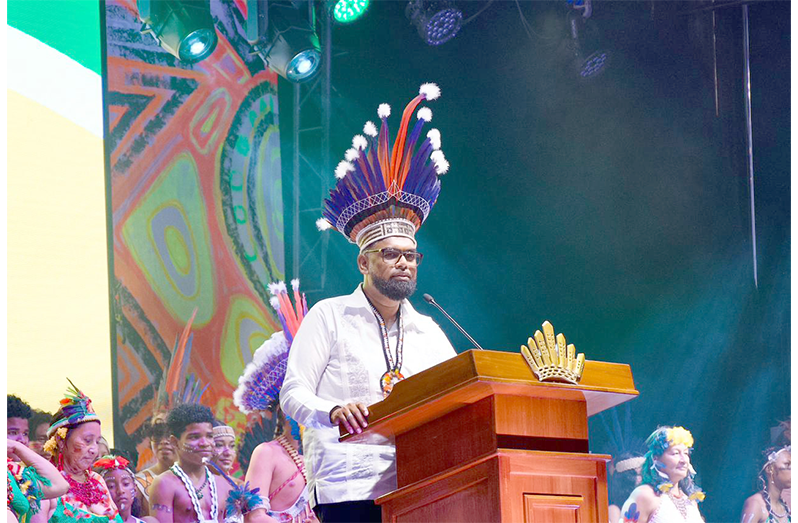
PRESIDENT, Dr Irfaan Ali has hailed what he described as a “revolution in energy” across indigenous Guyana, claiming electricity generation in hinterland communities has surged by more than 1,000 per cent from 1.62 megawatts to almost 17.5 megawatts through hydropower, solar farms and household solar systems that are now lighting homes, powering health posts and keeping young teachers in their villages.
Addressing the opening of the 2026 Amerindian Heritage Month celebrations at the Amerindian Village, Sophia, the president framed electricity as a cornerstone of his administration’s wider programme to modernise Amerindian communities and ensure they benefit directly from Guyana’s economic expansion.
Praising the work of Prime Minister Brigadier (Ret’d) Mark Phillips, Dr Ali said the transformation of power supply in the hinterland was deliberate and people-centred.
“Prime Minister, very quietly, you have led a revolution in energy in our indigenous villages. Through your leadership, we have invested more than 11 billion dollars in energy in our indigenous villages, hydropower, solar farms, household solar,” the president said.
The president said this surge in generation capacity from 1.62 megawatts to almost 17.5 megawatts was achieved without the usual commercial calculations.
“We did not ask what the rate of return is. We did not ask what is the return on investment. We did not ask those questions,” he declared. “What we know is what the investment will deliver: stronger villages, greater dignity. That is what we are about.”
Dr Ali linked the expanded electricity supply to concrete changes in hinterland life, noting that reliable power is enabling more young Amerindians to pursue training as teachers, nurses, and other professionals without having to migrate to the coast. This, he suggested, is helping to keep skills, income and opportunities rooted in indigenous communities.
The president’s remarks on energy came as part of a broader defence of his government’s record in Amerindian development.
He disclosed that over the last five years more than $41.7 billion has been invested in indigenous villages and communities, including $21.7 billion through the Amerindian Development Fund, nearly $3 billion in restored presidential grants, and $14.2 billion in Low Carbon Development Strategy funds returned to the hinterland after what he said was a five–year absence under the previous administration.
Within that wider envelope, he positioned the $11 billion energy spent as both symbolic and practical.
The new power capacity, he stressed, underpins investments in ICT, healthcare and economic empowerment that have been rolled out simultaneously in hinterland regions. With more reliable electricity, ICT hubs and satellite terminals can operate effectively, health facilities can safely conduct more procedures, and community enterprises such as sawmills, shops and ecotourism lodges can function on a more sustainable basis.
Guyana has rapidly expanded its energy infrastructure. Under its Low Carbon Development Strategy (LCDS), the country has taken a transformative approach to energy that seeks to reduce reliance on imported fossil fuels, by diversifying energy sources and ensuring affordable, reliable energy access for all Guyanese.
The aim is to integrate renewable resources such as solar, hydro, wind, biomass, and natural gas to meet growing energy demand, while keeping emissions low.
Further, the 300 MW Wales gas-to-energy project, Guyana’s largest infrastructural initiative to date, aims to reduce electricity costs by 50 per cent and support domestic production of liquefied petroleum gas (LPG) for cleaner household cooking.
Beyond immediate energy benefits, the GtE project is expected to enhance industrial competitiveness and strengthen the country’s energy mix.