






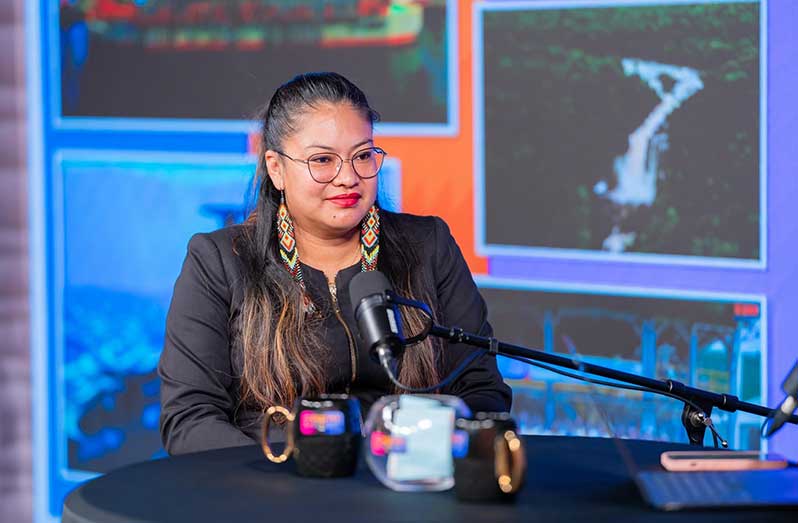
— Amerindian Affairs Minister says $41B investment only part of wider transformation of Indigenous communities
DEVELOPMENT across Guyana’s Indigenous communities is increasingly evident, with billions of dollars invested in agriculture, education, infrastructure and other areas, according to Minister of Amerindian Affairs, Sarah Browne-Shadeek.
The Minister said that while some $41 billion has been invested through the Ministry of Amerindian Affairs over the past five years, that figure does not capture the full scale of investment in Indigenous communities, as other ministries and agencies continue to fund roads, schools, water systems and other critical infrastructure.
Speaking on the most recent episode of the Starting Point Podcast, Browne-Shadeek pointed to the significant growth in resources allocated to Amerindian development over the years and the impact those investments have had on communities.
The Minister said it is important to examine the history of funding for Amerindian development to understand how far the country has progressed.
“We must understand where we came from. And I always refer to that. I did my research, and as we know, Carolyn Rodrigues, now contesting for U.N. Secretary-General, was the first minister,” she said.
Browne-Shadeek said her examination of previous national budgets showed a significant difference between the resources available to the ministry more than two decades ago and those available today.
“I would have been looking back at budget books, budget estimates, and it was surprising to see that when Carolyn got her first budget, maybe in about 2000, 2001 thereabouts, the budget for the Ministry of Amerindian Affairs was $200 million at that time. And this year our budget is $7.5 billion. That is how much, as to what she would have gotten then and what we are getting now,” she said.
According to Browne-Shadeek, the impact of increased investment can be seen firsthand in communities across the country.
“On the ground, the development is evident in every village that we go to,” she said.
While acknowledging that more remains to be done, the Minister said the $41 billion invested through her ministry over the past five years represents only one aspect of the overall development taking place.
“I always like to point out that there is still much more that needs to be done, of course, but the $41 billion does not really reflect a true reflection,” she said.
“Our ministry maybe alone would have invested that, but then there is infrastructure being put in, whether it is new secondary schools being built, whether it is roads, water infrastructure.”
COMMUNITIES DECIDE
Browne-Shadeek explained that funding provided through the Ministry is invested using a collaborative approach, with community leaders and residents playing a central role in determining their development priorities.
“The support from our ministry, it is basically given to villages. And the good thing about it is that the community decides how they want to spend the money,” she said.
“We do not dictate as a ministry. Every year they come to us and they say, ‘Here is what we want to do for this year. We want to embark on an economic project,’ whether it’s agriculture, youth, women.”
This approach, she said, allows individual communities to pursue initiatives that best suit their needs, including projects in agriculture, tourism, cultural development, youth and women’s empowerment and community infrastructure.
“The village decides basically how they want to spend the money. We just make the resources available and monitor,” Browne-Shadeek said.
The Minister noted that the approach also requires accountability at the community level.
“There are issues too in villages, accountability issues and other issues. When we say we talk about free, prior, informed consent, that is the essence of it. Whatever is happening in villages comes from the ground up. And so it is a different village, different needs, different requests,” she said.
While Guyana’s Indigenous communities are at varying stages of development, Browne-Shadeek said investments continue through collaboration among ministries, agencies and communities, with the priorities identified by residents helping to guide the development process.




