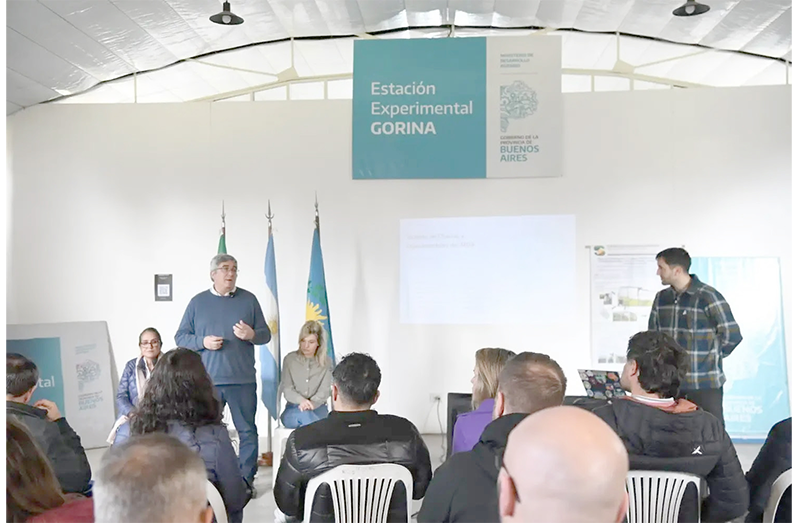
OVER a period of two working days, representatives of the public, scientific, and production sectors of Brazil and Argentina, along with members of the Inter-American Institute for Cooperation on Agriculture (IICA), shared experiences aimed at deepening scientific co-operation between both countries in the area of bioinputs.
Various stakeholders from the Brazilian agriculture sector visited Argentina, primarily to identify and forge partnerships to foster greater alignment between research, public policies, and the needs of the producer. The meeting facilitated the sharing of lessons learned in this field, with respect to science, regulations, innovation, and markets.
Brazil and Argentina are two major food exporters. Both countries have developed state-of-the-art production, based on solid scientific systems; and agriculture is an essential activity in job creation, the development of rural areas, and the generation of foreign exchange.
In recent years, both Brazil and Argentina have seen sustained growth in bioinput adoption, which would allow them to combine their productivity, sustainability, and international competitiveness. Today, bioinputs have become increasingly integrated into the producer strategies and innovation models of these two South American nations.
The mission was organised under an initiative developed by CropLife Brazil, in association with the Brazilian Trade and Investment Promotion Agency (ApexBrasil).
FIELD VISIT AND TECHNICAL SEMINAR
The Brazilian delegation conducted a technical visit to the Gorina Experimental Station of the Ministry of Agricultural Development in the province of Buenos Aires, where they gained insight into research and field work related to bioinput use. They also met with authorities of the Secretariat of Agriculture, Livestock, and Fisheries of Argentina; the National Service for Agrifood Health and Quality (SENASA); the Chamber of Agricultural Health and Fertilizers (CASAFE); and the Chamber of Bioinputs (CABIO).
A technical seminar was also held at the Embassy of Brazil in Buenos Aires, which was attended by Argentinian government representatives, business people, researchers, specialists, sectoral entities, and institutions from both countries.
Fernando Schwanke, IICA Representative in Argentina, participated in a debate on the bioinput context and market, in which he indicated that closer ties between the two countries offered an excellent opportunity not solely to share technical information, but also to create better trade prospects.
He noted that, “Brazil and Argentina are two leading players in the bioinputs sector and can be leaders in the hemisphere, thereby producing major benefits. We often look to Europe and Asia, forgetting that our hemisphere also has immense commercial potential, since many of our countries are already seeking to develop bioinput-related technology.”
Schwanke explained that Brazil has considerable public policy support for the sector. Consequently, today the country has registered more agricultural products that are bio-based as opposed to chemical-based. Moreover, he explained that in Argentina, IICA has been instrumental in efforts to formalise a national ecosystem, promoting the incorporation and correct identification of this topic in government institutions, as well as discussions with the industry of the sector.
“The countries of the Americas that have not yet introduced bioinput-related public policies should do so; and IICA is receiving significant demand from its Member States for collaboration in this area,” he maintained.
On the other hand, Angela Pimenta Peres, Director of the Trade Promotion, Technical Cooperation, and Investment Department of the Ministry of Agriculture and Livestock of Brazil, stressed that Brazil and Argentina should pool their individual capacities to develop a joint agenda to generate innovation, boost productivity, and open up new opportunities for products and companies.
“The challenge—she maintained—is to transform scientific knowledge into solutions that are accessible to the producer. In order for co-operation efforts to make headway, we need continuity and discussions must result in a joint work agenda.” (IICA)