-historic institution to expand legal education, serve students here and from across the Caribbean
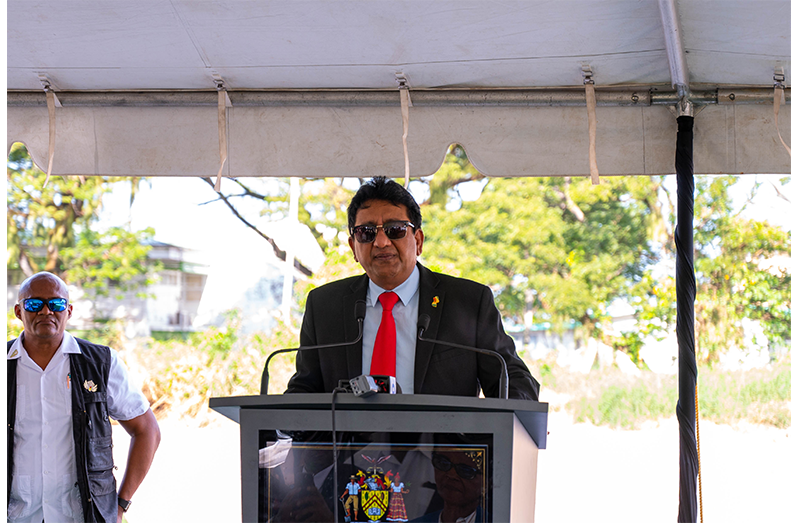
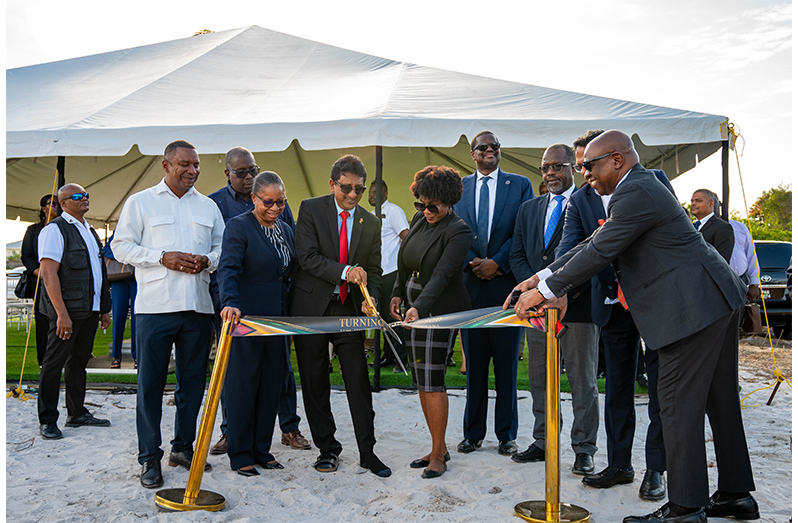
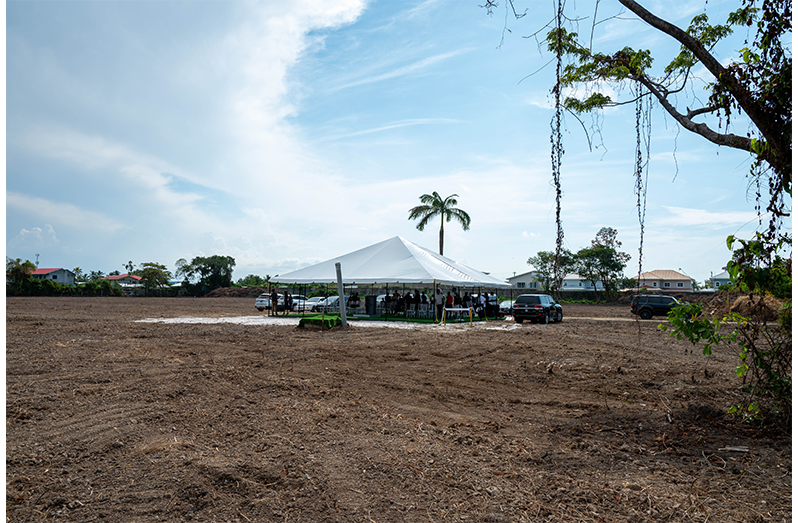
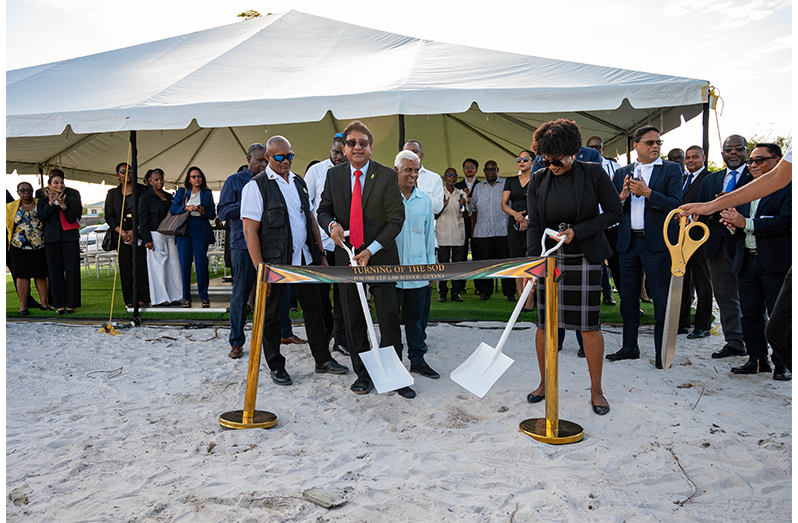
GUYANA on Thursday took a historic step towards filling a regional gap and fulfilling the government’s vision of becoming a regional education hub, as local and regional members of the law fraternity broke ground for the Law School of the Council of Legal Education at the University of Guyana’s Turkeyen Campus.
Speaking at the event, Attorney General and Minister of Legal Affairs, Anil Nandlall, SC, described the project as one of great historic and futuristic importance, noting that it will be the fourth law school under the council and the first in Guyana.
He said the school was made a reality after extensive negotiations and talks with the council and will serve the wider region and help meet the growing demand for legal education.
The 57th Annual General Meeting (AGM) of the Council of Legal Education (CLE) served as the backdrop for the event, which saw members of the council, along with invited guests, attend the simple but symbolic sod-turning ceremony.
The CLE’s 57th AGM is bringing together senior representatives from across the Caribbean, including principals and administrators of the region’s law schools, heads of judiciaries of CARICOM member states, and representatives of regional bar associations, for a meeting that began on Thursday and is slated to continue until Saturday, September 5, 2026.
Delivering the keynote address, Nandlall stated that this latest step is a culmination of the work, efforts, struggle, dedication, and collaboration of countless persons.
Giving a detailed history of the development of Guyana’s law school, the Attorney General said the idea of a local institution was first raised in the 1990s.
“The idea of a law school to be established in Guyana under the auspices of the Council of Legal Education was birthed in 1996 at a meeting of the Council of Legal Education,” he said, adding that the idea grew out of two years of difficulties faced by students graduating from the University of Guyana.
“The idea was born out of two years of successive difficulties encountered by students graduating from the University of Guyana who encountered great difficulties in getting admission into the Hugh Wooding Law School, an arrangement that had existed for over three decades, and which guaranteed 25 students’ automatic entry into the law school,” he said.
He added, “But the automatic entry was automatic entry from Cave Hill Campus, Barbados. Guyanese have never really, historically, I believe ever satisfied that criteria simply because of the economic cost and Guyana is not a contributory member to the University of the West Indies,” he said.
These challenges, the AG explained, gave rise to the University of Guyana’s LLB programme. However, difficulties remained, as limited space at institutions such as Trinidad’s Hugh Wooding Law School meant not all Guyanese graduates could be accommodated.
“I believe the first batch of graduates out of the LLB programme of Guyana, of University of Guyana, graduated in 1995. And when they were seeking admission to [the] Hugh Wooding Law School, they were basically told that there is no space for them, that the 25 spaces guaranteed to Guyana under the Council of Legal Education was guaranteed to Guyanese students graduating out of the University of the West Indies. After great struggles, those students got in,” he said, adding, “Then a second batch of students came, 1996, and the same problem they faced. In fact, that batch remained out of the classroom for almost the entire first semester. And it is against that backdrop that the then President of Guyana was forced to put it on the table of the CARICOM heads of government.”
DEMAND HAS SKYROCKETED
Efforts to establish the institution continued with another initiative being tabled at a council meeting. In the years since then, numerous steps were taken and a number of talks where held. Notably, the AG highlighted that an agreement was struck between the University of Guyana, the University of the West Indies and the Council of Legal Education that saw the automatic admission of 25 University of Guyana students into the Hugh Wooding Law School. This, however, while it mitigated the challenge, was not a sustainable solution and saw a change in admission arrangements over the years.
“Once again, we reached a place where you have the law schools themselves overflowing,” he said. He further noted that since the establishment of the council more than five decades ago, legal education has changed dramatically. “We are beyond 50 years; hence the world has dramatically changed. The Caribbean has dramatically changed. Legal education as we know it has changed.”

Over the years, technology has revolutionised the world, while demand for legal education has skyrocketed, the AG said. “I believe the council recognised that going forward for the next 50 years, it cannot continue with the same framework, the same infrastructure, the same method of delivery of education, the same system of administering legal education in the region. We have to prepare for the next 50 years,” he said.
He emphasised that this is why the development of a local law school is vital not only for Guyana but for the wider Caribbean region as well. He said Guyana remains a prime location to house the institution, with a need existing for a law school in the southern Caribbean. Additionally, he cited reasons why Guyana is an ideal location, noting that the country has been working towards the goal for more than three decades and possesses the requisite population and geography.
While these factors highlight why Guyana could serve as a good location, the AG noted that extensive work went into ensuring that establishing the school here would be feasible. “We had to undergo a particular process at the council. It was not handed to us on a platter. Strict criteria were laid out. A feasibility study was requested where we had to show how the law school is going to be viable. And not viable for the first and second year, but viable as a long-term venture,” he said, adding that the negotiations reinforced that the institution, while a local one, will serve Guyana as well as the wider Caribbean.
“It is not a Guyanese institution. While it will be located in Guyana, it is a regional institution to serve the people of the region and to be administered by the regional council administering legal education,” he said.
Moreover, he noted that an audit was conducted of current demand and of all students in different jurisdictions, not only in Guyana who are awaiting entry into a law school. Once all those criteria were satisfied, the AG explained that the CLE met in The Bahamas in September of 2025 and after executive deliberations formally accepted Guyana’s feasibility study and passed what has become known as the Bahamas Resolution. The resolution, he explained, approved the establishment of a fourth CLE law school in Guyana; directed negotiations of a framework agreement between the Government of Guyana and the CLE; mandated the appointment of a subcommittee chaired by the CLE to draft the agreement; and required that the draft agreement be returned to the council for final approval before execution. All these requirements, the AG noted, have now been met.
This, the AG stated, is a remarkable milestone for the nation. “It is the realisation of the aspirations of generations of Guyanese, many students, dozens if not hundreds of students are out there listening to us and waiting for this initiative to become a reality,” he said noting, “we will work with the Caribbean Court of Justice to establish a home here on these grounds for the CCJ Academy of Law. And we hope that judicial training, legal education, professional continuing legal education will be done from this facility. Again, not for Guyanese alone, but for the entire region.”
Currently, the project has advanced to the procurement stage, with a tender issued for the design and construction of the facility.
A Request for Proposals (RFPs) from the Ministry of Legal Affairs for the “Design and Supervision for the Construction of the Law School” was issued earlier this year, and according to reports, 15 consultancy firms have since submitted technical and financial proposals for the contract.
As the project moves into its next phase, the vision first conceived decades ago is becoming a reality, bringing Guyana closer to its goal of becoming a regional hub for legal education.