







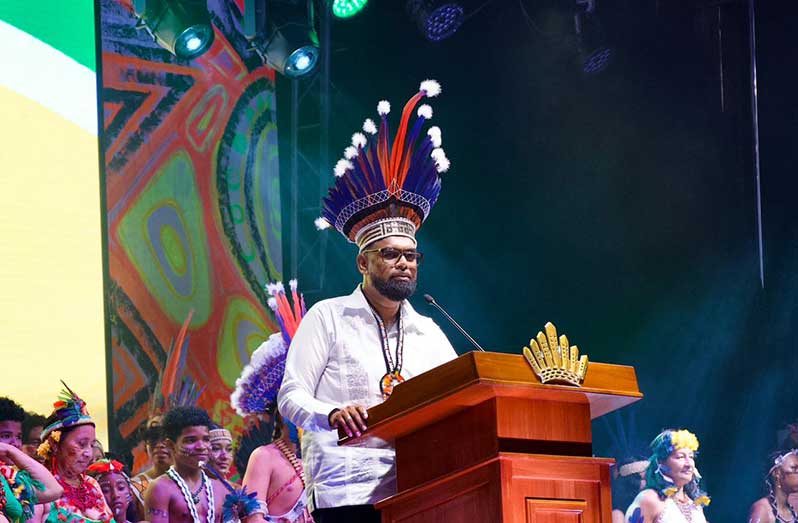
— President Ali highlights continued focus on expanding development and opportunities
— cautions against players seeking to gain political mileage
MORE than $41.7 billion in investments have been channelled into Amerindian and hinterland communities over the past five years, President Dr Irfaan Ali has said, further outlining his administration’s continued focus on expanding development and opportunities for Indigenous peoples.
Speaking at the opening ceremony of the 2026 Heritage Month celebrations, the Head of State argued that the real measure of development is not the absence of problems, but whether unprecedented growth is being used to tackle long-standing inequities faced by Indigenous peoples.
“The real test of development is not where the problem exists. The real test is whether we are using our unprecedented economic growth to solve them, and whether the benefits of that growth are reaching you, our Indigenous peoples,” the President said.
He pointed to a range of programmes which he said have moved Indigenous communities from the margins to the centre of national life.
According to Dr Ali, more than $41.7 billion has been invested in Amerindian villages over the last five years, including $21.7 billion through the Amerindian Development Fund. Villages now boast shops, sawmills, ecotourism facilities, buses and modern agricultural projects which, he stressed, were once unimaginable.
The President contrasted current conditions with earlier years, when the “biggest request” from an Amerindian community under regional development projects was a sewing machine.
“The critics will point to a pothole, a power outage, a school in need of repairs, a leaking roof, or some other problem, and declare, how can this happen? They will not point to the fact that for the first time we are on the verge of achieving 100% universal secondary education in the Indigenous village. They would not point to the fact that you now have 100 per cent primary education available in your village,” he said, adding,
“They would not point to the fact that in the last five months alone, more than 30,000 Indigenous persons have direct access to healthcare. They will not point to the fact that you have modern hospitals being built. They will not point to the fact that you have doctors, medics, nurses, teachers, soldiers, police officers, fire officers, right from your village, serving your region and serving your community.”
Dr Ali also cited the restoration and expansion of the Presidential Grant, now totalling almost $3 billion, and the return of Low Carbon Development Strategy (LCDS) funding which, he said, has delivered $14.2 billion to villages after being “absent for five years under another government”.
In agriculture, he reported that villages collectively own almost 300 tractors, alongside “hundreds” of boats, outboard engines, minibuses, pickups, ATVs, and trucks, all tied to targeted State support.
Energy, infrastructure and ICT were presented as pillars of this hinterland transformation.
The President credited Prime Minister Mark Phillips with leading what he called a “revolution in energy”, taking generating capacity in hinterland areas from 1.62 megawatts to almost 17.5 megawatts through hydropower, solar farms and household solar systems.
This, he said, is enabling thousands of hinterland residents to train as teachers without leaving their villages.
On roads, Dr Ali reported the delivery of 79 kilometres of paved roads in hinterland communities, 71 kilometres of asphaltic roads, more than 1,200 kilometres of laterite roads and nearly 100 structures, with some 2,400 kilometres of road corridors maintained nationwide and an additional 1,098 kilometres maintained in Region Nine alone.
Billions more, he said, have gone into education, healthcare, housing, water, safety and security.
In Region Nine, surgical procedures reportedly increased from 189 annually to almost 1,300, while malaria positivity rates, according to the President, have fallen from 24 per cent to less than seven per cent.
Water coverage in hinterland communities has risen from 45 per cent to 95 per cent, with 260 new systems installed and more than 400 now in operation.
Dr Ali urged Indigenous communities to “be careful” of those who appear only in moments of crisis, “arriving in fast boats, bearing hampers and expressions of sympathy”.
Drawing on the biblical image of “false prophets”, he cautioned saying,
“Be especially careful when people seek to turn your legitimate concerns into a vehicle for their own political or personal survival. Do not allow your grievances and aspirations to become somebody else’s escape route for their own legal troubles.”



