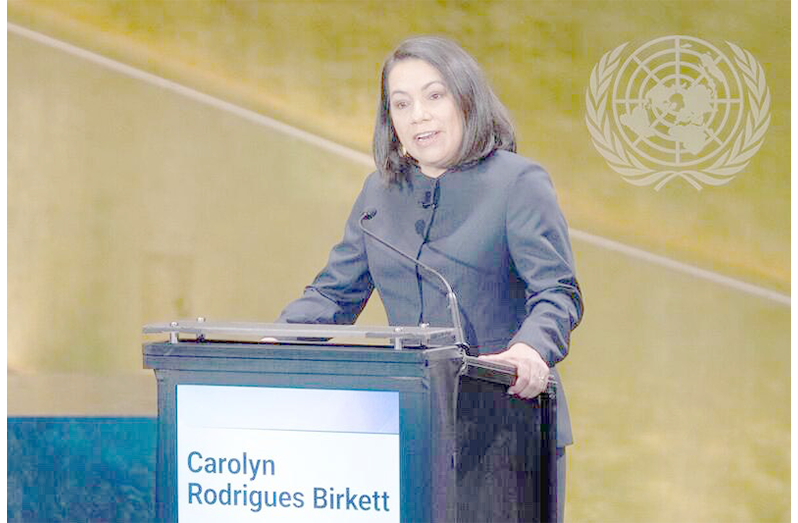
—edges ahead of Grynspan as race for top job tightens
GUYANA’S candidate for United Nations Secretary-General Ambassador Carolyn Rodrigues-Birkett moved into first place on Friday in the second Security Council straw poll to select a successor to António Guterres, narrowly overtaking early front-runner Rebeca Grynspan of Costa Rica in a contest UN affairs watchers are calling a close race.
According to information, Ambassador Rodrigues-Birkett received eight “encourage” votes, three “discourage” ones, and four “no opinion” ones from the Security Council’s 15 members.
That marks a slight step back from the nine encourage and two discourage votes she won in the first straw poll on 30 July, but it was enough to put her ahead, as rivals lost more ground.
Grynspan, who topped the first round with 10 encourage votes, slipped further this time to seven encourage, four discourage, and four no-opinion, down three encourage votes and up three discourage. The shift leaves her essentially level with the Guyanese envoy heading into the next stage of the contest.
Behind the two women, Argentina’s Rafael Grossi, Director-General of the International Atomic Energy Agency, held on to his seven encourage votes but saw his discourage tally jump from two to six, cutting his no-opinion votes to two. Senegal’s Macky Sall was unchanged, repeating his first-round score of six encourage, seven discourage, and two no-opinion.
Uganda’s Olara Otunnu climbed from two to five encourage votes, while Ecuador’s María Fernanda Espinosa dipped slightly to four encourage, three discourage and eight no-opinion.
Former Chilean President Michelle Bachelet suffered the steepest fall of the day, from six encourage votes down to two, with her discourage tally rising to six.
A new name also appeared on the ballot for the first time: Ecuadorean diplomat Ivonne A-Baki, nominated by Tonga on August 17, registered zero encourage votes, eight discourage, and seven no-opinion.
Commenting on the results on LinkedIn, UN affairs commentator Daniel Safran-Hon described the outcome as a deadheat, noting that while Ambassador Rodrigues-Birkett has taken the top spot, her margin over Ms. Grynspan remains slim.
He said the more significant question is what lies behind the broader rise in discourage votes, since ballots at this stage of the process are anonymous and not colour-coded, meaning it is impossible to tell whether any of the negative votes came from one of the Council’s five veto-wielding permanent members — China, France, Russia, the United Kingdom and the United States.
Colour-coded ballots, which expose potential vetoes, are only introduced in later rounds.
Safran-Hon added that while a dip in encourage votes and a rise in discourage votes is typical at this stage, the front-runner has not changed hands, nor fallen below the nine votes needed for an eventual Council recommendation, at this point in the process over the past three decades, making this year’s shake-up unusual.
He also noted that no secretary-general selection has ever been resolved after just two straw polls, with the fastest past process taking four rounds, and suggested this year’s race could run longer still.
Eight candidates now remain in contention to succeed Mr. Guterres, whose second five-year term ends on 31 December: Ambassador Rodrigues-Birkett, Ms. Grynspan, Mr. Grossi, Mr. Sall, Mr. Otunnu, Ms. Espinosa, Ms. Bachelet and Ms. A-Baki.
Further straw polls are expected in the coming weeks before the Council moves to a final, colour-coded round meant to identify a candidate who can secure at least nine votes without a veto from any of the five permanent members.
The Council would then formally recommend that nominee to the 193-member General Assembly, which by longstanding practice has endorsed the Council’s choice. The next Secretary-General is due to take office on 1 January, 2027.
Ambassador Rodrigues-Birkett, who has served as Guyana’s Permanent Representative to the UN since 2020, and was previously the country’s first female Foreign Affairs Minister, was nominated by President Dr. Mohamed Irfaan Ali, and the Government of Guyana, with the backing of the Caribbean Community (CARICOM).
If appointed, she would become the first Guyanese, the first Caribbean national, and the first woman to lead the United Nations in its 80-year history.
Regional advocates have argued it is Latin America and the Caribbean’s turn to hold the post, noting that no one from the region has led the UN since the 1980s, and that a missed opportunity now could mean a long wait under the UN’s informal system of regional rotation.