THE Government is moving on several fronts to strengthen electricity supply in Region 10 (Upper Demerara-Berbice), as rapid economic activity and expanding businesses push demand on the Linden grid to record levels.
Region 10 has a standalone electricity network, with Bosai Minerals responsible for generating power for the area.
The electricity is then supplied to consumers through two local utilities—the Linden Electricity Company Incorporated (LECI), which serves the Mackenzie area, and the Linden Utility Services Co-operative Society Limited (LUSCSL), which serves Wismar.
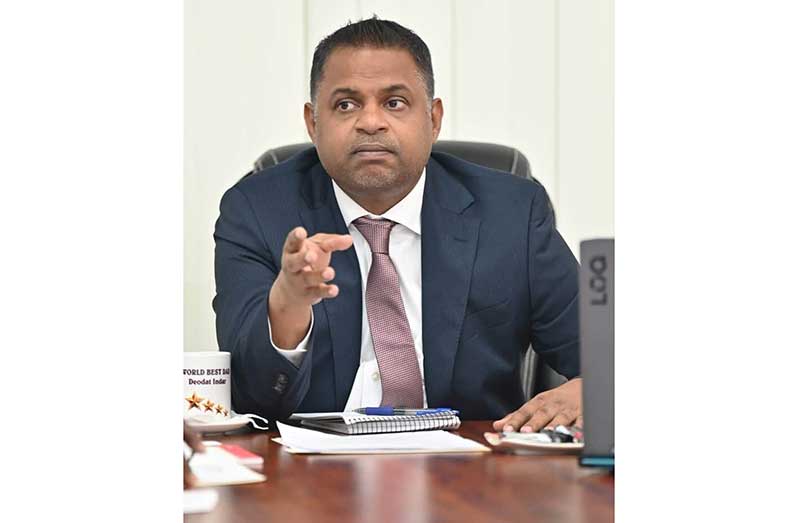
During a press conference on Friday, Minister of Public Utilities and Aviation, Deodat Indar, said the government is engaging electricity provider Bosai to increase generation capacity in Region 10.
He said businesses are also being engaged on measures to manage electricity consumption during peak periods.
The interventions come as peak demand in Linden recently reached 15.1 megawatts (MW), exceeding the approximately 14.1 MW of generation currently being supplied by Bosai from its Mackenzie and Wismar operations.
“So, we were short on generation there,” Indar said, noting that Region 10 is currently the only area where the country is experiencing a generation shortfall.
He attributed the increased demand largely to growing economic activity, particularly the expansion of the sawmilling sector.
Indar said officials counted 32 sawmills operating in Linden and have been engaging their operators on measures to manage electricity consumption.
He said, “They have 32 sawmills set up in Linden, and those 32 sawmills use Wood-Mizer equipment. They use high-speed motors, and those motors use a lot of power, which has added significantly to the demand in Linden.”
Rather than restricting the growth of the industry, the government is working with sawmill operators to shift their electricity-intensive operations to periods when demand on the grid is lower.
Indar said Linden experiences two major demand peaks, between 1 p.m. and 3 p.m. and again between 7 p.m. and 9 p.m.
“They have been asked to work between 10 p.m. to 6 a.m. That is when people turn off the lights, the shops are closed down, and the demand drops,” he said.
The arrangement is intended to allow the sawmills to continue operating while easing pressure on the grid during the hours when households and businesses place the greatest demand on the system.
COMMERCIAL CONSUMPTION
The government is also working to ensure that residential customers connected to sawmill businesses are not adversely affected by efforts to manage commercial consumption.
Indar said some operators currently have a single connection serving both their businesses and homes.
“Some of the sawmills have one connection for the business as well as the household. So, we are detaching those to make sure the house has power.”
At the same time, the government is pursuing an immediate increase in generation for Region 10.
“We’re also engaging Bosai to add an additional three megawatts of power to that grid immediately,” he added.
The Region 10 interventions form part of a wider programme to expand and strengthen Guyana’s electricity system in response to rapidly increasing demand.
National electricity demand recently reached 242.64 MW, the highest recorded since the Demerara-Berbice Interconnected System (DBIS) was formed, while planners expect demand to rise to approximately 266 MW during the August-to-October hot season.
Indar said the increase is being driven by hotter weather, expanded housing activity and the rapid growth in the number of customers connected to the national grid.
GPL’s customer base has increased from approximately 204,000 in 2020 to 250,000 by July 2026, an increase of about 46,000 customers.
“The peak demand then [in 2020] was 125 megawatts. Now it’s 242.6 and counting. Literally double the demand in the period,” Indar said.
To meet the growing demand, the government is also bringing additional generation capacity into service.
Reliable generation currently stands at approximately 256 MW, with a further 9.3 MW expected from an engine at Garden of Eden by Monday.
By the end of August, additional interventions—including the return of a 4.5 MW Hyundai generator, another 5.5 MW engine undergoing a major overhaul and an additional 5 MW of generation—are expected to lift available generation to approximately 280.3 MW.
Region 10 is also being positioned for greater renewable-energy capacity.
Indar said solar projects under the government’s programme are expected to add approximately seven MW to the Linden grid by the end of the year, including projects at locations identified as Dakoura and Block 37.
An additional Eight megawatts solar plant at Retrieve is expected to come on stream next year.
The minister said the government is addressing electricity challenges through a combination of increased generation, stronger transmission and distribution infrastructure, renewable energy and demand management.
For Linden, the immediate measures are designed to ensure that the region’s expanding economic activity can continue while the government works to bring additional generation capacity onto the grid.