






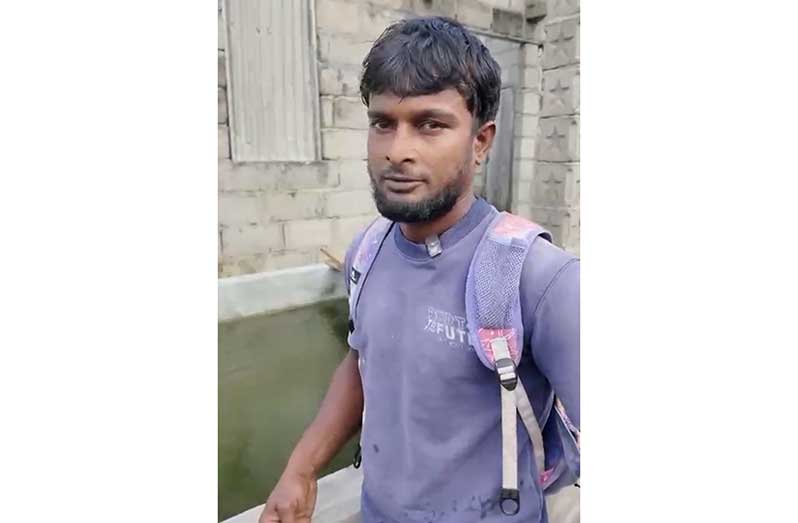
–31-year-old embraces red tilapia production with support from Agriculture Ministry
By Bebi Shafeah Oosman
AGRICULTURAL diversification is taking root in Black Bush Polder, where 31-year-old cattle farmer Azam Shivgobin is expanding his livelihood into aquaculture, demonstrating how young farmers are embracing new opportunities to increase production and build more sustainable agricultural enterprises.
Shivgobin, a resident of Yakusari, has already established himself in cattle farming, but his ambition to broaden his agricultural operation recently led him into fish farming.
With support from the Ministry of Agriculture, the young farmer has embarked on the rearing of red tilapia, receiving more than 1,000 fingerlings to begin his operation.
His decision to diversify was sparked in an unconventional but increasingly common way through social media.
After watching online videos of farmers successfully rearing red tilapia, Shivgobin became interested in the potential of aquaculture and began exploring whether he could establish a similar operation in his community.
Instead of simply admiring what he saw, the young farmer decided to act. He approached the Ministry of Agriculture with his interest in entering fish production and subsequently received assistance to get the project started.
The fish are expected to reach between eight and 12 pounds within approximately nine weeks, and Shivgobin is already optimistic that a successful first batch could pave the way for a larger operation.
While diversification can create new income opportunities, Shivgobin’s experience also demonstrates the level of discipline required to successfully manage multiple agricultural operations.
His working day begins before sunrise. Before heading into the pasture to attend to his cattle, Shivgobin first turns his attention to the fish.
They must be fed, while the filtration system, water temperature and other conditions are carefully checked to ensure that the environment remains suitable for healthy growth.
Once satisfied that everything is functioning as it should, he heads out to tend to his cattle.
But his responsibility to the fish does not end there. After returning from the pasture, Shivgobin repeats the process, checking the system, monitoring the fish and feeding them throughout the day.
The routine requires consistency, patience and careful observation, particularly as he familiarises himself with an entirely different form of farming. For Shivgobin, however, the additional work is an investment in the future of his agricultural enterprise.
His transition from solely cattle farming into aquaculture also represents the changing nature of agriculture, as farmers increasingly look beyond traditional production and explore ways to diversify their operations. Technology has also become an important part of that transformation.
In Shivgobin’s case, an idea discovered through videos online has been transformed into a tangible farming operation in Yakusari, showing how access to information can expose farmers, particularly young people, to new techniques and opportunities.
Shivgobin has credited the Ministry of Agriculture’s technical team for helping him navigate the early stages of the venture. While he brought the determination and willingness to learn, technical officers have been providing guidance and support to ensure that the project is properly managed.
The assistance has been particularly important as Shivgobin learns the technical requirements associated with aquaculture, including water management, feeding, filtration and maintaining the conditions necessary for the fish to thrive.
The venture comes at a time when greater emphasis is being placed on agricultural diversification, increased food production and encouraging more young people to view agriculture not only as a traditional occupation, but as a viable business opportunity.
For communities such as Black Bush Polder, which have long been among Guyana’s major agricultural producing areas, farmers embracing new areas of production can further strengthen the sector while creating additional economic opportunities at the household and community levels.
Shivgobin received the more than 1,000 red tilapia fingerlings several weeks ago, but he is already looking beyond his first production cycle. Should the initial batch prove successful, he intends to expand. That ambition is rooted in a simple philosophy: agriculture must continue to evolve.
Rather than walking away from the cattle farming operation he has already built, Shivgobin is adding to it, creating another potential source of production and income while developing new skills in the process.
His story also carries an important message for other young Guyanese interested in agriculture that opportunities within the sector extend far beyond one crop, one animal or one traditional method of farming.
From cattle in the pastures of Yakusari to more than 1,000 red tilapia being carefully monitored each day, Shivgobin is steadily building an agricultural enterprise shaped by hard work, curiosity and a willingness to embrace change.
At just 31, the Black Bush Polder farmer is showing that diversification does not mean abandoning what has worked before. It means building on that foundation, exploring new opportunities and positioning an agricultural operation for greater growth.
And although his fish-farming journey is only two weeks old, Shivgobin is already thinking about what comes next.
If the first batch delivers the success he is working towards, expansion will be the next step turning an idea discovered online into yet another productive agricultural venture in one of Guyana’s most important farming communities.




