–says banks now on board; Registry to establish presence in Regions One, Eight and 10
A TOTAL of 36,500 persons have so far been enrolled for Guyana’s new Digital Identity Card, with the Digital Identity Card Registry preparing to expand its presence to Regions One, Eight and 10, Data Protection Commissioner Aneal Giddings has disclosed.
Giddings, speaking exclusively to the Guyana Chronicle on Tuesday, said enrolment has already taken place across Regions Two, Three, Four, Five, Six, Seven and Nine, while efforts are underway to establish Government of Guyana service centres in the three remaining regions.
He said mobile enrolment exercises are also expected to be conducted in those areas before permanent centres are established, allowing residents to obtain the cards without having to wait for the completion of the new facilities.
Giddings said, “We have enrolled 36,500 persons across Regions Two, Three, Four, Five, Six, Seven, and Nine.”
According to the Data Protection Commissioner, Region Two currently has an enrolment location at the Government Service Centre at Anna Regina, where 2,087 transactions have been completed.
In Region Three, the Electronic Identity (E-ID) operation at West Central Mall in Leonora has recorded 8,625 transactions.
The Georgetown operation, based at the Registry’s headquarters on Lot 37 Craig Street, Campbellville, Georgetown, was reported by Giddings as having completed 18,150 transactions.
The Registry also recently established a unit at the Central Immigration and Passport Office at Camp Road, Georgetown, where approximately 63 transactions have been completed since the facility became operational about two weeks before the interview.

In Region Five, the Fort Wellington Government Service Centre has recorded 3,817 transactions, while the Port Mourant Service Centre in Region Six has completed 2,903.
In Region Seven, the Registry has begun operations at Bartica, although the facility had not yet been officially launched at the time of the interview.
Giddings said between 12 and 20 transactions had been completed at the new location, with the total for Region Seven, including previous mobile enrolment exercises, standing at 94.
In Region Nine, where the Registry has been conducting both office-based and mobile operations, 773 persons have been enrolled.
Giddings said the Registry is working to establish permanent service centres in Regions One, Eight and 10. However, residents in those regions are not expected to be left waiting until the offices are completed.
“It is likely that we will, before those centres are even established, be there to do mobile enrolments of persons and issuance of the ID card,” he said.
He explained that the Digital ID Card Registry forms part of the wider Government of Guyana Service Centres, which bring together several government services, including passport services, licensing and revenue services and National Insurance Scheme services.
EXPANDING PRESENCE
Giddings said the Registry is also looking at expanding its presence within larger regions, particularly Regions Three, Four and Six, to ensure that residents do not have to travel long distances to access the service.
The expansion comes as the Registry seeks to increase acceptance of the new card by government agencies and private-sector institutions.
According to Giddings, there were challenges during the initial months of the programme, particularly in January and February, when some banks were reluctant or unable to accept the new Digital ID as an identification document.
He said, however, that the situation has since improved significantly following discussions with the Guyana Association of Bankers and the provision of information and mechanisms to allow the banks to properly receive and process the cards.
“I have since went through a lot with the banks, particularly, and provided them certain mechanisms and a lot of information, which has satisfied them to the point where now I am sure that all the banks are on board and are receiving the cards,” he said.
Giddings said the initial difficulties were not necessarily because banks were deliberately rejecting the card, but because their systems had not been properly configured to accept it as a form of identification.
He said discussions have also been held with several public-sector agencies, including the Guyana Revenue Authority, the Ministry of Housing, the Central Housing and Planning Authority and the National Insurance Scheme.
Clear instructions, he said, have been issued to those entities not to refuse citizens who present the Digital ID card, which is valid for 10 years, as a form of identification.
The same applies to eligible non-citizen residents of Guyana who possess valid work permits and are issued the relevant category of Digital ID card.
He said the expiry requirement is also in keeping with International Civil Aviation Organization (ICAO) standards governing identity documents.
He explained: “That gives an opportunity for the person to return to renew their card, but also to update their biometrics. As a person grows, particularly a younger person going in 10 years later, they may look completely different. Their fingerprints may suffer minor changes. Their signature may change quite likely. So, it gives a person an opportunity to update those features.”
Giddings said the Digital Identity Card Act makes it unlawful for institutions to refuse a person who presents the E-ID card as identification.
ACCEPTANCE OF THE CARD
The Data Protection Commissioner said acceptance of the card is important as the country moves towards increased digitalisation of government and private-sector services.
He explained that the card is designed to allow institutions to verify a person’s identity electronically rather than relying on photocopies and manual data entry.
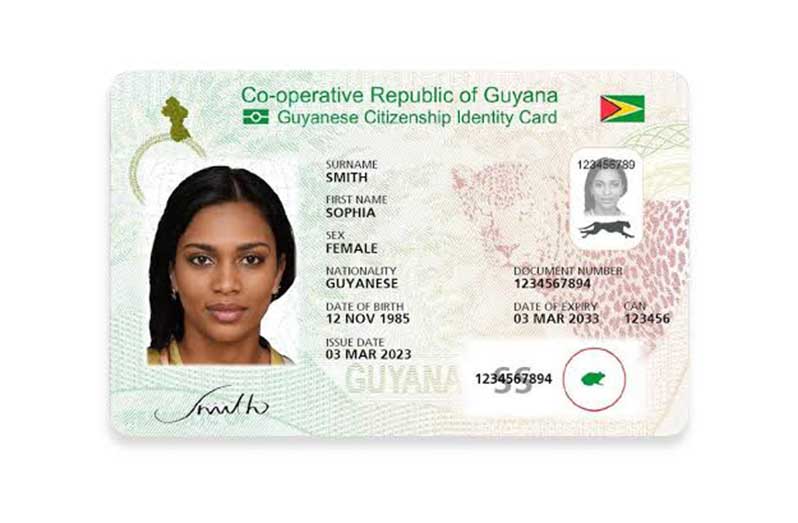
The physical card contains basic biographical information, including the holder’s name, date of birth and gender, as well as a Guyana Unique Identification Number, commonly known as the GIN.
The GIN remains attached to an individual throughout their lifetime, even if the physical card is lost, renewed or replaced.
The card also contains an embedded chip which, according to Giddings, stores the holder’s photograph, fingerprints, signature and other biographical and biometric information.
When institutions develop the necessary systems, the chip can be scanned to retrieve and authenticate information, subject to the person’s consent.
Giddings said this would eventually eliminate the need for institutions to photocopy identification cards and manually enter information when conducting transactions such as opening a bank account.
Meanwhile, the Digital Identity Card Registry is also making efforts to ensure vulnerable citizens are not excluded from the E-ID programme.
Giddings said mobile teams have been visiting communities and can respond to requests involving elderly persons, persons with disabilities and others who are unable to leave their homes.
He said families can request assistance for persons who are effectively shut-ins, with registration teams able to visit them at home and subsequently return to deliver their cards.
The Data Protection Commissioner said the mobile registration system is particularly useful for persons who require identification to access government assistance but do not have another suitable identity document.
With permanent service centres expected to expand across the country and mobile operations continuing, Giddings said the Registry’s objective is to eventually place the Digital ID card within the reach of all eligible persons.
He encouraged residents to take advantage of upcoming mobile enrolment exercises and the permanent service centres as they become available.
For more information on the Digital Identity Card, including registration, visit the official website: e-id.gov.gy