
THE Government has unveiled an ambitious multi-phase redevelopment programme aimed at transforming the neighbouring East Coast Demerara communities of Melanie Damishana and Non Pariel into a modern “Model Village”, with extensive investments planned in drainage, roads, public spaces, utilities and community infrastructure.
The project, presented during a public consultation on Thursday with residents and stakeholders, will cover approximately 470 acres, and is expected to improve flood resilience, road safety, sanitation, and the overall quality of life for more than 1,700 households in the two communities.
According to government officials, the initiative will benefit approximately 1,730 households, 44 businesses, five places of worship, and several public facilities, including the Melanie Fire Station, Nursery School, Health Centre, Post Office and National Insurance Scheme (NIS) office.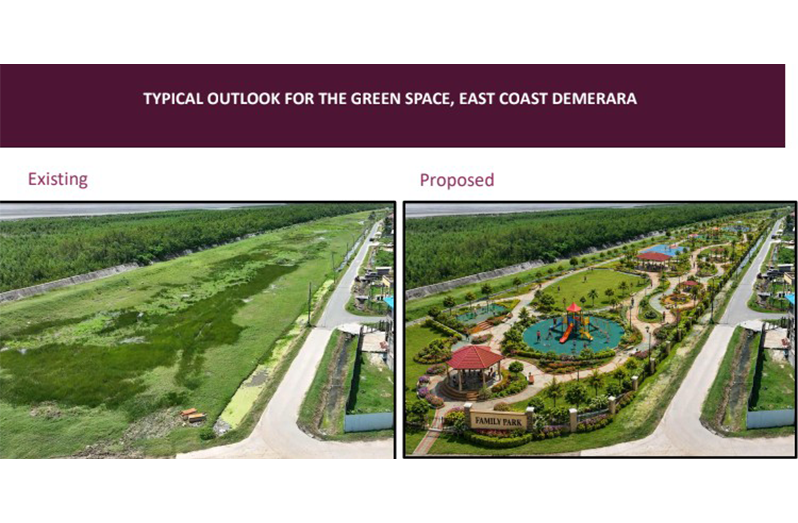
MAJOR DRAINAGE AND FLOOD MITIGATION WORKS
A baseline assessment conducted by engineers found significant deficiencies in the area’s drainage infrastructure. The survey revealed that the 73 streets, which collectively span about 27.7 kilometres, are served by only 7,000 metres of concrete drains, while approximately 55 kilometres of earthen drains have become clogged by vegetation and silt.
To address chronic flooding, the government plans to construct 43.4 kilometres of reinforced concrete drains, and an additional 8.7 kilometres of drainage systems for alleyways.
The project also includes the installation or rehabilitation of 70 culverts, seven concrete bridges, and a retaining wall to improve water flow and protect vulnerable sections of the drainage network.
ENCUMBRANCES TO BE REMOVED
Authorities also announced a zero-tolerance approach to illegal encroachments on public reserves ahead of the commencement of civil works.
Technical inspections identified 556 stockpiles of construction materials, 100 roadside garbage heaps, 70 derelict vehicles, and 56 unauthorised roadside vending structures obstructing road shoulders and drainage reserves.
Officials said approximately 64.1 kilometres of road shoulders and drainage corridors will be cleared, with formal notices to be issued to affected residents and business operators requiring them to remove encumbrances before construction begins.
ROADS, WALKWAYS AND PUBLIC AMENITIES
The redevelopment programme also includes significant improvements to transportation infrastructure.
Engineers have developed three road designs tailored to varying street widths, featuring combinations of open and covered concrete drains, reinforced road edges, pedestrian walkways and designated utility corridors.
Overall, the project will deliver approximately 26.9 kilometres of concrete walkways, and 32.2 kilometres of crusher-run hard shoulders, while five priority roads will undergo major rehabilitation and resurfacing.
Road markings, community signage and designated industrial parking areas will also be introduced to improve traffic management and reduce heavy-duty vehicle parking along residential streets.
GREENER, SAFER COMMUNITIES
The initiative extends beyond infrastructure to include environmental and community enhancements.
Plans call for the planting of 423 shade trees, installation of 73 standardised community signs—including a landmark entrance monument for Melanie Damishana—and the upgrading of all 14 public spaces within the project area.
Four playgrounds will be rehabilitated while three new multi-purpose green spaces will be developed to serve as recreational parks and regulated vending areas.
Public safety infrastructure will also be significantly expanded with the installation of 122 new streetlights, the relocation of approximately 100 leaning utility poles in collaboration with utility providers, and the addition of 43 fire hydrants, increasing coverage in communities that currently have only three hydrants.
PHASED IMPLEMENTATION
Government planners said the redevelopment will be implemented in five phases to minimise disruption to residents.
The first stage will focus on coordinating utility relocations with the Guyana Water Incorporated (GWI) and the Guyana Power and Light Inc. (GPL), followed by the clearing and desilting of drains.
Subsequent phases will see the construction of drainage infrastructure, culverts and bridges, followed by the development of walkways, road rehabilitation and final landscaping works, including tree planting and streetscape improvements.
Officials assured residents that concerns raised during the public consultation would be reviewed by engineers before construction begins, with adjustments to the design to be made where feasible.
The Model Village Initiative forms part of the Government’s broader strategy to modernise communities through improved infrastructure, enhanced public services and sustainable urban planning, while establishing a template for future rural and suburban development across the country.