






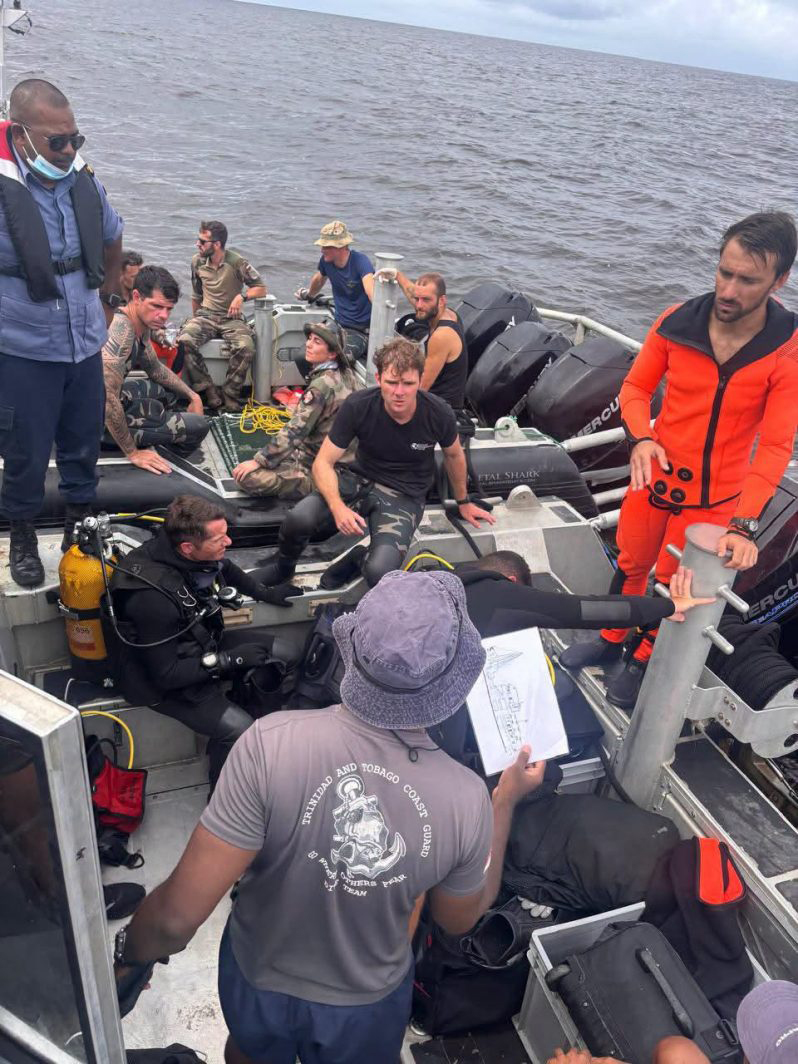
ZERO visibility, powerful currents and the maze of ropes and hammocks inside the capsized MV Barima are making recovery efforts extraordinarily dangerous, French military divers told anxious relatives of the missing during a briefing at the Charity Operations Centre on Sunday.
The update came as international dive teams continue painstaking operations at the wreck site, where authorities are racing to recover those still unaccounted for following Guyana’s worst maritime disaster.
Speaking directly to family members, a French military officer explained that the environmental conditions beneath the surface have severely limited what divers are able to do.
“We arrived on Monday, and since Tuesday we have committed about 15 dives on the wreck,” the officer said.
He explained that the operation is being carried out in complete darkness, with strong tides and currents making navigation extremely hazardous.
“It is totally dark there. There are very, very hard environmental conditions, especially because of the tide and the current on the wreck,” he said.
“So it is very difficult for us to navigate through the wreck. We have to feel the wreck, and it’s like we are blind.”
The officer said divers are unable to rely on visibility and instead must navigate by touch while feeling for the vessel’s structure.
“We follow the rope, arrive on the wreck and try to navigate by searching the characteristics of the wreck,” he explained.
The presence of ropes, hammocks and other obstructions inside the vessel has made entering the wreck especially dangerous.
“It is too dangerous for us to enter into the wreck, and because of the many ropes and the hammocks, it’s very difficult to see where we are going,” he said.
The officer thanked the Guyana Defence Force for its support throughout the operation, while stressing that the difficult underwater conditions—not a lack of effort—remain the greatest obstacle facing recovery teams.
“I would also like to thank the Guyana Defence Force for all their support, which has allowed us to conduct the dives, but the weather conditions and the environmental conditions of the sea are really, really hard,” he said.
During the briefing, one relative asked whether the condition of the wreck and the underwater environment made it possible to move the vessel.
In response, the French officer acknowledged that such an operation would be extremely challenging.
“I think it is very, very hard… the wreck is very strong, so it is difficult,” he said.
The briefing formed part of the Government’s ongoing engagement with relatives of those still missing, providing families with updates on the search, rescue and recovery mission.
The French Armed Forces are among several international teams assisting Guyana’s multi-agency operation, alongside specialist divers from Trinidad and Tobago and local dive teams.
Authorities have said recovery efforts remain focused on carefully searching the vessel while ensuring the safety of divers working in one of the most difficult underwater environments encountered during the operation.
The MV Barima capsized on the night of July 18 while travelling from Georgetown to Port Kaituma with 116 passengers, 17 crew members and cargo on board. As of Sunday, 73 bodies had been recovered, with 69 positively identified by their families, while search and recovery operations continue for those still unaccounted for.




