






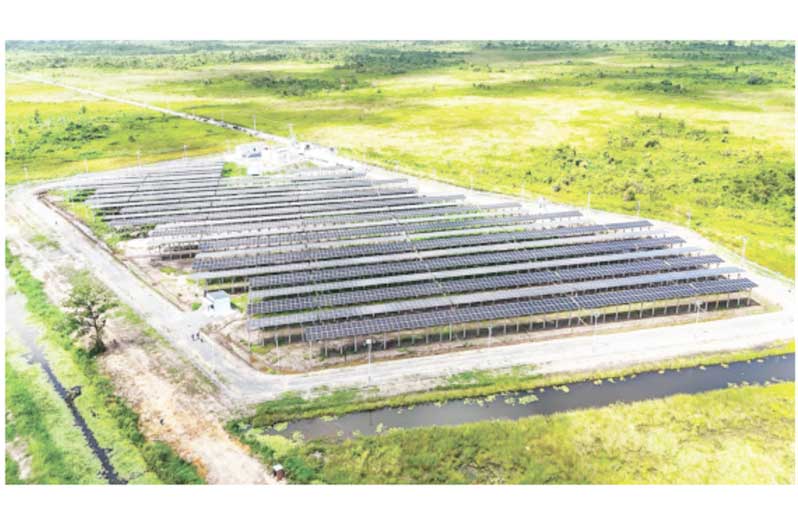
–capacity moves from 1.62 megawatts in 2020 to 16.35 megawatts in 2026
THE government has invested more than $11 billion to expand renewable energy infrastructure in hinterland communities, increasing installed renewable energy capacity by 909 per cent between 2020 and 2026.
The update was provided by Head of the Guyana Energy Agency (GEA), Dr Mahendra Sharma, during the National Toshaos Council (NTC) Conference on Tuesday, where he highlighted the government’s efforts to improve access to reliable and sustainable energy in indigenous communities.
Dr Sharma said renewable energy capacity has grown from 1.62 megawatts in 2020 to 16.35 megawatts in 2026 through investments in solar farms, hydropower facilities, solar mini-grids and off-grid systems.
More than 37,000 solar home systems have also been distributed to households across the hinterland, while 56 solar mini-grids have been established in communities nationwide, with 21 currently under construction. Additionally, 227 rooftop solar photovoltaic systems have been installed on public and community buildings.
Among the flagship projects is the 1-megawatt Lethem Solar Farm, commissioned in August 2022 at $490 million.
Since becoming operational, the facility has generated more than 4,300 megawatt-hours of electricity, reducing the need for more than 7,000 drums of diesel and preventing over 3,500 tonnes of carbon dioxide emissions.
Dr Sharma also highlighted the rehabilitation of the Moco Moco Hydropower Plant and the construction of the 1.5-megawatt Kumu Hydropower Plant in Region Nine. The combined investment of $2.679 billion has displaced the use of more than 24,000 drums of diesel while avoiding approximately 9,700 tonnes of carbon dioxide emissions.
Other major renewable energy projects include the 1.5-megawatt Bartica Solar Farm, built at $703 million, and the 0.65-megawatt Mahdia Solar Farm, which continues to reduce diesel-powered electricity generation in Region Eight.
Dr Sharma said the renewable energy programme is transforming electricity access in hinterland communities while reducing dependence on fossil fuels and lowering greenhouse gas emissions.
He also urged village leaders and residents to safeguard the infrastructure by using the systems responsibly, noting that overloading community solar mini-grids can affect service for entire villages.
“We need your help. We need the leaders to help us too, and we need the community to be caring of the system and ensuring that it is not abused and that it is sustained,” Dr Sharma said. (DPI)




