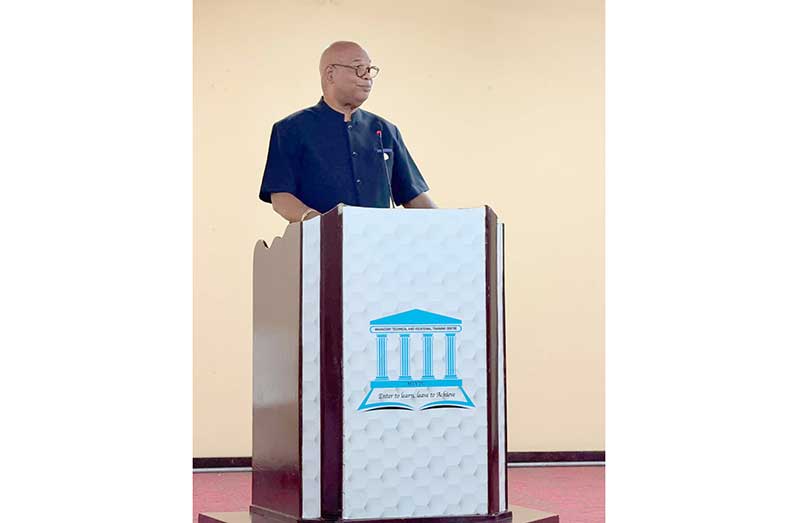
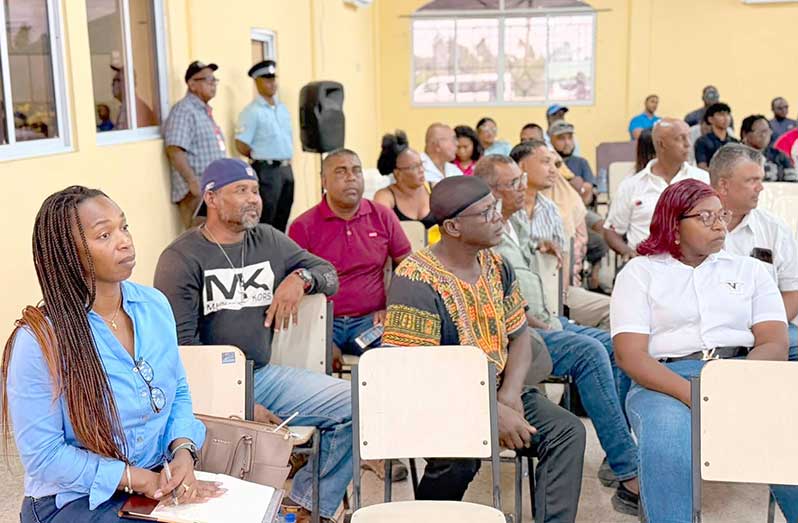
RESIDENTS, business owners, religious leaders and other stakeholders, on Friday, engaged officials from the Ministry of Public Works on the proposed four-lane highway for the Mahaicony corridor, with discussions on the project’s design, environmental impacts, drainage, and property concerns.
The stakeholder consultation, held at the Mahaicony Technical and Vocational Training Centre, was led by Minister of Public Works, Bishop Juan Edghill and formed part of the government’s ongoing engagement process ahead of the commencement of works.
During the meeting, officials outlined the scope of the project, its proposed design, environmental and social considerations, and the mechanisms that will be in place for addressing grievances throughout implementation.
According to the ministry, the new highway is being designed with a projected lifespan of 20 years and will be divided into three construction lots. Initial works will focus on Lots One and Two, which will involve the rehabilitation of the existing roadway.
The upgraded highway will feature widened carriageways separated by a median, street lighting, raised pedestrian crossings, rumble strips, improved junctions, pedestrian crossing signs and designated crossings for livestock.
Minister Edghill told stakeholders that the current round of consultations is intended to familiarise residents with the government’s plans before a contractor is selected.
He explained that once a contractor has been engaged, additional consultations will be held to present detailed traffic management plans and construction schedules.
“The operational aspects will arise once that engagement occurs,” the ministry said, noting that residents will continue to be kept informed throughout the process.
While welcoming the proposed development, stakeholders raised several concerns, including the possible acquisition of private lands, the impact on drainage infrastructure, and the preservation of historic railway bridges regarded as monuments and artefacts.
Responding to those concerns, the project’s consultant said options would be explored to preserve the railway structures, stressing that the bridges would not simply be discarded.
On the issue of drainage, Minister Edghill assured residents that any interventions would be subject to approval by the hydrologic engineer at the National Drainage and Irrigation Authority (NDIA).
He noted that similar concerns have arisen during major infrastructural projects elsewhere in the country and have been successfully resolved.
“So, while there must be some inconvenience, it is for the long-term good and it will definitely help with the development of your region,” Edghill told the gathering.
Addressing concerns about private property, the minister assured residents that no one would be unfairly treated if land acquisition became necessary.
“If for any reason, in order to get this road completed, we have to use anyone’s private property, you will not be disadvantaged. The Constitution provides that you are given fair market compensation,” he said.
The proposed highway forms part of the government’s wider transport infrastructural programme aimed at expanding and modernising the national road network.
According to the ministry, the project is expected to improve connectivity, reduce travel times, strengthen economic corridors and support long-term development across Region Five and surrounding communities.