






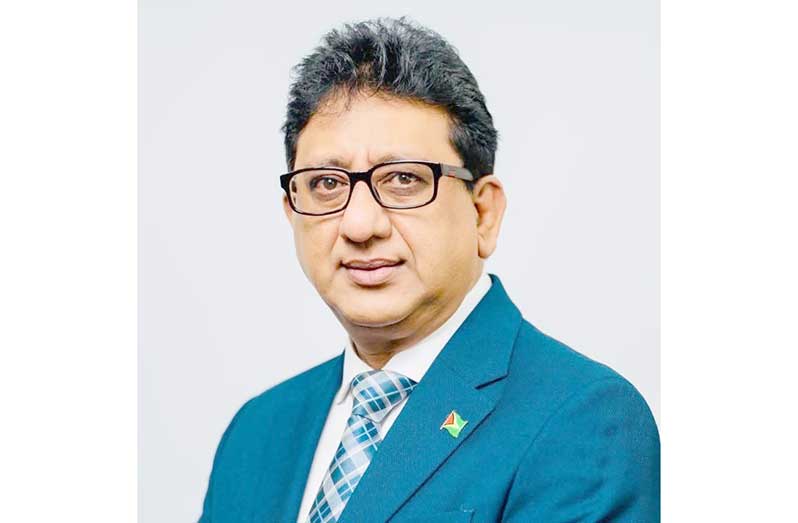
ATTORNEY General and Minister of Legal Affairs, Anil Nandlall, SC, has called for greater judicial involvement in the Caribbean’s fight against financial crime, arguing that judges and magistrates must adopt a specialised approach when interpreting and applying asset recovery legislation.
Speaking on Wednesday at the opening ceremony of the 2026 Annual General Meeting of the Asset Recovery Inter-Agency Network for the Caribbean (ARIN-CARIB) at the Georgetown Marriott Hotel, Nandlall said the judiciary is a critical stakeholder in the fight against organised crime. He stressed that judicial officers play an essential role in depriving criminals of the proceeds of their illegal activities.
Appealing to the ARIN-CARIB to include greater judicial participation in its work, Nandlall said, “I appeal to that body to incorporate in that body’s engagement the judiciary. The judiciary is an important part in this equation.”
According to him, the legal framework governing anti-money laundering and asset recovery differs significantly from ordinary criminal legislation and therefore requires a different judicial approach.
He described the legislation as sui generis, explaining that it demands specialised methods of interpretation rather than the traditional principles applied in conventional criminal cases.
“We are dealing with legislation that I’ve described elsewhere as sui generis. They require different canons of interpretation. They differ from the ordinary criminal statutes,” he said.
While acknowledging that the laws contain far-reaching powers, Nandlall said that is necessary given the sophisticated nature of modern organised crime and illicit financial activity.
“They are draconian, but that is the nature of the legislative framework,” he stated.
The Attorney General argued that judicial officers must recognise the unique purpose of asset recovery legislation when presiding over such matters.
He emphasised, “They cannot use ordinary canons that apply to the ordinary criminal law in interpreting and applying this statutory framework. It’s different.”
Nandlall warned that the region’s efforts to combat money laundering, organised crime and other forms of illicit finance would be significantly hampered without the active participation and understanding of the judiciary.
“And if we don’t get the judiciary on board, then our task becomes tremendously more difficult,” he cautioned.
Nandlall noted that today’s criminal organisations operate across multiple jurisdictions, moving illicit proceeds through complex financial networks and exploiting differences in national legal systems to evade prosecution.
He said this evolving threat underscores the need not only for stronger co-operation among law enforcement agencies but also for a judiciary equipped to effectively interpret and enforce modern asset recovery legislation.
He maintained that strengthening judicial understanding of these laws is essential to ensuring that criminals are stripped of the financial gains derived from their unlawful activities and that confiscation becomes an effective tool in the administration of justice.
Guyana has, over the past several years, significantly strengthened its anti-money laundering and countering the financing of terrorism framework through legislative reforms, institutional capacity building and closer cooperation among local and international law enforcement agencies.
The government has also expanded the use of mutual legal assistance, enhanced co-operation through Interpol and the Egmont Group, and increased the use of ARIN-CARIB mechanisms to support cross-border financial investigations and asset recovery.




