






By Naomi Parris in Beijing, China
WHEN most Guyanese hear the words China-Guyana relations, the first images that spring to mind are often familiar ones: the Chinese supermarket around the corner, the food shop that somehow serves enough fried rice to feed an entire family, or the hardware store where you’ll probably find exactly what you need for less than expected.
Let’s be honest, few things can rival a mixed Chinese fried rice after a long day.
But if that’s where our understanding of the relationship between Guyana and China begins and ends, we’re missing a much bigger story.
As I write this from Beijing while participating in a media exchange programme, one thing has become increasingly apparent. For all the attention given to our differences, our language, our culture, and our geography we may actually have more in common than we realise.
Both Guyana and China are countries with long civilisations and rich traditions that are now navigating rapid modernisation. Both place considerable emphasis on infrastructure as a pathway to development.
Both speak often about lifting people’s quality of life through investment, connectivity and economic opportunity. And perhaps most importantly, both are looking confidently towards the future while trying to preserve their heritage.
Back home, conversations about China can sometimes become narrowly focused on the visible presence of Chinese-owned businesses.
Over the past two decades, Guyana has seen an increase in Chinese nationals establishing supermarkets, restaurants, hardware stores and other enterprises, particularly in Georgetown and newer housing developments.
Opinions remain divided; many consumers appreciate the convenience, extended opening hours and competitive prices these businesses often provide. Others argue that the growing number of foreign-owned enterprises creates tougher competition for local businesses that have served communities for generations. Those concerns deserve thoughtful discussion, particularly as Guyana’s economy continues to expand.
Yet reducing the Guyana-China relationship to supermarkets and takeaway boxes overlooks the much larger picture.
Take the new Demerara River Bridge, officially named the Bharrat Jagdeo Demerara River Bridge.
The project, one of the largest infrastructural investments in Guyana’s history, was constructed by a joint venture consisting of China Railway Construction Corporation (International) Limited, China Railway Construction (Caribbean) Co., Ltd, and China Railway Construction Bridge Engineering Bureau Group Co., Ltd.
The four-lane, high-span bridge replaced the aging floating bridge and transformed connectivity between Regions Three and Four, reducing congestion while supporting trade and economic growth.
That is far more than concrete and steel.
It is a statement about how infrastructure shapes a country’s future.
The same can be said for the Guyana-China Friendship Park, a recreational space that has become a gathering point for families and fitness enthusiasts. While it may not command the same headlines as a billion-dollar bridge, it represents another dimension of co-operation, one centred on environmentally friendly public spaces and quality of life.
Then there is trade.
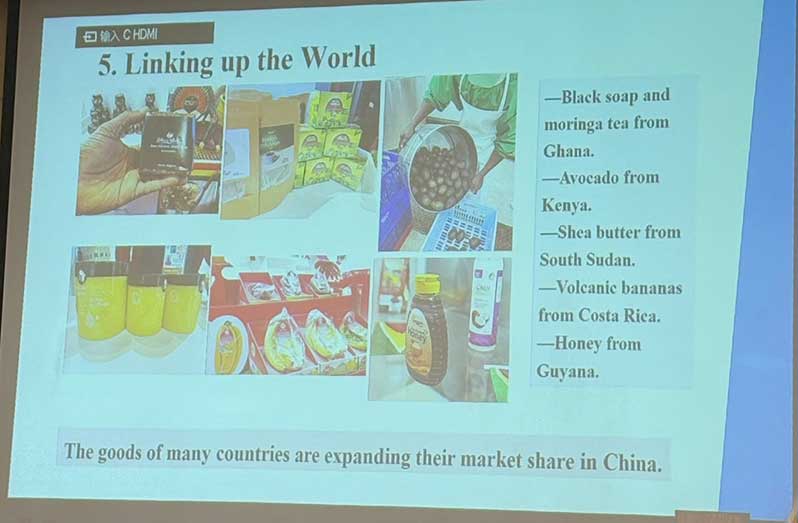
Standing in Beijing, thousands of miles from Georgetown, I was pleasantly surprised to discover that Guyanese products have made the journey too.
Our honey produced from the forests and savannahs of Guyana can be found on shelves here, albeit not on every street corner. After all, Beijing is no Robb Street.
You may have to look a little harder, but there is something quietly satisfying about knowing that products from one of the world’s most forested countries are finding their way into one of the world’s largest consumer markets.
It is a reminder that trade is not a one-way street.
We import goods that fill our shops, while Guyanese products are gradually finding opportunities abroad.
During lectures throughout this exchange programme, much has been said about Chinese development assistance, investment and international co-operation. Those discussions naturally invite questions, debates and differing viewpoints.
Healthy conversations about foreign investment, economic partnerships and national development are essential for any nation, but they should also be informed by the full picture.
China’s engagement with Guyana cannot simply be measured by the number of supermarkets in our neighborhoods or the takeaway containers leaving Chinese restaurants on Friday evenings.
It should also be measured by trade that creates opportunities for producers, scholarships that educate young people and the countless exchanges—like the one that brought me here—that allow ordinary citizens to better understand one another.
Perhaps that is the greatest lesson of travelling, it reminds us that countries are rarely as different as headlines sometimes suggest.
And whether you’re walking through Beijing or Georgetown, you’ll quickly realise that progress isn’t just about the buildings going up around you.
It’s about the relationships being built alongside them.
Maybe the next time we think about Guyana-China relations, we should think beyond the fried rice and supermarkets.
Although, admittedly, I’ll still be ordering the mixed fried rice with two extra pieces of Chinese chicken.




