






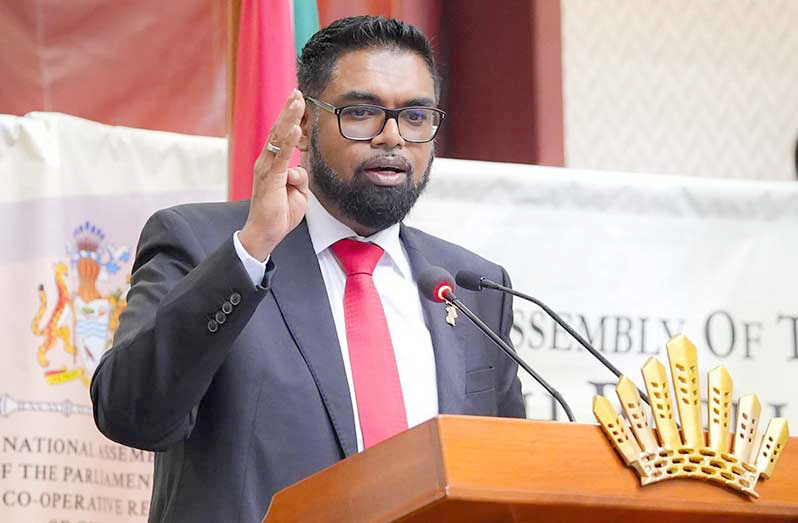
-President Ali says, urges Region Two residents to take advantage of free cancer screening, other health services
— announces ambitious goal of 3,000 women, 3,000 men being screened for cancer by year-end
PRESIDENT Dr. Irfaan Ali has ordered an aggressive cancer screening push in Region Two, directing health officials to ensure that at least 3,000 women receive mammograms and 3,000 men undergo prostate screening by the end of the year, warning that early detection is the difference “between life and death”.
Speaking at the commissioning of the Regional Medical Distribution Centre at Onderneeming, Region Two, the President disclosed that the region has moved from virtually no mammograms to more than 400 screenings, but insisted that this is still far too low, given the scale of the risk.
“We have to create a new paradigm in the public service, one that is people-centred, people-focussed, and service-oriented. And that is what we are about. And if we speak about service orientation, it is not only putting in the infrastructure,” he said.
He said that breast cancer is preventable and more easily treatable when caught early. And used the opportunity to urge women to use the new facilities, insisting that the State has already met its obligation to provide the service.
“Let me say this to every single woman out there, we can prevent breast cancer by early screening, because you can also treat breast cancer better by early screening. Early identification decreases the risk of the cancer being fatal; it increases chances of survival and increases your ability to fight that cancer, but it requires early screening,” he said.
The President said he has asked a senior medical specialist to front a public‑education campaign to increase the numbers.
Turning his attention to men’s health, the President described prostate cancer as the most prevalent form of cancer among Guyanese men, stressing that it is “completely treatable” if detected early.
“The PSAs, prostate examination men, there is nothing so ‘brave’ about not having a prostate examination; it will save your life,” he said, adding: This is the type of cancer most prevalent among men in Guyana; Number One, that is completely treatable with early intervention.”
However, he expressed dissatisfaction that only 335 men in the region have so far been screened, despite the availability of testing services.
“I am going to put the RHO on notice now that we are not satisfied that only 335 men were scanned so far. We have the facility. The RHO, before the end of this year, must ensure at least 3,000 men are scanned.”
The President said health authorities must move beyond waiting for patients to present themselves and instead take screening directly into communities through sustained outreach and education.
“You have to go to the communities, you have to reach and educate the people and get them so that they can be scanned,” he told regional officials, adding: “We have to set these ambitious targets if we are going to get the results we want with the investments we’re making.”
He linked the screening agenda to a broader shift towards prevention and primary healthcare, arguing that a reliable system is one that reduces the number of people ending up in hospital with advanced complications.
“A reliable healthcare system is one that stops people from coming to the hospital. If you have diabetes and you’re taking your medication and following the doctor’s nutritional chart, you’ll avoid amputating your toe, your leg, or ending up on dialysis or going blind. It’s a simple choice you have to make, but we have to help you make that choice.”
The President repeatedly stressed that the State is investing heavily in diagnostics and treatment from mammograms and CT scans to dialysis and eye‑care vouchers, but these investments will only translate into better outcomes if citizens respond to the call for early screening and consistent care.
“Here is a government pleading with you to do the mammogram, pleading with you to do the PSA, pleading with you to take a voucher and establish your baseline numbers, so we can know how to treat you. Pleading with you to take your medication and use it… to take the eye‑care voucher and get the spectacles that we will pay for if you need it,” he said.



