






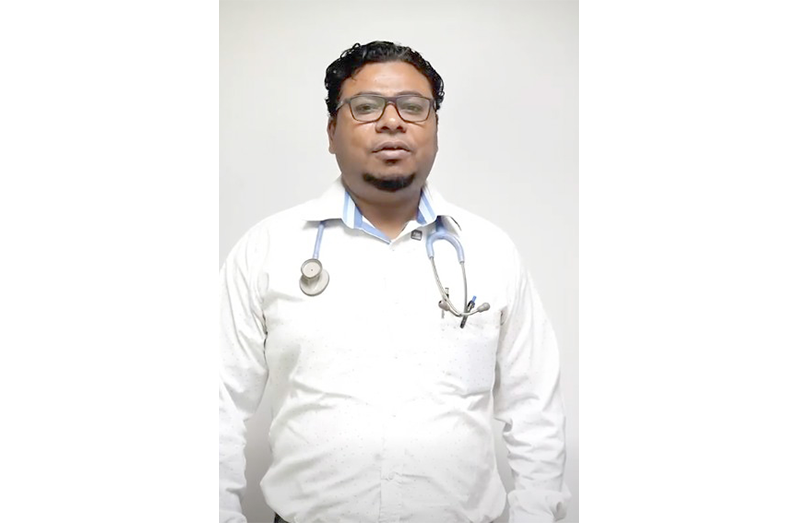
DR AMAR Deeb, a Medical Officer at the Georgetown Public Hospital Corporation (GPHC), recently underscored the causes of diabetes, helping Guyanese to understand the risk factors of the disease.
He noted that diabetes is not an actual “chronic condition.” Differentiating between type one and type two diabetes, he said in type one diabetes, there is not enough insulin produced by the pancreas, while in type two, the disease is caused by insulin resistance, meaning the body’s cells do not respond effectively to the insulin it produces. The doctor said that this happens mostly in adults around 30 years to 45 years of age.
“Even though the incidence of the type one diabetes is increasing, we’re seeing a lot of children who coming with the type one diabetes…from 11, 12 to teenager age. Type 1 diabetes is caused by the autoimmune condition in which the pancreas is attacked by the autoimmune cells, and it does not produce enough insulin,” he continued.
“So, we need to give insulin in the form of an injection. Type two is caused by insulin resistance. It means your body is producing insulin, but your cells are not utilising that insulin properly. So, in that condition, we need to prescribe certain medications to the person to increase insulin sensitivity. So, our body can digest the glucose properly.”
Dr Deeb pointed out that some of the early signs of diabetes include increased thirst, and an increased frequency of urination. Another sign is unexplained weight loss, and a constantly tired feeling.
According to the doctor, daily exercise, and dietary changes (from junk food to healthier and often more home-cooked meals) are needed.
In June this year, Dr. Stephen Carryl, the Head of the Overseas Medical Assistance Team (OMAT), appealed to Guyanese to adopt healthier lifestyles.
At the time, the doctor had noted that people in their early 30s are now increasingly showing signs of early onset of hypertension and diabetes. These diseases, according to a previous report, often go “hand in glove.” He called for Guyanese to take more preventative measures when it comes to their health, increase exercise, and change eating habits to lower the risk.




