






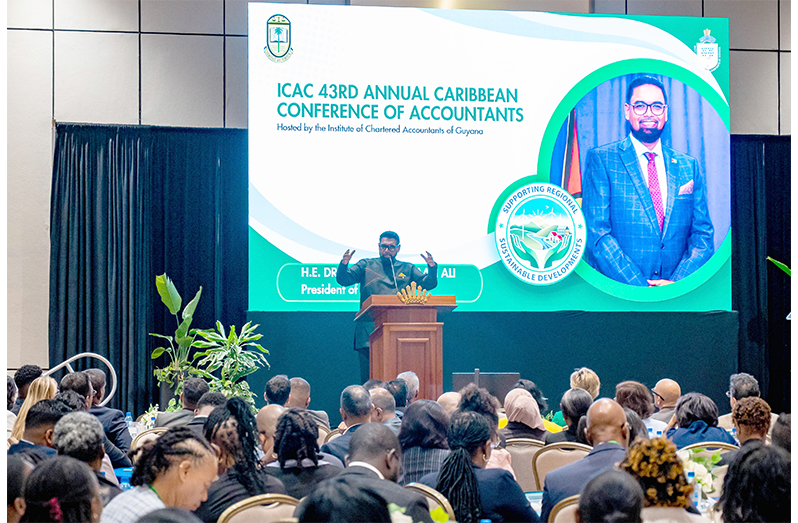
–President Ali emphasises, urges professionals to keep up with rapidly changing times
PRESIDENT Dr Irfaan Ali has warned regional accountants against becoming overly dependent on artificial intelligence (AI), urging the profession to protect its “brain muscle” and evolve into strategic advisers rather than mere operators of digital tools.
Addressing the 43rd Annual Caribbean Conference of Accountants of the Institute of Chartered Accountants of the Caribbean (ICAC) in Georgetown, on Friday, Dr Ali said AI must serve as a tool to enhance professional judgment, not replace it.
“You’re also meeting at a time when professions around the world are changing and changing because of systems; you have to decide in your profession whether people drive [the] system or the system is driving people,” he said.
Dr Ali noted that the days of accountants being confined to recording and reporting figures are over.
With governments and businesses now able to obtain real‑time dashboards and predictive analytics from AI systems, the value of the profession must increasingly lie in interpretation, strategic insight, and policy influence.
“AI is a tool to help us, but if we allow AI to be the tool that directs us, then we will have challenges, so we have to decide in the region how we shape AI to meet our own model and to meet our own needs,” he said.
Against that backdrop, he challenged the profession to redefine its core competencies.
” Accountants now need to evolve, not just generating the data anymore, but using the data to enhance decision‑making, using the data to influence policy,” Dr Ali said, adding: “And for accountants to be relevant in this environment, you have to now also be like an accountant, a Wall Street trade policy analyser, because this accountant now must move into a system where they understand policy.”
He also cautioned about the cognitive risks of over reliance on automation, drawing a parallel between children overexposed to devices and professionals who outsource too much thinking to algorithms.

“There’s a great danger in becoming an AI human,” he warned. “The muscle of the brain is trained to think, and if we stop the process of allowing your brain muscle to work, it will become dead. You may not have a physical stroke, but you will have a different type of stroke.”
Against the backdrop of Guyana’s rapid economic expansion fuelled by oil and gas, major infrastructure, and rising foreign investments, Dr Ali said the demand for high‑quality professional services, including accounting, has multiplied.
He noted that the region’s central challenge is not merely producing more accountants, but also producing the right accountants for a profession that is undergoing profound transformation.
In the changing climate, he noted that accountants must be technologically literate, comfortable with AI, cloud‑based systems, digital audit tools, and real‑time analytics; ethically grounded, able to resist political capture and retain independent judgment; and strategically oriented, capable of interpreting data for policy, competitiveness, and development outcomes.
Despite the scale of the transition, Dr Ali expressed confidence that Caribbean accounting can adapt, as it has done through previous waves of regulatory change, globalisation, digitisation, and now AI.
“Each generation of accountants has faced this challenge and responded accordingly, and therefore, I’m confident that with the right preparation, Caribbean accounting will continue to evolve in tandem to meet the changes that lie ahead. I’m confident that this profession will continue to play a vital role in supporting economic growth, strengthening governance, enhancing transparency, and building confidence throughout our region.”
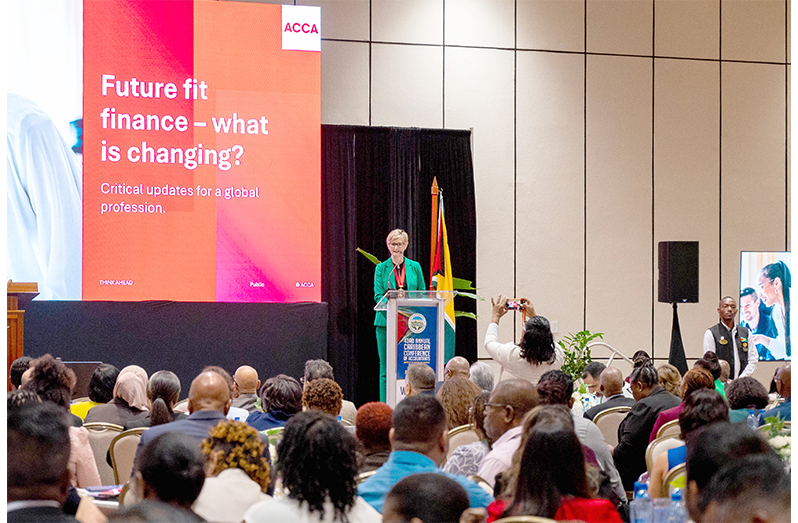
Meanwhile, Melanie Proffitt, President of the Association of Chartered Certified Accountants (ACCA), highlighted the evolving role of accountants in a rapidly changing world, emphasising the importance of embracing three mega trends: demography, climate change, and technology. Proffitt highlighted too the profession’s shift towards environmental and social sustainability, ethical decision-making, and AI adoption.
“The organisation is redesigning its qualification to include new awards, experiential learning, and a stronger focus on sustainability, AI, and technology. The future of accountancy involves specialised skills, transferable skills, and generalist interpersonal skills,” she said.
Held under the theme, “Supporting Regional Sustainable Development,” the four-day conference has brought together more than 300 delegates from across the Caribbean to examine the accounting profession’s role in advancing sustainable growth and regional development.




