






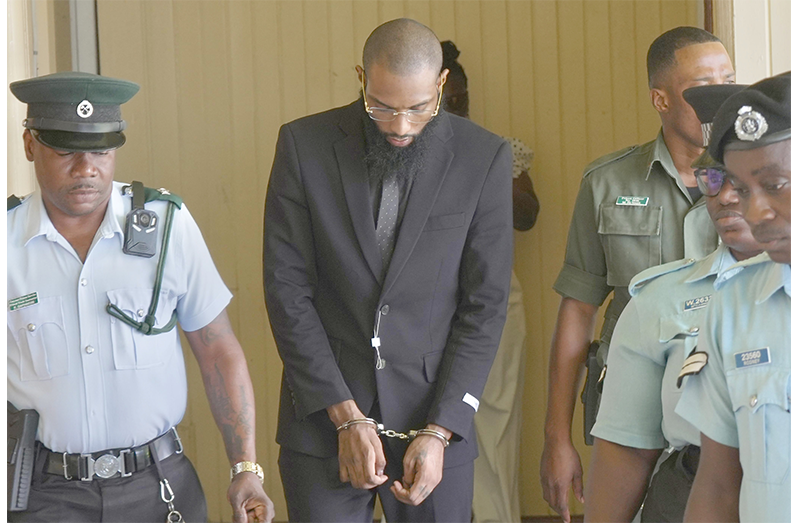
-apologises to victim’s relatives, nation
TWENTY-FOUR-YEAR-OLD Shaquan Alleyne, called “Iswe Boss” and “Iswe,” broke down in tears on Thursday as he was sentenced to 25 years’ imprisonment for the 2021 murder of his girlfriend, 21-year-old Shonnette Dover.
Her body was discovered buried in a shallow grave behind Alleyne’s home at Wismar, Linden, Region 10 (Upper Demerara-Berbice). The murder occurred between April 3 and April 30, 2021.
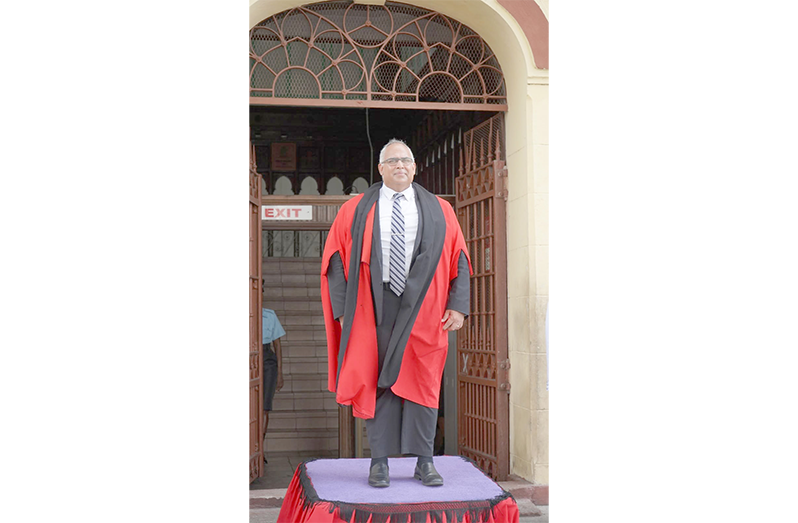
The sentence was handed down by Justice Sandil Kissoon at the Demerara High Court after
Alleyne had admitted to the capital offence of murder under a plea agreement negotiated between his attorneys and the Office of the Director of Public Prosecutions (DPP).
Alleyne was represented by attorneys Paul Fung-a-Fat, Charlene Fung-a-Fat and Domnick Bess, while State Counsel Cicelia Corbin led the case for the prosecution.
Before sentencing, he addressed the court through tears, offering an apology to Dover’s family, several members of whom were present in the courtroom, as well as to the nation.
“With a heavy heart, I stand here before you. I apologise to the court and the victim’s family for my actions. I am taking responsibility for my actions,” Alleyne said.
He told the court that he had spent time reflecting on his relationship with Dover and the events that led to her death.

He said, “It was an accident and I was afraid. I am asking the family of Shonnette Dover to forgive me. I am also asking the nation to forgive me. I understand that I made a mistake. I understand that there are consequences for my actions.”
The convicted killer added that he hoped his case would serve as a warning to others and expressed hope that it would serve as a warning to others. He pleaded for a second chance to one day prove that he could become a productive member of society.
In handing down the sentence, Justice Kissoon stressed that the welfare and protection of women, particularly vulnerable women, remained a central consideration in sentencing.
“The paramount and overriding consideration in sentencing remain the welfare and well-being of all women in society generally, but in particular the most vulnerable,” the judge said.
“That is the fundamental pillar that underlines the rule of law, our criminal justice system and the very objectives of sentencing.”
‘THIS WAS A SERIOUS CRIME’
The judge noted that the offence before the court was among the most serious crimes known to law and said the court was required to examine both the circumstances of the offence and the offender before determining an appropriate sentence.
Justice Kissoon identified several aggravating factors, beginning with the prevalence of domestic violence and intimate partner killings in Guyana.
The judge reminded the court that Dover was a young woman whose life was cut short by a person she trusted.
“Shonnette Dover was then a child of Guyana. She was the intimate partner and common-law spouse of the accused standing in the dock. She was a child of the community of Linden,” Justice Kissoon said.
He noted that she was shot in her own home with an illegal firearm.
The judge stated, “She was shot to the forehead with an unlicensed firearm which he possessed no lawful right to bear or to be in possession of.”
According to Justice Kissoon, the circumstances surrounding the murder made the offence particularly serious.
“She was brutally killed in her own space, in the presence of her younger sister, by one in whom she reposed trust and confidence as her intimate partner and husband.”
The judge referenced research and statistics on violence against women in Guyana, including findings showing the widespread nature of domestic and gender-based violence.
He said these realities could not be ignored by the courts when determining an appropriate sentence.
“Too frequently, society only becomes aware of the existence of the faceless, the voiceless and the vulnerable victims when the situation enters the public domain following… the murder of the victim,” Justice Kissoon observed.
The judge said the objectives of sentencing required the court to denounce such conduct and deter others from engaging in similar acts.
Justice Kissoon also outlined several aggravating factors specific to Alleyne’s conduct after the shooting.
He stated, “The accused, after shooting his intimate partner, did not see fit to render or provide assistance to her or to take her to the medical facilities available in Linden.”
The court further noted that Alleyne enlisted the assistance of Dover’s younger sister in concealing the crime.
“He placed his victim in a shallow grave and made a family member, that is the youngest sister of the deceased, a whole conspirator in his criminality after the fact to help dispose and conceal the body.”
The judge also criticised Alleyne’s attempts to mislead the victim’s relatives and the wider community.
“After committing the murder of his partner, [he] led the entire community and perhaps segments of society on a mission for the truth by manipulating those closest to his victim and family members.”
He added that, “with assistance from his elders who knew better, he took steps to actively conceal” his crime before investigators uncovered the truth.
Justice Kissoon further observed that Alleyne fled Guyana and did not voluntarily return to face justice. The judge noted that Alleyne did not voluntarily return to Guyana to face justice. Instead, he was apprehended in Suriname, deported, and taken into police custody in January 2024.
Turning to the sentence itself, Justice Kissoon explained that the court applied the established sentencing methodology used throughout the Caribbean.
He said the court arrived at a starting point of 35 years’ imprisonment based on the seriousness of the offence.
The court then considered mitigating factors personal to Alleyne, including the fact that he had no significant previous convictions.
“On that basis, the court adjusts its starting point by two years and six months to 37 years and six months,” Justice Kissoon stated.
The judge then granted Alleyne a reduction for his early guilty plea.
As a result, the sentence was reduced by 12 years and six months, leaving a final sentence of 25 years’ imprisonment.
Justice Kissoon ordered that Alleyne serve the full 25-year sentence.
The court also granted Alleyne credit for time spent on remand and ordered that the sentence commence from January 30, 2024—the day he was first remanded to prison.
In concluding the proceedings, Justice Kissoon encouraged Alleyne to pursue educational and vocational opportunities while incarcerated so that he could eventually reintegrate into society after serving his sentence.
BACKGROUND
The case stemmed from Dover’s disappearance in April 2021. Her decomposed body was later discovered in a shallow grave behind Alleyne’s Canvas City, Wismar residence with a gunshot wound to the head.
Investigators subsequently alleged that Alleyne shot Dover and buried her body with assistance from her then 15-year-old sister before fleeing to Suriname.
He was later apprehended by Surinamese authorities and returned to Guyana, where he ultimately admitted to the murder and brought an end to the long-running case.
In a confession statement to police, Alleyne maintained that the shooting was accidental.
“While cleaning the gun, I pulled back the hammer, and I did spray double WD-40. Shonette was sitting in a chair, and I was in front of her on another chair handle when I pointed the gun and waved it. Shonette told me to stop playing and my finger touched the trigger, and the gun went off, and I see smoke in the living room and Shonette lying motionless with a wound in her forehead and blood coming out,” he reportedly told investigators.
Police said Alleyne further admitted that after the shooting, he became fearful and concealed Dover’s death from her family, falsely claiming that she had gone to work and never returned.
He also allegedly confessed to selling the murder weapon to a man before fleeing to neighbouring Suriname.




