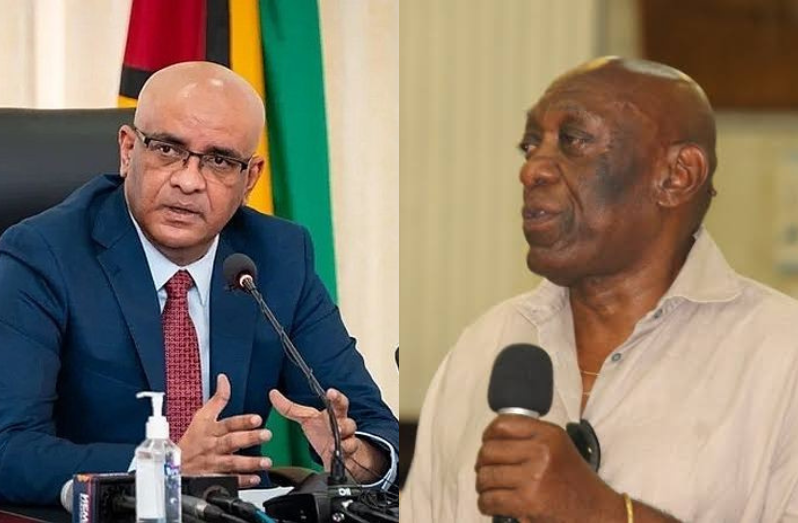
Vice President Bharrat Jagdeo has appealed a High Court ruling that awarded businessman Charles Ceres G$15 million in damages and G$2.15 million in costs in a libel case, arguing that the dispute cannot be separated from a broader and deeply contentious debate over the allocation of State lands during the final years of the former APNU+AFC administration.
The appeal seeks to overturn a decision by Justice Fidela Corbin, who found in favour of Ceres after concluding that remarks made by Jagdeo during a 2019 press conference were defamatory.
At the time, Jagdeo was Leader of the Opposition. His comments focused on Ceres’s acquisition of several parcels of State land while Ceres’s wife, Ndibi Schwiers, held a senior position within the Ministry of the Presidency, the government agency responsible for State-land allocations.
When the court awarded damages to Ceres, the ruling appeared to bring to a close a years-long legal battle over statements made during a politically charged period.
In his newly filed appeal, however, Jagdeo contends that the case was never solely about one businessman, but about what he viewed as a wider pattern of questionable State-land transactions involving politically connected beneficiaries.
Through his attorney, Pratesh Satram, Jagdeo argues that the trial court failed to properly assess evidence showing that Ceres received multiple parcels of State land while his wife occupied a senior government position with responsibility for land allocations.
According to the appeal, those facts were not in dispute and should have been given greater weight in determining whether the statements were substantially true.
The filing contends that Ceres acquired valuable parcels of land in areas including Liliendaal, Canje and near the mouth of the Berbice River during the tenure of the APNU+AFC administration. It further argues that the trial judge did not adequately consider the significance of Ceres’s relationship to a senior official whose ministry oversaw land allocations.
The appeal also points to evidence that Ceres transferred a portion of land in Liliendaal to Ms. Schwiers, maintaining that this supported the substance of the statements at issue.
At the heart of the appeal is the argument that the court examined Jagdeo’s comments too narrowly, focusing on specific wording and timing rather than the broader circumstances in which they were made.
Jagdeo argues that his remarks arose amid mounting public controversy over the allocation of State lands during the final months of the APNU+AFC administration, when critics alleged that public assets were being distributed to selected individuals without competitive bidding or transparent procedures.
MASSIVE LAND GIVEAWAYS
Records found in Guyana’s Official Gazette document a series of significant land distributions between 2019 and 2020.
Among them were 18 land orders signed in August 2019, six more in September of that year, and a further 45 orders signed in February 2020 and published the following month. Beneficiaries included public officials, political figures and individuals connected to State institutions.
The records list allocations to then government parliamentarians and others, including Amanza Walton-Desir.
Additional allocations involved senior officials attached to agencies operating under the Ministry of the Presidency.
Marlon Bristol, then Head of the Project Management Office within the ministry, was listed as receiving one acre at Mocha, 12 acres in Linden and 80 acres in Bohemia.
Aubrey Heath-Retemeyer, then Deputy Head of the State Assets Recovery Agency (SARA), was listed as receiving 10 acres along the Linden-Soesdyke Highway and another acre at Mocha.
Eric Phillips, then a SARA Special Assistant, was listed as receiving 1,000 acres in the Essequibo River and another 1,000 acres in the Demerara River. Former Chief Elections Officer Keith Lowenfield was listed as receiving 216 acres at Millie’s Hideout in Region Ten and two acres at Mocha.
The records also refer to allocations through the Mahaica Mahaicony Abary/Agricultural Development Authority scheme, under which then Chairman Kelvin Saul was listed as receiving more than 10,000 acres behind the Mahaica River.
For Jagdeo and the governing People’s Progressive Party/Civic (PPP/C), these transactions became emblematic of what they described as a broader pattern of non-transparent land distribution involving strategically valuable State assets.
QUESTIONS OVER VALUE AND PAYMENT
The controversy intensified following the change of government in 2020.
Several companies that had acquired prime State lands during the APNU+AFC administration later surrendered those lands to the State, citing concerns about the circumstances surrounding the transactions.
Among them was Caribbean Marketing Enterprises Incorporated (CMEI), a consortium of foreign investors that had acquired 21 acres at Ogle for a proposed hotel development.
In announcing its decision to return the land to the National Industrial and Commercial Investments Limited (NICIL), the company stated that the acquisition had placed it in an “unfamiliar and uncomfortable position”.
CMEI said it believed it had followed a lengthy and transparent process but noted that the completion of the transaction coincided with the post-election political crisis and the global Covid-19 pandemic.
The Ogle transaction attracted particular scrutiny because it was finalised after the March 2, 2020 elections, during a period when the APNU+AFC administration was serving in a caretaker capacity following the December 2018 no-confidence vote.
Government figures released after the change in administration suggested that nearly 100 acres of prime East Coast State lands had been vested to various companies. Those lands were said to have a combined value of approximately G$2.9 billion, while NICIL reportedly received only about G$64 million in payments.
Five companies that benefited from similar transactions subsequently returned lands to the State, including Navigant Builders Incorporated, Cardiology Services Incorporated, the Corum Group, American Marine Services Incorporated and Supergraphics Enterprise.
Their decisions fuelled allegations that some transactions had been executed at prices far below market value and before the State had realised the full worth of the assets involved.
The government later referred several transactions to the Special Organised Crime Unit (SOCU) and the Criminal Investigation Department for investigation. Former NICIL Chief Executive Officer Colvin Heath-London was questioned by investigators as scrutiny intensified over the disposal of State assets.
CRIMINAL CASES AND CONTINUING FALLOUT
The political controversy surrounding land allocations has since found its way into the courts.
In March 2025, former Finance Minister Winston Jordan was charged with misconduct in public office in connection with the sale of more than five acres of State land at Plantation Beterverwagting and Sparendaam.
Prosecutors alleged that Jordan signed a vesting order between February and June 2020 for land valued at G$150 million that was sold for G$2.425 million. The charge alleged that the transaction amounted to an abuse of public trust without reasonable cause or justification.
Jordan was not required to enter a plea because the charge is indictable. His attorneys argued that the matter had previously been discharged and described the prosecution as politically motivated.
Although unrelated to the litigation involving Ceres, the case underscored the continuing legal and political fallout from land transactions executed during the final months of the APNU+AFC administration.
THE APPEAL’S CORE ARGUMENTS
Jagdeo’s appeal maintains that his comments concerning Ceres reflected legitimate concerns about a wider system of State-land distribution involving politically connected beneficiaries and individuals linked to agencies responsible for approving allocations.
The filing argues that the judge placed excessive emphasis on distinctions between land allocated directly to Ceres and land allocated to companies in which he held shares, contending that such distinctions were irrelevant to the broader reality of the transactions.
Among its 31 grounds of appeal, the filing challenges the rejection of legal defences including justification, fair comment and qualified privilege.
On justification, Jagdeo argues that the statements were substantially true and that the court erred in concluding otherwise. On fair comment, the appeal contends that sufficient evidence existed to support criticism of allocations made without competitive bidding or tendering processes.
The appeal further argues that, as Opposition Leader, Jagdeo had both a right and a duty to comment on matters involving public property and the management of State assets.
The filing also challenges findings related to land allocations that remained pending after the government’s defeat in the 2018 no-confidence vote. It alleges that Ceres was not truthful when denying knowledge of a pending allocation near the mouth of the Berbice River, citing documentary evidence presented during the proceedings.
In warning of the broader implications of the ruling, the appeal argues that the decision risks discouraging scrutiny of public transactions and limiting the ability of elected officials to speak on matters of public concern.
It states that “the legal and practical effect of the ruling delivered by the learned Judge was to silence any form of public criticism by political leaders on the allocation of public property to persons employed by the state and their relatives. The decision of the learned Judge has effectively destroyed the right of the Appellant to comment on matters of public importance and prevents him from exercising and/or fulfilling his public duties as an elected official.”
The Court of Appeal has not yet indicated a date when it will hear the matter.