





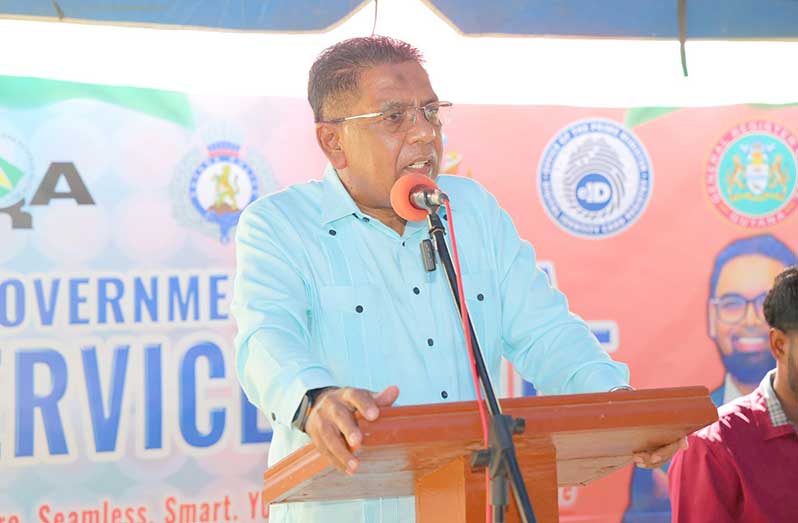
MINISTER of Agriculture Zulfikar Mustapha has reaffirmed the Government’s commitment to Guyana’s sugar workers, assuring that retroactive payments promised to employees in the industry will be paid and defending the administration’s record of investment in the sector.
Speaking during an engagement in Berbice on Wednesday, Mustapha dismissed claims circulating among some sugar workers that the payments would not materialize, stating that the People’s Progressive Party/Civic (PPP/C) government has consistently fulfilled its commitments to the industry and its workforce.
“As the Minister responsible for the sugar industry, this government, this PPP/C government has always delivered to the people of this country and to the sugar workers,” Mustapha declared.
The minister said the government has invested more than $76 billion in the sugar industry since returning to office in 2020, arguing that these investments demonstrate the administration’s commitment to revitalizing the sector and protecting jobs.
He pointed to several initiatives undertaken by the government, including the reopening of the Rose Hall Estate, the ongoing efforts to attract investors to the Skeldon Estate, and the resumption of cane cultivation in Skeldon.
“It was the PPP/C government that reopened Rose Hall Estate, it is the PPP/C government that will be reopening and have investors come and invest in the Skeldon Estate, it is the PPP/C government that started back planting cane at Skeldon and it is the PPP/C government that will ensure sugar workers receive their retroactive payment,” Mustapha said.
The agriculture minister also contrasted the current administration’s approach with that of the former APNU+AFC government, which he said closed several sugar estates, resulting in widespread job losses and economic hardship for thousands of families.
According to Mustapha, the closure of estates in Region Six alone left more than 5,000 workers without employment and contributed to population movement from the region as residents sought alternative sources of income.
“Region Six depends heavily on the sugar industry. We had two massive sugar estates closed and over 5,000 persons in the region were placed on the breadline,” he said.
Mustapha urged residents to consider the broader progress being made within the industry rather than focusing solely on localised concerns, arguing that significant strides have been made in restoring the sector and creating opportunities for workers.
He also criticised opposition figures whom he accused of spreading misinformation about the government’s handling of the sugar industry, contending that many of those now voicing concerns were absent during the challenges faced by workers following the closure of estates under the previous administration.
The minister’s remarks come amid renewed debate over the future of Guyana’s sugar industry and ongoing efforts by the government to modernise operations, attract investment, and secure long-term sustainability for one of the country’s traditional economic sectors.
Mustapha maintained that the government’s investments and policy measures demonstrate its commitment to ensuring that sugar workers remain at the centre of the industry’s recovery and development.





