






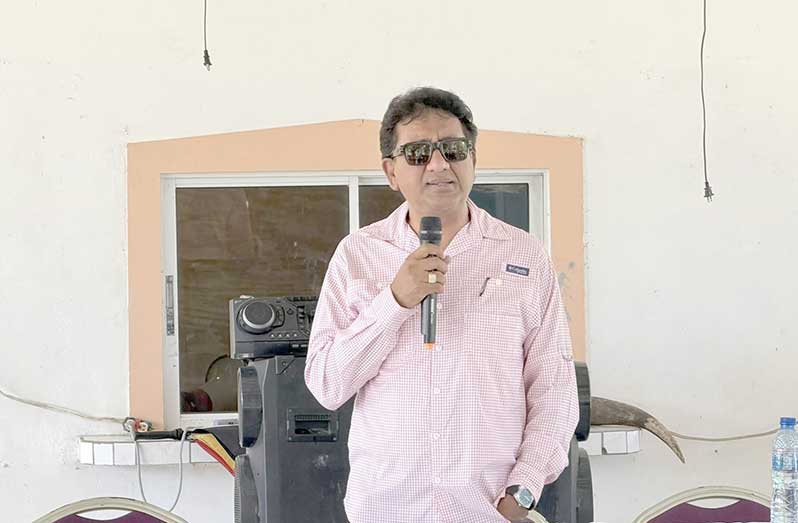
–says direct engagement with citizens remains a cornerstone of PPP/C governance
ATTORNEY-GENERAL and Minister of Legal Affairs Anil Nandlall, SC, has defended the government’s nationwide outreach strategy, describing the recent engagements in Region Seven (Cuyuni-Mazaruni) as a demonstration of representative politics, accountability, and transparency in governance.
Speaking during his weekly programme, Issues in the News, Nandlall contended that the People’s Progressive Party/Civic (PPP/C) administration has maintained a direct connection with citizens by taking government services and decision-makers into communities across the country.
“We believe that we should do so in a direct manner,” Nandlall stated while outlining the philosophy behind the government’s outreach initiatives.
He explained that the government places significant importance on engaging residents in their own communities rather than relying solely on interactions from government offices in Georgetown.
“We believe we should do so by going into the communities, the villages, the towns, the rivers, the creeks and all the areas where Guyanese live and interact with them in those communities,” he said.
According to Nandlall, this approach allows government officials to gain a first-hand understanding of the issues affecting citizens.
“We believe that once we do that, we get a first-hand feel and a first-hand knowledge of the people’s issues, their challenges, their problems, and their concerns,” he noted.
The Attorney-General pointed to the frequency of ministerial visits throughout the country, explaining that Cabinet outreaches are supplemented by regular visits by ministers to communities across Guyana’s 10 administrative regions.
He described the outreach exercises as a long-standing feature of the administration’s governing style.
“These are not isolated events. These are events that occur with regularity. It’s a standard staple of our style of government,” Nandlall stated.
The latest exercise took place over two days, May 31 and June 1, in Region Seven, where members of Cabinet, presidential advisers, parliamentarians, senior technical officers, permanent secretaries and other public officials travelled throughout the region to meet with residents.
Nandlall explained that government representatives visited communities across the region to hear concerns and document issues raised by residents.
“That engagement would have addressed hundreds, if not thousands, of issues raised by residents.”
He noted that every major village, locality and settlement in the region was visited by a member of the government, including President Dr. Irfaan Ali.
As part of the exercise, Nandlall visited the village of Isseneru in the Middle Mazaruni alongside Minister of Amerindian Affairs Sarah Browne, while also engaging residents of Four Miles, Bartica, with Minister within the Ministry of Culture, Youth and Sport, Steven Jacobs.
The Attorney General explained that concerns raised during the outreach were subsequently reviewed by Cabinet during a meeting held on Sunday night and continuing into Monday morning.
According to him, issues documented by ministers and their teams were entered into a central dashboard and examined by Cabinet members.
“Those issues that would have been documented by those ministers and their staff were then entered into a dashboard, reviewed by Cabinet and actioned,” Nandlall explained.
He added that actions were authorised or directed in relation to each issue raised and that many matters were addressed immediately.
The following day, President Ali addressed residents during a community meeting in Bartica, where updates were provided on recommendations, solutions and actions arising from Cabinet’s deliberations.
Reflecting on the initiative, Nandlall argued that the exercise represented a practical example of democratic governance.
“What you saw there over the past two days is representative politics. What you saw there is accountability and transparency in government at work. What you saw there was responsible government. What you saw there was government, the Cabinet, taking governance to the people,” he declared.
Nandlall further asserted that he was unaware of any comparable initiative elsewhere in the Caribbean or Commonwealth where an entire government travels into communities for several days to engage directly with residents and address their concerns.
“I don’t know of a parallel initiative in any part of the Caribbean or any part of the Commonwealth,” he said.
The Attorney-General also rejected suggestions that the administration has become disconnected from its grassroots base.
“So, when they speak about our government not engaging and our government not meeting the people, our government losing its grassroots philosophy, it cannot be true,” he stated.
Looking ahead, Nandlall announced that similar Cabinet outreaches are planned throughout the remainder of the year.
“Every month of this year, we will be going to a different region to execute a similar Cabinet outreach.”
Describing the initiative as an important component of the administration’s governing model, Nandlall maintained that the exercises demonstrate a commitment to citizen engagement beyond traditional government operations.
“That, my friend, is accountable and transparent governance. That is taking government to the people,” he said.




