






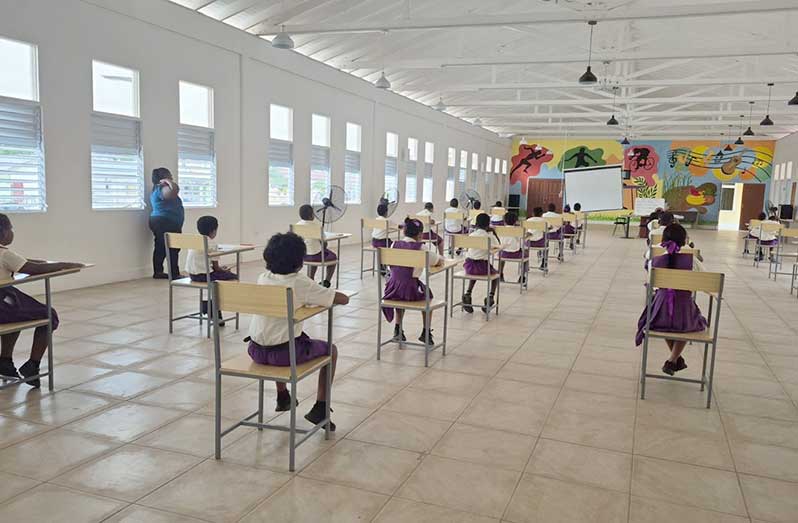
 THE Ministry of Education’s National Literacy Department hosted the National Grades Two and Four Reading Assessments on June 3 and 4, 2026.
The assessments were designed to help the Ministry, schools, and teachers better understand how learners are developing in reading and writing.
According to the Department, the results will help identify learners who may require additional support and guide targeted literacy interventions across the country. The assessment was described as more than a test, serving as a tool to help children become stronger readers.
The Department noted that the assessment was administered as a group-based classroom exercise, with clear and consistent instructions to ensure learners participated in a calm and organised environment.
This approach was used to promote fairness in administration, support standardisation across schools, regions and districts, and provide reliable national data.
For Grade Two learners, examiners read aloud while pupils listened and selected the correct answers in their booklets. Grade Four learners completed examiner-guided tasks as well as independent reading exercises, answering both multiple-choice and written-response questions.
Sir Roger Wong of St. Lawrence Primary School in Region Three said he fully supports the initiative, noting that the assessment examines not only reading but also comprehension and phonetic awareness, among other skills.
“It serves as a guide for the teachers, even parents and even the learners themselves so they can understand areas that need improvement,” he said.
“This assessment, I think, is not just for those reasons which I mentioned, but it also sets the stage for the National Grade Six Assessment because it exposes the children to that kind of environment,” Wong added.

Meanwhile, Esther McCloud of Mahdia Primary School in Region Eight said the initiative would help teachers identify and address learning gaps.
“I think it’s a good initiative because the children will be able to complete an exam, and after that exam, the teachers, after receiving their grades, will be able to assist him or her in whichever area he or she falls back on or needs assistance with,” she said.
McCloud added that parents of Grade One learners who will soon enter Grade Two can begin preparing their children early for the assessment.
In Region Ten, Sarfina Bowling of One Mile Primary School described the assessment as a well-structured exercise.
According to Miss Bowling, “The paper mainly focused on word recognition, rhyming words, listening, and reading comprehension, and some other areas.”
Continuing, she said, “For the pupils it will help them to know their strengths, and it will also help them to know what they need to work on, and our school, as a whole, it will help us the teachers to know our pupils strength, their weaknesses and how we could put them in differentiated groups in our classroom, see who we really need to help, and see who, yes we’re going to help them although they would have done well,”




