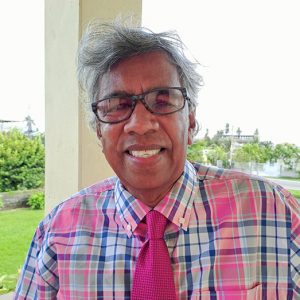
DID you see the interview on the Freddie Kissoon Show with former Cabinet Minister, Joseph Hamilton on Guyana’s 60th year of independence? If you haven’t, then please do, because Mr. Hamilton said he wants the younger generation of Guyanese to know where Guyana came from before it reached 60 years.
There could not have been a wiser saying within the context of Guyana at 60. Guyana has one of the youngest populations in the world. At 60 years of independence, about 90 percent of the population was not born. Give and take a two per cent, that takes you to 88 percent of the present generation that was not born in 1966.
To understand how we arrive at 60, we must know what went on before we ever came close to 40, much less 60. It has been a long journey to 60 and the best person to tell you about that time of travel is someone in the 70s because they have seen it all.
When you are in your seventies and you look back at Independence in Guyana, then that recording of history should be a gift to young people. They don’t know what they have today and they should cherish it. The ride to 60 was almost impossible with twists and turns and deadly boulders in front of you. That how they did not derail you is a miracle.
The journey to 60 should be seen from the perspective of different citizens. There were those in the sugar industry, the public service, the retail trade, the school system, the state medical service, etc. Each person in that realm has a different tale to tell.
For me, it was 26 consecutive years at UG. Before I go there, a few words about the Georgetown Hospital. My mother died there in 1985. There was no attendant to lift her up the stairs. She died because the hospital had neither staff nor resources. Today, at the hospital, a discharged patient is wheeled outside. There are elevators that patients use without having to climb the stairs.
Here is an incident at UG in 1988. Four of us – Compton Saul, Anthony Teixeira and Theo Morris (the last two are dead) – finished teaching one Friday evening. We decided we will go downtown for a lime. We couldn’t find even a third-rate place to sit and chat. We ended up buying coconut water from a vendor at the junction of King Street and Regent Street.
A homeless man was molesting us and I was the one to accost him. It triggered some mad instinct in the man and he picked up a coconut shell and pelted it at us. The shell missed Theo’s head by a court of varnish. They were all annoyed with me for admonishing the homeless man because of the perennial misuse of my worst characteristic – an aggressive big mouth.
Today, university lecturers each have their own cars and patronise modern restaurants in Guyana. When you look at the prices and the daily packed clientele at these places then, the new generation certainly lives in a Guyana that has left the world of Kings Street and Regent Street behind. There is a restaurant today that sells a beef steak for $72,000.
Each one of us in our seventies has a story to tell about the journey to 60 years. I remember when I came back home in 1984, we had to line up at a place named Coop Complex to buy rationed soap, rice, toilet paper. At that time, I lived at Louisa Row and Hadfield Street, two blocks from Cummings Street and Charloltte Street which had a branch of JP Santos supermarket.
One day, I went into that supermarket and it was not half-empty but almost empty except for preserved carambola (five-finger) that made dates and other foreign preserved fruits tasteless. It was produced by a state company managed by Mrs. Burnham, the president’s wife. The carambola line was personally managed by Ms. Vashti Warner.
That was in 1984. A few years ago I asked my wife if she knows what has become of Ms. Warner. My wife worked with Ms. Warner at Guyana Pharmaceutical Corporation (where now stands Marriot Hotel) which housed Quality Foods, which was a state company that produced the carambola. Does anyone know if Ms. Warner is still alive?
Today, look at Guyana at 60. It is a modern country where you can get anything you want and you don’t have to go in the night searching for a restaurant to eat and end up being killed by the blow of a coconut shell. Part 2 is about the tragic remnants of the colonial mind in Guyana 60 years after independence.
DISCLAIMER: The views and opinions expressed in this column are solely those of the author and do not necessarily reflect the official policy or position of the Guyana National Newspapers Limited.