






—projected to eliminate millions of plastic bottles while expanding access to clean drinking water in schools
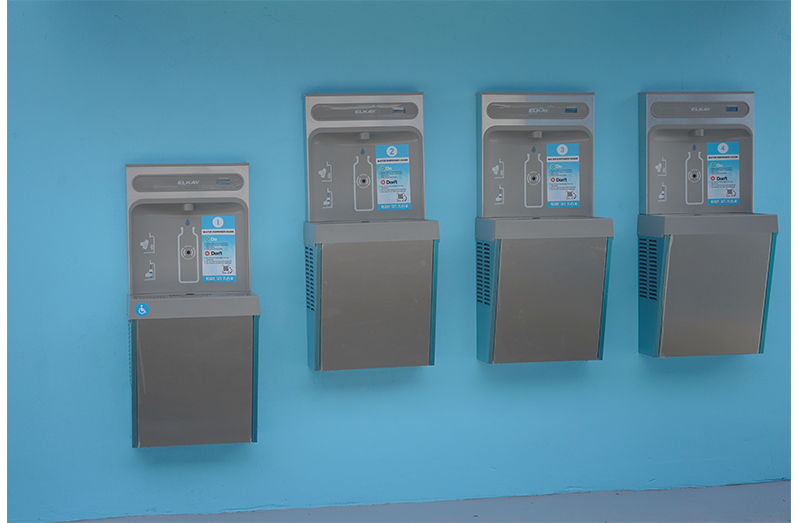
RECOVER Guyana, in partnership with the Greater Guyana Initiative (GGI) and the Ministry of Education, has advanced Project FLOW with the commissioning and handover of 15 water purification systems across secondary schools in Region Three, significantly expanding access to clean drinking water for thousands of students and teachers.
The initiative forms part of Project FLOW, the National Water Purification and Sustainability Initiative, which aims to improve access to safe drinking water in schools while promoting environmental sustainability and reducing plastic waste across Guyana.
With the latest commissioning at Tuschen Secondary School on Friday, Region Three now accounts for 16 completed FLOW sites, including the pilot location at the West Demerara Secondary School.
Approximately 9,519 persons across the region, including 8,692 students and 827 teachers, are expected to directly benefit from the initiative.
By 2030, the project is expected to benefit more than 58,000 students across 141 secondary schools, 10 technical and vocational education training (TVET) institutions and four special needs schools nationwide.
Delivering the feature address, Education Minister, Sonia Parag, said the project aligns closely with the government’s broader vision to improve the quality of education over the next five years.
She noted that with the commissioning of several new secondary schools by the end of 2026, Guyana is expected to achieve universal access to secondary education.
According to Minister Parag, Project FLOW represents the power of partnership, sustainability, innovation and national development.
“Coming to school and accessing that, especially in the rural areas and the hinterland areas, is something new, but something beneficial, highly beneficial for them. So, I see this as having many benefits, not just what it is supposed to be and what we know it to be, but as promoting sustainability and ensuring that our environment is clean, but also providing a very crucial service to our people in their communities,” the minister said.
She added that initiatives such as FLOW are helping to create the kind of environment in which students can thrive.
Founder of Recover Guyana and FLOW Project Lead, Dave Lalltoo, described the initiative as a symbol of opportunity, innovation, sustainability, public health and national progress.
According to Dr Lalltoo, FLOW demonstrates what can be achieved when civil society, the public sector and private sector work together with a shared responsibility toward sustainable development.
Reflecting on the pilot programme at the West Demerara Secondary School, he noted that the institution recorded measurable environmental impact by eliminating more than 65,000 plastic water bottles within nine months.
That success, he said, paved the way for the national expansion of FLOW across Guyana, with the 16 completed sites already representing more than 10.5 per cent of the project’s national target.
Each completed site, he explained, now provides students with reliable access to safe drinking water throughout the school day.
From Patentia Secondary School to Leguan Secondary School, the initiative has already created measurable environmental benefits across Region Three.
It was revealed that the project is projected to eliminate approximately 1,903,800 plastic water bottles annually across the region. Over three years, that figure is expected to rise to an estimated 5,711,400 plastic bottles prevented from entering the environment.
“This projection is based on the combined direct beneficiary population each consuming the equivalent of one bottle of water per school day across an average of just 200 school days annually. Imagine if we created this for 365 days. That’s millions of plastic bottles diverted from drains, trenches, landfills, waterways, communities, and ultimately our ocean,” Dr Lalltoo said.
As of Thursday, a total of 10,315 plastic bottles had already been eliminated through the use of the FLOW systems.
The estimated savings per school stand at approximately $1.82 million annually. Across the 16 schools over a three-year period, the initiative is projected to generate approximately $87.36 million in direct financial savings in Region Three alone.
“With proper management and continued support, the FLOW systems are projected to positively impact schools and communities for a minimum of 15 to 20 years,” Dr Lalltoo said.
“FLOW is not simply about water. FLOW is about human potential. It is about ensuring that no child has to choose between learning and basic dignity. It is about giving thousands of young people across Guyana the opportunity to learn healthier, dream bigger, and believe that their future matters.”




