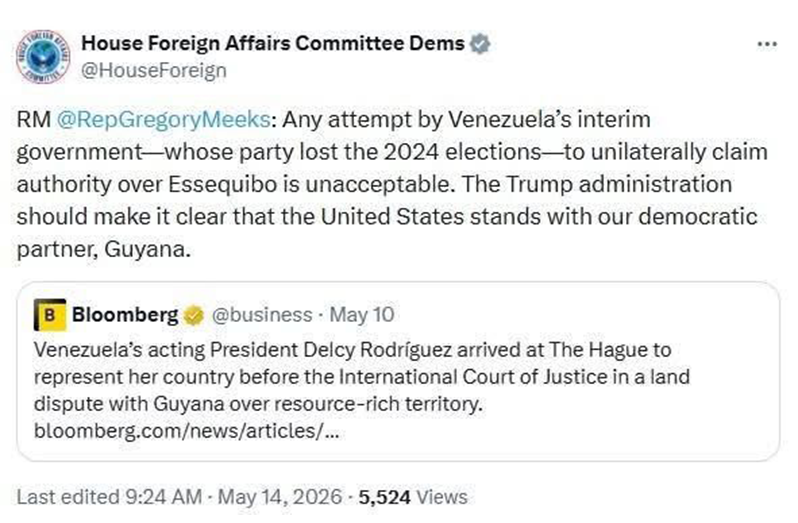
SENIOR United States Congressman Gregory Meeks has publicly urged the Trump administration to take a firm position in support of Guyana amid the ongoing border controversy with Venezuela.
Meeks, the Ranking Member of the House Foreign Affairs Committee and the most senior Democrat on foreign policy in the U.S. House of Representatives, made the remarks in a post on X this week while referencing Venezuela’s latest actions concerning the border controversy before the International Court of Justice (ICJ).
“Any attempt by Venezuela’s interim government — whose party lost the 2024 elections — to unilaterally claim authority over Essequibo is unacceptable,” Meeks stated.
He added: “The Trump administration should make it clear that the United States stands with our democratic partner, Guyana.”
Venezuela’s Interim President Delcy Rodriguez had told the ICJ that Venezuela would not accept an ICJ decision that favours Guyana.
During recent hearings before the ICJ in The Hague concerning the longstanding controversy over the Essequibo region, Guyana argued that Venezuela’s claims to the Essequibo region threaten the country’s territorial integrity, peace and development.
The ICJ had already issued provisional measures ordering Venezuela to refrain from actions that could alter the status quo in the territory while the case remains before the court.
Guyana has repeatedly maintained that it remains committed to a peaceful resolution of the controversy through the rule of law and the ICJ process.
As oral hearings concluded at the ICJ at the Peace Palace in The Hague, Netherlands, earlier this week, Attorney General and Minister of Legal Affairs, Anil Nandlall, described the completion of proceedings as a triumph for international law and the rules-based global order, while warning that any refusal by Venezuela to comply with the court’s eventual ruling would place Caracas in breach of fundamental international obligations.
Guyana argued the award conclusively settled the border more than a century ago, while Venezuela maintains its claim of invalidity.
Importantly, the ICJ has already ruled that it has jurisdiction to hear and determine the matter on its merits. In a December 2020 judgment, the court rejected Venezuela’s challenge to its authority and ruled it has the power to determine the validity of the 1899 award and the land boundary between the two neighbouring states.
According to Nandlall, Guyana entered the hearings confident in its legal position but emerged even more optimistic after presenting its case.