






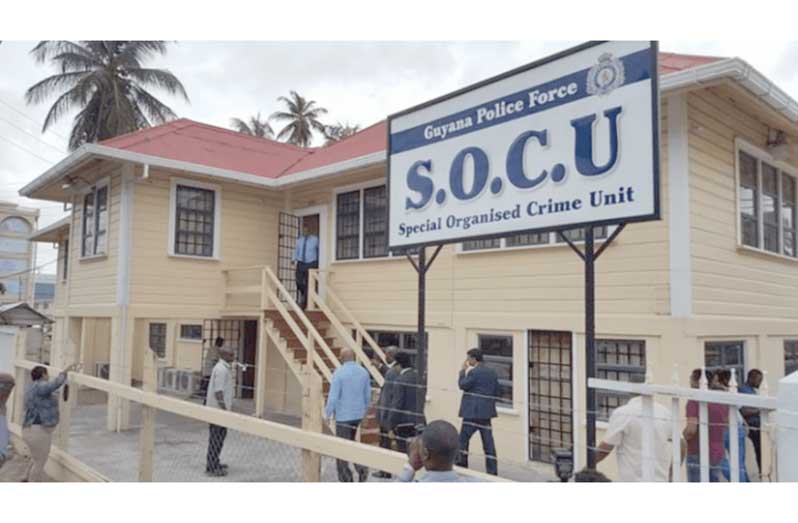
THE Court of Appeal of Guyana has dismissed an attempt by Brazilian businessman Sebastiao De Oliveira and mining company Moura Gago Gold Incorporated to challenge the legal authority of the Special Organised Crime Unit (SOCU) to institute court proceedings under Guyana’s Anti-Money Laundering and Countering the Financing of Terrorism (AML/CFT) Act.
The court ruled that the proposed appeal had no realistic chance of succeeding.
In a judgment delivered on Monday, a three-judge appellate panel comprising Justices of Appeal Dawn Gregory, Jo-Ann Barlow and Rafiq Khan dismissed the Notice of Motion seeking leave to appeal a previous Full Court ruling which found that SOCU has the legal capacity to bring proceedings under the AML/CFT Act.
At the heart of the appeal was whether SOCU possesses the legal personality required to institute proceedings in court for the detention, restraint and forfeiture of property under anti-money laundering laws.
De Oliveira and Moura Gago Gold Inc. had argued that amendments to the AML/CFT Act in 2022 and 2023 did not confer legal personality on SOCU and that, unless an entity is formally established as a body corporate or otherwise clothed with legal standing, it cannot sue or be sued.
The appeal arises from an ongoing legal battle over millions of dollars in gold and cash linked to De Oliveira Moura and Moura Gago Gold Incorporated. At the centre of the matter are 4,018.15 pennyweights of gold valued at approximately $80.9 million, and $81.1 million in cash, which SOCU alleges constitute tainted property connected to suspected money laundering activities.
The assets were initially detained following a February 2024 joint operation involving SOCU, the Ministry of Natural Resources, the Guyana Gold Board and the Guyana Geology and Mines Commission (GGMC).
The High Court later issued detention orders preserving the assets until May 2025. However, former acting Chief Justice Roxane George — who now serves as Acting Chancellor of the Judiciary — subsequently ordered the release of the gold and cash.
Soon after, SOCU instituted five money laundering charges against De Oliveira under the AML/CFT Act. He was subsequently granted bail totalling $1.7 million in connection with the allegations.
Although the assets were returned in November 2025, the agency later re-seized the gold and cash, arguing they were at risk of dissipation and required as evidence in the ongoing criminal proceedings.
More recently, acting Chief Justice Navindra Singh granted SOCU fresh detention orders under Section 37A of the AML/CFT Act, finding the agency had set out “cogent evidence” and demonstrated “reasonable grounds” to justify continued seizure of the property as part of an ongoing money laundering investigation.

In opposing the latest appeal, SOCU argued there was “no real prospect of success,” contending that amendments to the legislation — particularly Sections 39 and 109A of the AML/CFT Act — expressly identify SOCU as a “relevant Competent Authority” and provide the statutory basis for it to engage the courts in matters prescribed under the law. SOCU further argued the issue had become largely academic because the original detention proceedings were no longer before the court. The appellate court agreed.
“Having considered the material placed before the court, the applicants have not satisfied us that they have met the threshold for the grant of leave to appeal,” the judges ruled.
Under Section 6(4) of the Court of Appeal Act, leave must first be obtained before appealing a decision of the Full Court arising out of summary proceedings, and such leave is only granted where an intended appeal has a “realistic prospect of success.” The court noted that a “fanciful appeal” does not meet that legal threshold.
The judges endorsed the earlier reasoning of the Full Court, which overturned a High Court finding that SOCU lacked legal personality to institute proceedings.
The Full Court had ruled that the AML/CFT Act expressly assigns SOCU functions involving the “restraining, seizing, detaining and forfeiting of tainted property” and that it would be “illogical” to conclude Parliament intended for the agency to carry out those responsibilities while denying it the procedural means to approach the courts.
The Court of Appeal held: “In light of the express statutory designation of SOCU as a Relevant Competent Authority, combined with the statutory power to apply for restraining orders and its mandate to restrain and seize tainted property, this court finds that SOCU does possess significant legal capacity under the AML/CFT Act to institute proceedings for the restraint and detention of property. Formal incorporation is not required. Parliament has, by necessary implication arising from its statutory function, conferred the requisite legal standing.”
The appellate panel also agreed with the Full Court’s reliance on the Jamaican case of Andrew Hamilton v Assets Recovery Agency, which found that statutory agencies do not need formal corporate status to initiate proceedings where legislation expressly authorises them to act.
Ultimately, the Court of Appeal dismissed the application for leave to appeal and made no order as to costs.




