–says Venezuela’s actions against Essequibo are ‘redolent of colonialism’
–insists the 1899 Arbitral Award remains the ‘full, perfect and final settlement’ of boundary between the two nations
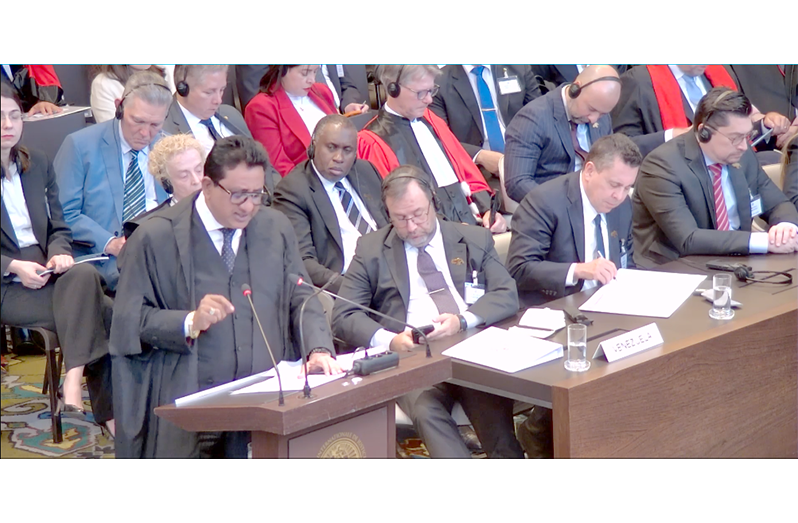
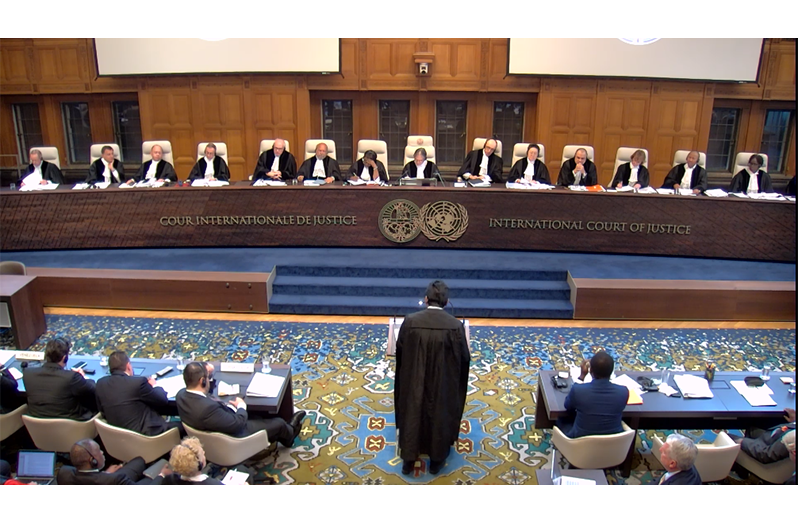
ATTORNEY General and Minister of Legal Affairs Anil Nandlall, SC, on Friday delivered an emotional and forceful closing rebuttal before the International Court of Justice (ICJ), warning that Guyana’s future as a sovereign nation depends on a clear and definitive judgment affirming the validity of the 1899 Arbitral Award issued in Paris, France.
Addressing the judges at the close of Guyana’s rebuttal in the historic Essequibo border controversy case, Nandlall described the proceedings as one of immense national importance, stressing that Venezuela’s claim to more than 70 per cent of Guyana’s territory has overshadowed the country’s existence since independence.
Nandlall told the court, “For more than 60 years, Venezuela has laid claim to more than 70 per cent of Guyana’s sovereign territory.
“Generations of Guyanese, mine being one of them, have grown up under the long and threatening shadow caused by Venezuela’s claim to nearly three-quarters of our country.”
The Attorney General said the territorial controversy has deeply affected Guyana’s development, security and national well-being for decades.
“Venezuela’s claim has blighted, bedevilled, and burdened Guyana for the entirety of its life as a sovereign state,” he said.
Nandlall warned that the consequences of losing the Essequibo region would be catastrophic for Guyana.
“The loss of the territory claimed by Venezuela would eviscerate Guyana. Indeed, the country as we know it would cease to exist,” he declared.
According to him, the case before the ICJ is, therefore, not merely a legal dispute but an existential issue for the Guyanese people.
“Guyana’s Foreign Minister [Hugh Todd] was not exaggerating when he described this case as having an existential quality for Guyana,” he told the judges.
“For Guyana and its people, the stakes could scarcely be higher.”
Despite the enormous stakes involved, the Attorney General stressed that Guyana chose to place its trust in international law and the international judicial system when it approached the World Court in 2018.
Guyana is asking the ICJ to confirm the validity of the 1899 Arbitral Award, which legally established the land boundary between then British Guiana and Venezuela.
The award emerged from an international arbitration process established under the 1897 Treaty of Washington after Venezuela and Great Britain had agreed to submit the boundary controversy to arbitration.
Nandlall told the court Guyana’s faith in international law remains unwavering.
He said, “As Attorney General of Guyana, I can personally attest to Guyana’s profound commitment to the rule of international law.
“It is a commitment which runs deep in Guyana’s institutions and national culture. It is both an article of faith and a source of national pride.”
He added that Guyana views international law as essential to maintaining peace and stability among nations.
“It is founded on a firm conviction that international law is the bedrock of the international order and the indispensable foundation for peaceful relations between all states,” Nandlall stated.
“From Guyana’s perspective, there is no higher value or greater imperative than respect for international law.”
THREE SPECIFIC AREAS
The Attorney General said Guyana approached the court in 2018 with confidence in three specific areas: the validity of the 1899 Arbitral Award, the United Nations Secretary-General’s decision to refer the matter to the ICJ and the court’s ability to fairly and impartially determine the controversy.
“First, Guyana had unwavering confidence in the correctness of its decision regarding the validity of the 1899 award and the boundary which it determined.
“Second, Guyana was equally confident in the wisdom of the decision of the Secretary-General of the United Nations that the court should be entrusted with resolving this intractable controversy.
“Third, Guyana had complete confidence in the independence and impartiality of the court, and its ability to deliver a just outcome based on the fair-minded and even-handed application of international law,” Nandlall said.
He underscored that the proceedings over the last eight years have vindicated Guyana’s confidence in the court.
“Since Guyana filed its application eight years ago, these proceedings have vindicated and reinforced Guyana’s confidence in each of those things,” he told the judges.
He praised the ICJ for conducting the case with fairness and diligence.
“At every stage, the court has conducted the proceedings with conspicuous care, attentiveness and fairness,” he said.
Nandlall said: “The court has carefully considered and confirmed its jurisdiction to entertain Guyana’s application and it has carefully considered and confirmed the admissibility of that application.”
The Attorney General said Guyana remains confident that the court will now move on to determine the merits of the case concerning the validity of the 1899 Arbitral Award and the land boundary established by it.
At the same time, he accused Venezuela of consistently attempting to prevent the court from ruling on the substantive issues.
“Since the start of these proceedings, Venezuela has strained every sinew to avoid the court delivering a judgment on the merits of Guyana’s application,” Nandlall asserted.
“These strenuous efforts have even continued throughout this hearing on the merits.”
According to him, Venezuela has repeatedly attempted to argue that the 1966 Geneva Agreement prevents the court from ruling on the validity of the 1899 Arbitral Award.
However, Nandlall said Guyana’s legal team demonstrated that those arguments are unsupported by the agreement itself, its historical context, and Venezuela’s own previous positions before the court.
“Guyana’s counsel have demonstrated the lack of merit in those arguments, which find no support in the text or the history of the Geneva Agreement and which are contradicted by Venezuela’s previous statements to the court,” he said.
“It is not hard to see why Venezuela is so reluctant for the court to determine the merits of Guyana’s application.”
Nandlall argued that Venezuela understands that a ruling on the merits would effectively end its territorial claim to almost 160,000 square kilometres of Guyana’s territory.
“Venezuela knows that it has no good answer to Guyana’s case and it knows that a judgment on the merits should bring to an end Venezuela’s claims to almost 160,000 square kilometres of Guyana’s territory,” he submitted.
STRONG DEFENCE
The Attorney General also strongly defended the validity of the 1897 Treaty of Washington and the 1899 Award itself.
“In its written and oral pleadings, Guyana has convincingly demonstrated that Venezuela’s attempt to impugn the validity of the 1897 Treaty of Washington has no merit whatsoever,” he said, adding: “Venezuela was neither deceived nor coerced into signing the treaty.”
“On the contrary, the treaty achieved what for years Venezuela had desired and demanded, the submission of its boundary dispute with Great Britain to international arbitration,” he said.
Nandlall further rejected Venezuela’s attacks on the arbitral tribunal itself.
“The arbitral tribunal faithfully fulfilled the mandate conferred by the 1897 Treaty,” Nandlall stated.
“Neither the terms of the award nor the way it was reached involved any excess of power or impropriety by the eminent members of the tribunal,” the Attorney General said.
Nandlall related that Guyana’s case also demonstrated that Venezuela knew about all the matters it now claims invalidated the award at the very time the award was issued in 1899.
Yet, according to him, Venezuela respected and affirmed the award for decades afterward.
He said, “Yet, for more than 60 years after 1899, Venezuela respected, asserted and affirmed the validity of the award.
“As Guyana has shown at this hearing, Venezuela has no credible answer to any of this. In short, the award was and remains valid and binding on the parties,” Nandlall emphasised.
The Attorney General noted that the 1897 Treaty itself described the award as “the full, perfect and final settlement of the boundary between Venezuela and Guyana.”
Nandlall also addressed what he described as Venezuela’s ironic attempt to invoke decolonisation principles in support of its case.
“…Venezuela’s attempt to invoke the law of decolonisation to support its case is legally unfounded,” he said, adding: “But it is also ironic, because Venezuela’s sudden repudiation of the 1899 award in the 1960s, just as the process of Guyana’s decolonisation was underway, impeded and delayed Guyana’s progress towards independence by several years.”
He accused Venezuela of behaving in a manner that mirrors the very colonial conduct it criticises.
“In the years since Guyana attained independence in 1966, Venezuela has acted in a way that has striking echoes of the imperial colonialists whom it rightly denounces,” Nandlall declared.
The Attorney General outlined what he described as repeated violations of Guyana’s sovereignty over the Essequibo region.
“As Guyana has explained, both in its written and oral pleadings, since 1966, Venezuela has repeatedly denied and violated Guyana’s sovereignty over its Essequibo region,” he said.
He pointed specifically to Venezuela’s occupation of Ankoko Island and repeated military incursions into Guyanese territory.
“Venezuela has invaded and illegally occupied Guyana’s territory on Ankoko Islands for six decades. It has conducted numerous other military incursions into Guyana’s land and maritime territory, incursions which are intended to menace and intimidate Guyana and its people.”
VENEZUELA’S OPEN DEFIANCE OF ICJ ORDERS
Nandlall also criticised Venezuela’s recent actions during the pendency of the ICJ proceedings, accusing Caracas of openly defying provisional measures orders issued by the court.
“During the pendency of these proceedings, and in contumacious defiance of this court’s provisional measures orders, Venezuela has enacted legislation which purports to incorporate our Essequibo region as a new Venezuelan state,” he noted.
Nandlall further said that Venezuela has sought to place the region under the jurisdiction of its legislative, executive and judicial organs, and has even depicted the territory as part of Venezuela on official maps.
According to Nandlall, Venezuela has also attempted to rewrite the region’s history.
“Venezuela has also sought to rename the territory as Guyana Esequiba,” he said.
“It has even falsely claimed at this hearing that the Essequibo River was named after a Spanish explorer.”
Nandlall corrected the assertion, explaining that the river’s name originates from the indigenous word “dishikibo,” meaning fireside.
“The name of the Essequibo River is in fact derived from an indigenous word, dishikibo, meaning fireside, which was later adopted by the Dutch and the British,” he explained.
Nandlall described Venezuela’s conduct as deeply troubling.
“Venezuela’s attempts to annex its smaller neighbour’s territory, its attempts to erase and rewrite the history of Guyana’s Essequibo region, and its innumerable bellicose threats to Guyana’s sovereignty and territorial integrity are all redolent of colonialism,” Nandlall declared.
As he concluded his presentation, the Attorney General stressed that the wording of the court’s eventual judgment would be critically important.
“The judgment that you deliver in this case will be of exceptional importance to Guyana,” he told the judges.
“It is not simply the outcome of the judgment that will be important. The terms of the judgment will be equally crucial.”
Nandlall urged the court to issue a ruling that leaves no uncertainty regarding the validity of the 1899 Arbitral Award and the boundary it established.
“If the court accepts Guyana’s arguments, as we are confident that it will, then it is essential that the court’s judgment directly, explicitly and unambiguously affirms the validity of the 1899 award in its integrity and the boundary which it established,” he said.
He cautioned that any lack of clarity could be used by Venezuela to prolong the controversy.
“Any ambiguity in the court’s judgment will inevitably be seized upon by Venezuela as a basis for continuing to lay claim to vast swathes of Guyana’s sovereign territory,” the Attorney General cautioned, noting: “The clarity and specificity of your judgment are vital to the effective resolution of this longstanding dispute.”
A final ruling from the ICJ is expected later this year, according to Guyana’s Ministry of Foreign Affairs and International Co-operation.