





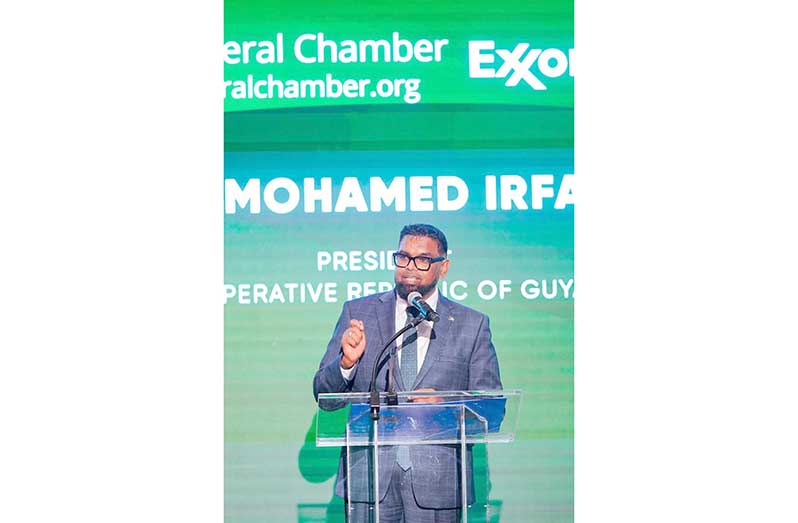
PRESIDENT Dr. Irfaan Ali has emphasised that true national prosperity depends not only on natural resources, but also on how effectively countries invest in people, partnerships and long-term development strategies.
After receiving the Visionary Leadership Award from the Bilateral Chambers of Commerce in Houston, Texas, in recognition of his transformative vision and leadership in advancing Guyana’s economic development, Dr. Ali delivered remarks outlining his vision for the country’s future.
“I receive this Visionary Leadership Award not as a trophy to be displayed, but as a mirror—one that reflects not merely my own efforts, but the collective vision of every colleague, mentor, and every citizen who was there to work towards a brighter horizon for our nation,” he said.
He also emphasised the importance of strong partnerships in driving shared prosperity.
Addressing the gathering, President Ali said economic growth must translate into real improvements in people’s lives, rather than remain confined to statistics or macroeconomic indicators.
“Oil and minerals are gifts of the earth. Prosperity is a gift we give ourselves,” he said.
He related that development should be understood through tangible outcomes, such as improved living standards, access to education and healthcare, and opportunities for upward mobility.
President Ali added: “It is found in real-life examples. It is found in a child whose need for nourishment is satisfied; in a classroom built to nurture minds and impart knowledge; in a health clinic equipped and stocked with medicines that support healing; and in a family lifted from the margins of poverty to the mainstream of dignity.”
He highlighted the importance of partnerships in achieving these outcomes, noting that collaboration between governments, private sector actors and institutions plays a critical role in driving growth.
“When a bilateral chamber facilitates an investment flow, it does more than move money; it moves possibility. When it forges a strategic alliance, it does more than sign a memorandum; it writes a chapter of shared prosperity.
“Nowhere is this more evident than in our own beloved Guyana, where it is said that our golden years are now before us,” he reasoned.
President Ali also underscored the value of strong international relationships, particularly with the United States, pointing to its role in supporting Guyana during a critical political period.
The Head of State reminded that during the first term of Donald Trump, Guyana faced a significant internal threat to the rule of law and democracy after elections, when the losing party, A Partnership for National Unity + Alliance for Change coalition (APNU+AFC), refused to concede.
“And it was the United States, under then-Secretary of State Mike Pompeo, that stood up and ensured that the rule of law and democracy prevailed. Otherwise, none of this would have been possible,” Dr. Ali said.
According to the Head of State, democracy and the rule of law form the foundation for sustainable development.
“Any system that is built without those pillars… is a system of failure,” he said.
The President outlined Guyana’s development strategy, which includes significant investment in human capital.
He noted that, “The greatest investment we are making is in human capital; the development of our human capital, upskilling people, creating opportunities, diversifying the economy, and building resilience and sustainability in everything we do.”
According to him, this includes future-proofing the economy through investment in technology, sustainability, security, and politics.
He said this approach is aimed at building a more resilient and diversified economy, capable of withstanding both internal and external shocks.
President Ali also pointed to investments in technology, sustainability and security as key components of future-proofing the country’s economy.
In addition to energy, he said Guyana is positioning itself as a leader in food security, environmental services and biodiversity.
He highlighted the country’s extensive forest cover and low deforestation rate as examples of its environmental stewardship.
ENVIRONMENTAL STEWARDSHIP
“We have shown what true environmental stewardship looks like, feels like, and in policy. That is why today our forest stores 19.5 gigatons of carbon, has one of the lowest deforestation rates in the world, and one of the highest levels of forest cover in the world,” he stated.
He also pointed to Guyana’s agricultural potential, citing its arable land and freshwater resources as key assets in becoming a regional food producer.
Dr. Ali referenced emerging sectors such as biodiversity services and cultural industries, noting their potential to contribute to economic growth and diversification.
Importantly, he stressed that development must be inclusive, with opportunities extended beyond large corporations.
“We must always reach for the opportunities for the small and medium-sized enterprises,” he said.
He encouraged international partners to support smaller businesses and ensure broader participation in economic growth.
Dr. Ali also addressed the importance of resilience and perseverance, particularly in a changing global environment.
“This is not the time to quit. This is not the time to lose faith. This is a time to be strengthened in faith and purposeful in our endeavours. Development is a poetry that follows the prose of trade agreements and joint ventures,” he emphasised.
He reinforced this message with a familiar phrase: “Winners never quit and quitters never win.”
Reflecting on Guyana’s future, Ali expressed confidence in the country’s trajectory, noting: “Our golden years are now before us.”
He added that continued effort and sound policy decisions will be essential.
Dr. Ali, however, cautioned against relying solely on natural resources, reiterating that sustainable prosperity depends on deliberate action and strategic planning.
In closing, the President emphasised the collective nature of development and leadership.
He reaffirmed Guyana’s commitment to working with global partners to build a sustainable and inclusive future, positioning the country as an active contributor to regional and global development.





