






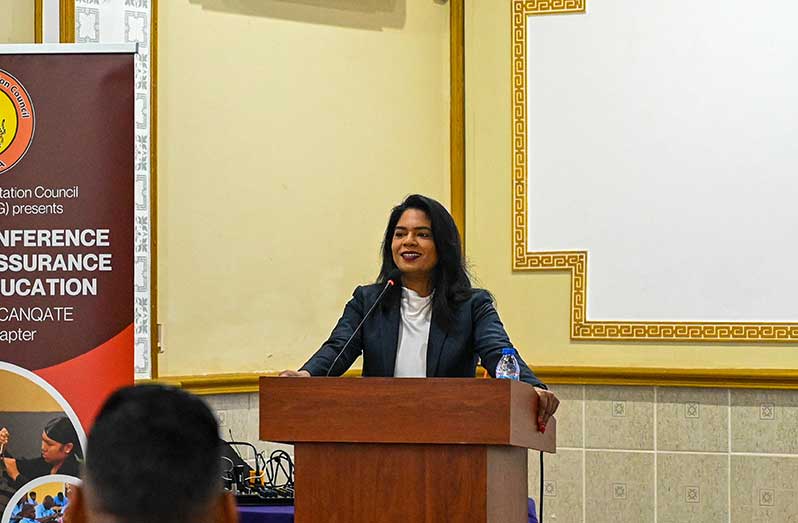
MINISTER of Education Sonia Parag recently stated that Guyana has to be that country that every other country in the Caribbean region is looking to as the model for education, asserting that in every sector, education and skills training play a vital role.
She also announced that, in another five years, there will be an unlimited number of scholarships being offered to Guyanese through the Guyana Online Academy of Learning (GOAL) platform.
These announcements were made on Monday, as the Minister highlighted advancements in education locally.
Minister Parag said that there are now more than 26 universities from around the world and hundreds of programmes that are on the GOAL platform. These, she said, range from technical skills to doctorate degrees, diplomas, bachelor’s degrees and master’s degrees.
She disclosed that, in the last five years, there were limited funds and a limit on the number of scholarships offered. Highlighting the massive expansion of GOAL, the Minister recalled the promise made by the government to deliver 20,000 scholarships in the first term. This number was doubled, with 40,000 or 41,000 scholarships delivered in that time.
“It is now, in the next five years, going to be unlimited scholarships to guide these. An unlimited amount of scholarships, which is a fantastic thing,” she expressed.
Aside from this, the minister mentioned the fact that many persons are working in an environment where artificial intelligence is an important component. “How do we produce critical thinkers, look at institutions that will be teaching our students, or look at STEM education?” she asked.
“How do we produce problem solvers in a world where AI is the first thing a student will go to when they want to answer a question?” she further asked adding, “It is all of these things that have to align. For example, we are now talking with the Caribbean Examinations Council, or CXC as you know it, about AI checkers. How do we know that we are producing students that will be globally competitive, that will be analytical in thinking?”.
Additionally, she looked at a wider issue of how they improve technical and vocational skills that will place students who do not want to be academic in a position of sustainable development and growth within our communities.




