






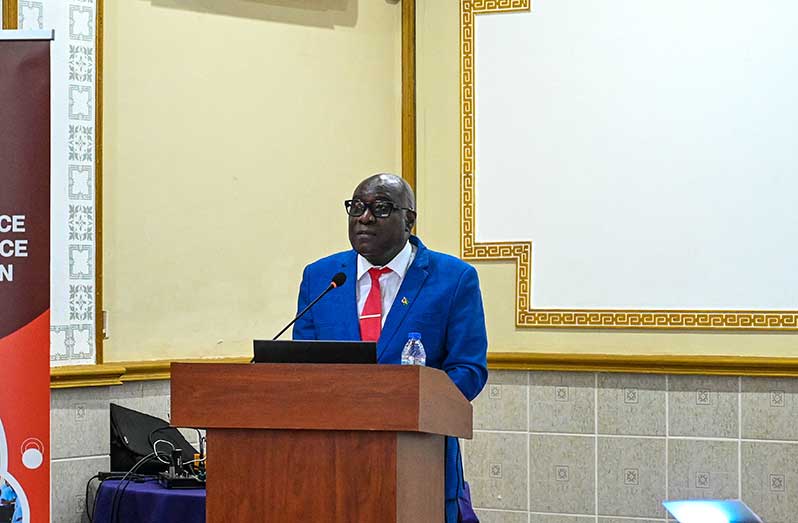
THE National Accreditation Council of Guyana (NAC-G) recently hosted the launch of the Caribbean Area Network for Quality Assurance in Tertiary Education (CANQATE) Guyana Chapter, under the theme, ‘Assuring Quality in a Time of Expansion: Access, Equity, and Standards for a Growing Tertiary Sector.’
The CANQATE launch signalled the start of a two-day conference focused on advancing quality tertiary education in Guyana, which is aligned with a few objectives: to unite Guyanese stakeholders around the shared vision of quality in higher education and training, support the development of internal quality cultures across institutions, strengthen the role of accreditation as a national trust mechanism, and the launch of the Guyana Chapter of CANQATE as a platform for continued capacity building.
Additionally, this also positions Guyana as a credible and standards-driven participant in the regional quality assurance landscape. The timing of CANQATE’s launch is intentional as Guyana builds and transforms its tertiary education landscape.
Delivering a featured address, Minister of Education Sonia Parag said that over the last five years, the government has invested heavily in infrastructural development and education. This means more than the construction of buildings, but also ensuring that opportunities are created, along with access to those opportunities.
She noted that while all of this has been done, the future of education is based on quality and improving the quality of education across Guyana, whether at a nursey, primary, secondary or tertiary level.
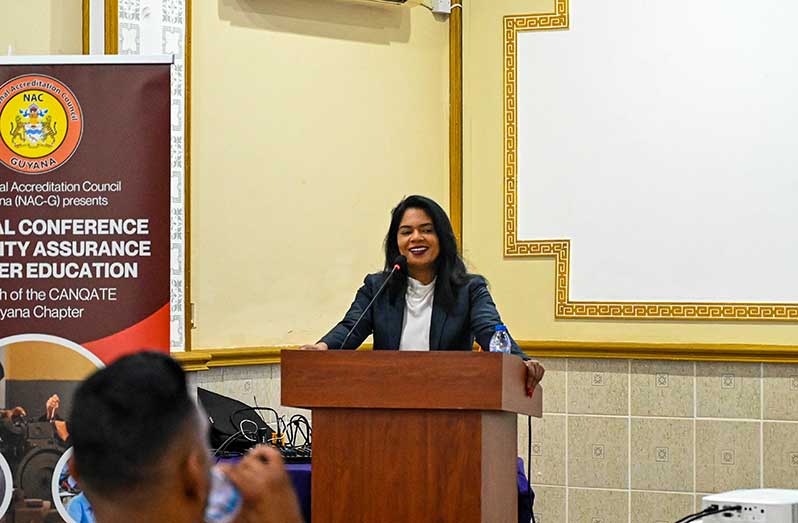
The minister remarked further that when we are looking to accredit an institution, we must not only look at the academic quality, but also what they bring to our social development as well.
She told attendees that as stakeholders that are integrally involved in the development of education, they need to ask how they can make higher education, and the quality of higher education improve.
She asked, “You have to look at when you are going to accredit an institution, how is it going to align to your developmental agenda in your country? How is it going to align in what exists now, but also what will exist 10 years from now, 20 years from now, 30 years from now? What are the skills that we will need? What is the quality of the education that we need to improve on? And how do we make our people, while they are gaining their skills, how do we make them globally competitive?”
Minister Parag pointed out that curriculum reform is very important to improving the quality of education, along with technology.
The minister mentioned the Guyana Digital School, which was rolled out within the first 100 days of President Dr Irfaan Ali’s second term. She stated that the school not only provides secondary students with their curriculum and content through this platform, but the Digital School ensures that in event there is another pandemic, like COVID-19, there is a system in place already for distance learning to take place.
Meanwhile, Executive Director of the NAC-G, Dr Marcel Hutson said that if left unattended, the growth being experienced does not guarantee progress. He stated that this is not a question of whether we are growing, but if our growth is grounded in integrity, guided on purpose, and reflected in quality.
In his remarks, he noted that quality assurance must be understood not as a bureaucratic exercise, but as a national ethic. Dr Hutson described it as quite a force that gives meaning to access, credibility, certification, and confidence in the public.
Without it, opportunity becomes uncertain and achievement becomes questionable, he said, adding that the work before us is moral, intellectual, and deeply national.
“Guyana stands at the threshold of becoming a significant educational presence within the Caribbean and beyond. Our investment in government scholarships, technical education, and emerging sectors signal ambition. But ambition must be matched with discipline. Access must be matched with standards; and inclusion must be matched with excellence,” he said.




