






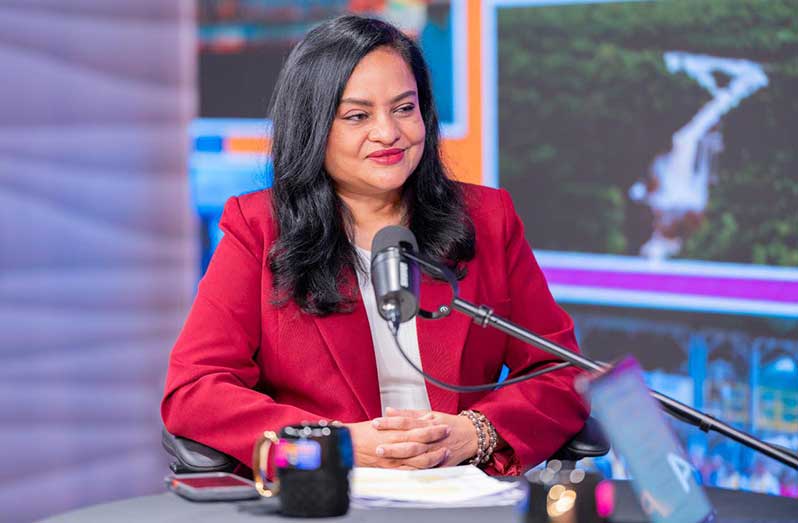
THE Ministry of Human Services and Social Security is prioritising the comprehensive development of robust, transparent, and accountable systems, Minister Dr Vindhya Persaud affirmed on Sunday, highlighting an ‘ambitious’ plan that builds on reforms achieved over the past five years.
During an interview on the most recent episode of the ‘Starting Point’ podcast, she said the focus is on strengthening systems, expanding social protection, and deepening empowerment programmes across Guyana.
This is occurring as the ministry moves to consolidate key reforms in its second-term priorities. At the heart of this push, Minister Persaud outlined a focus on building robust, transparent, and accountable systems to improve delivery for vulnerable groups, including pensioners, persons living with disabilities, and low-income households.
Citing the major aims of the ministry as ambitious, Minister Persaud noted that comprehensively developing robust, transparent, and accountable systems require relearning and repositioning within the ministry and sector at large.
“I believe in strengthening systems overall. So, I have been focused on having robust, transparent, and accountable systems. Now, this is an ambitious challenge because it is relearning, it is reshaping, and it is in doing that to strengthen systems that would have been put in place in the last five years or to build on that,” she said. Moreover, accountability and evaluation within these systems are also important, as she added: “It is also making sure that the persons who have the responsibility to ensure all of this happen within the construct of what I said that they are aware of the serious nature of their responsibilities. So, it goes without saying, monitoring and evaluation and impact analysis are also very critical.”
Minister Persaud shared that the aim also involves work to build on the systems and milestones already achieved, to ensure that the beneficiaries of these systems, primarily vulnerable groups, can continue to benefit and achieve a state of independence.
This is where the ministry’s empowerment programmes are important, Minister Persaud said, adding that these initiatives could be a powerful driving force for vulnerable groups such as single mothers.
“I want to intensify this because I believe that with our country moving at the rate that it is, we need to ensure that people understand that there is space for them to be financially independent, economically empowered, and to have a really strong role in Guyana’s development,” she said, adding, “They must see themselves like that. And so, it is creating that ecosystem around these populations to give them that opportunity to be there.”
Moving ahead, another major area of priority will be the strengthening of the country’s childcare system. As Minister Persaud shared, her first two years leading the ministry highlighted major issues in this regard.
She further explained that the last five years have seen the ministry assess policies and implement programmes, adding that the goal was to create a structured approach and response.
“What would have happened in the last five years would have been to look at policies and to look at programmes. We had practice, but not a lot of documented policies. So, it was working on that to create that kind of structured approach and that kind of measurable approach to understand how we were doing,” she said.
Reflecting on the last six months, Minister Persaud said the ministry has worked to build out the care economy, a project outlined by President, Dr Irfaan Ali, and one that she says is very close to her heart.
The minister said that the development of the care economy will allow more mothers to join the workforce, while ensuring good, structured care for the nation’s children. “I think it will be dismantling a structural barrier that for a long time would have prevented women especially from entering the labour force and from really moving to that state of independence, but at the same time providing much-needed care and support for children,” she said.
At the same time, Minister Persaud noted that steps are also being taken in working with boys and men to bridge the gap caused by gender-based violence. “We are also looking at working with men and boys in particular and really tackling and closing the gap when it comes to our roadmap on addressing gender-based violence,” she added.
However, beyond childcare, Minister Persaud said that child protection is also a vital point of focus of the ministry.
She explained that the issue of efficiency and impact requires the implementation of stronger response systems.
Last year, the ministry launched its rapid response programme. However, she noted that there are still some limitations within the system, such as the lack of child protection officers. While noting that the lack of officers creates major hurdles, she noted that the ministry is focused on bolstering its response system and creating a tracking system, adding, “It is looking at that rapid response. It’s also looking at creating a digital tracking system. We have started that process, and we will be improving on it this year and next year, so that every case that comes to our attention is tracked.”
A further development in the child-protection pipeline is the planned establishment of a dedicated Forensic Interview (FI) unit.
“We are moving to have our own FI unit pretty soon as a state, to be able to have better access and faster resolution of these things,” Minister Persaud shared.
She further clarified that once a forensic interview is completed, the case file is transferred directly to the police and the Director of Public Prosecutions (DPP), rather than remain with Child Protection Agency. This streamlined process, she emphasised, is just one of many steps designed to ensure greater legal action and swifter accountability, marking a significant step forward in the ministry’s efforts to deliver timely justice and comprehensive protection for the country’s children.




