






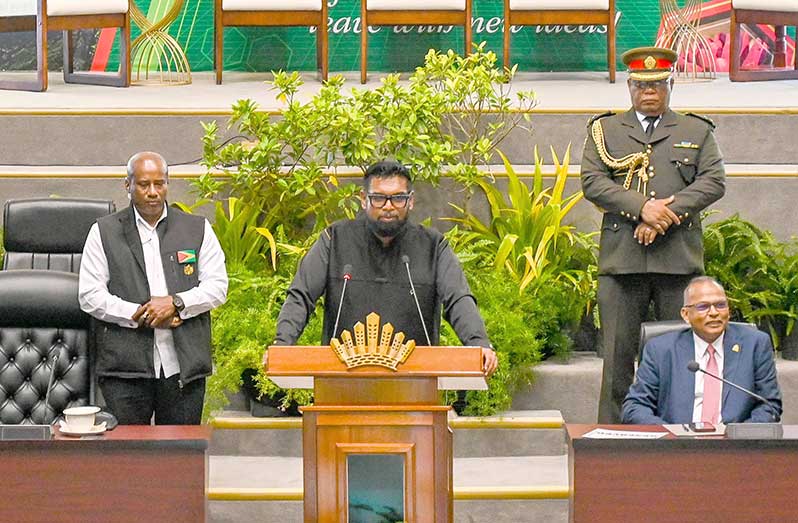
– President Ali says as CARPHA conference highlights innovation, collaboration
By Shaniya Harding
GUYANA is working towards defining itself as a regional leader in digital healthcare, with President Dr. Irfaan Ali signalling that the nation is ready to take up the mantle of regional leadership through the creation of a telemedicine hub.
Speaking at the opening of the 70th Annual Health Research Conference hosted by the Caribbean Public Health Agency (CARPHA) at the Arthur Chung Conference Centre, the Head of State addressed hundreds of healthcare leaders and stakeholders from across the region, calling for stronger Caribbean collaboration and faster adoption of innovation in healthcare systems.
He underscored that while the region is not short on ideas or technology, the real challenge lies in building the systems, regulations, and human capacity needed to scale solutions such as telemedicine, artificial intelligence, and digital diagnostics across member states.
The landmark conference, celebrated under the theme, ‘Innovations in Health’, brings together regional and international health leaders to examine how innovation and data can strengthen public health systems, with a focus on improving coordination and response across the Caribbean.
Giving the feature address, President Ali highlighted that Guyana is working towards building a “world-class health people system,” going beyond just healthcare.
Highlighting the recent achievements Guyana has seen in the development and implementation of digitisation, the President said Guyana was able to leverage telemedicine because of its geographic realities. This step, he explained, has been significantly successful for Guyana, highlighting major strides in the reduction in the need for medical evacuation and greater access to specialist staff in the hinterland.
Looking beyond local strides, however, the Head of State shared that the next step is to take these successes outside of the country and implement them at the regional level.
Highlighting the success that Guyana has had at the national level, President Ali emphasised that Guyana is ready to invest in the region.
As he stated, “We are ready to deploy this investment for the rest of the region. We are ready to partner with the rest of the region in creating a telemedicine hub here in Guyana to support the rest of the region. Whether it is for clinical care, research, or educational purposes,” he said.
He shared survey findings from the conference, highlighting that the main priorities for modern healthcare are improved patient access, better health outcomes, and greater efficiency. Moreover, the President highlighted the finding of gaps as among the main priorities for the conference. The President noted that while the world has advanced in the areas of AI, telemedicine, and data systems, the real issue is not a lack of ideas but weak systems to implement, scale, and sustain innovation. Giving a detailed overview of where Guyana stands in its development of the health sector, President Ali shared that there are a number of challenges facing both Guyana and the region. He said the first challenge he noted is scaling innovation, noting that many successful pilot projects never expand due to weak systems.
He pointed out that the Caribbean has the potential to be a global testing ground for new technologies. Citing the recent successes of local pilots, the Head of State shared that, “The persistent difficulty of moving from pilot projects to population-wide systems across low, middle, and even high-income countries is a problem. There is no shortage of successful demonstrations,” he added, “Telemedicine pilots that improve access in remote communities. Mobile health applications that improve adherence. AI tools that enhance diagnostic accuracy. And community-based diagnostic innovations that bring care closer to patients,” he said. Innovation now, the President noted, depends on governance, infrastructure, financing, workforce capacity, and public trust, not just invention.
The digital divide is also an area that the Head of State pinpointed, explaining that digital transformation requires connectivity, trained personnel, data systems, and integration across sectors, not just devices and software. He emphasised that healthcare digitisation must be linked to broader systems, adding, “Digital transformation is often presented as a technological leap forward. But in reality, it depends on much more than devices and software. It requires reliable connectivity, interoperable data systems, training personnel, organisational readiness, and regulatory coherence,” moreover, he added that in many settings, these foundations are unevenly distributed and lack personnel who are trained in data analysis.
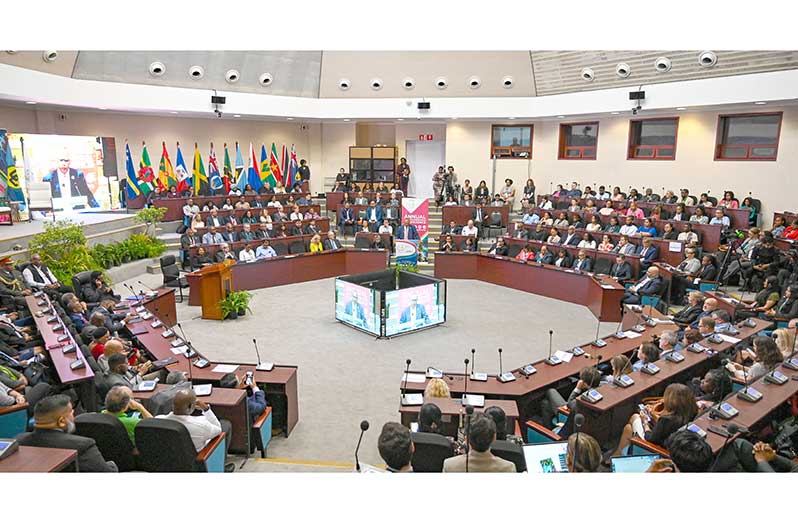
Further delivering an insightful address, the Head of State identified several other major challenges Guyana is working to combat, highlighting in particular the areas of regulation, inequality in research, and the role of national data. On the note of regulation, the President highlighted that systems are often too slow in keeping up with technological change. Similarly, the President noted that regions like the Caribbean are often under-researched despite being equipped with resources. Equitable and innovative research, the Head of State added, is vital in creating a diverse healthcare sector. “Healthcare innovation is not done in a vacuum. It is linked to the interest of every citizen. It is linked to your digital ID card. It is linked to your school records. It is linked to your early clinic card. It is linked to your travel history.”
Among the other areas of collaboration President Ali highlighted was financing. Pointing to the decline in global health funding and ongoing hurdles in the sector, he stressed the need for sustainable, blended financing models, urging fellow regional leaders to combine public and private resources with stronger accountability. Furthermore, the challenge of human capital is also a major issue within the region’s health sector. As the Head of State shared, workforce shortages and training gaps create challenges in achieving sustainable development. Innovation, President Ali added, depends heavily on people, and without investment in skills and education, technology will not deliver results.
Highlighting Guyana’s progress, President Ali outlined several key initiatives, including partnerships with leading international institutions to digitise health records and modernise patient management systems and the expansion of primary and secondary healthcare through the construction of 12 new hospitals. He also noted the acquisition of advanced medical technologies and the use of AI in diagnostics. Speaking on the expansion of telemedicine services in hinterland region, the head of state added, “Distance should be a challenge of geography, not the basis of inequality.”
Additional efforts include outlined partnerships with private healthcare providers under a public-supported, private-delivered model; exploration of 3D printing for customised medical tools and the introduction of robotics for surgery and drones for the delivery of blood and anti-venom supplies. Moreover, President Ali referenced expanded hybrid training for healthcare workers and the development of a life sciences park to support research, pharmaceutical manufacturing and the creation of a biobank.
Closing his address, President Ali emphasised that the region must move decisively from discussion to action, urging Caribbean nations to build resilient, integrated systems that can sustain innovation and deliver real improvements in healthcare. He stressed that Guyana stands ready to work with regional partners to transform shared challenges into opportunities, positioning the Caribbean as a leader in modern, data-driven healthcare.




