





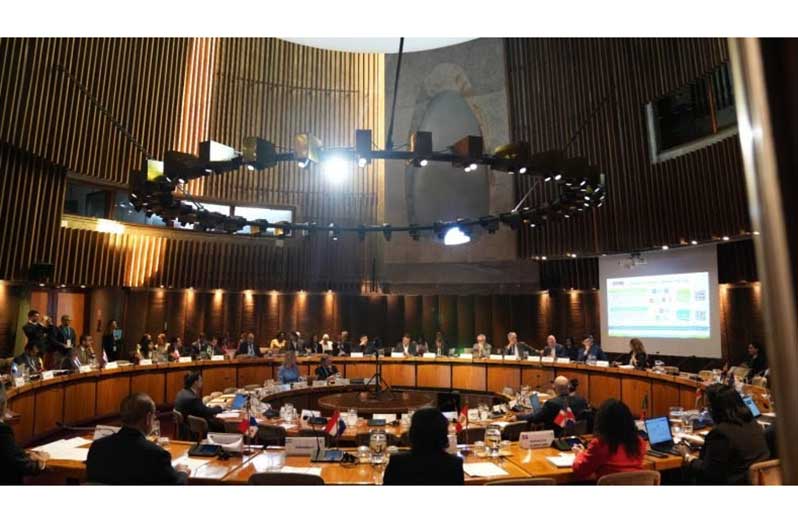
LEADING economists and policymakers convened in Chile this week to examine emerging global economic ideas and their implications for Latin America and the Caribbean, amid growing calls for a shift in development strategies to address inequality, instability and technological change.
The high-level seminar, hosted by the Economic Commission for Latin America and the Caribbean (ECLAC) in collaboration with the London School of Economics and Political Science (LSE), brought together international experts at ECLAC’s headquarters in Santiago on April 21, 2026.
Held under the theme “The London Consensus in Latin America and the Caribbean,” the forum explored new frontiers in economic thinking, focusing on productive development policies, macroeconomic stability with equity, and shifting global trade and investment dynamics.
Opening the discussions, ECLAC Executive Secretary, José Manuel Salazar-Xirinachs, emphasised the evolving nature of economic thought over the past three decades and the importance of adapting policy frameworks to current realities.
He noted that ideas and narratives play a decisive role in shaping policy direction, influencing whether societies mobilise or stagnate in the face of challenges. According to Salazar-Xirinachs, updating the region’s development narrative is critical to addressing persistent structural issues such as inequality, low social mobility and environmental vulnerability.
The seminar also highlighted key principles emerging from the “London Consensus,” a body of work that builds on lessons from the Washington Consensus while proposing a more nuanced approach to development. These include prioritising well-being, strengthening resilience, recognising the importance of structural conditions for growth, and reaffirming the role of the State alongside markets.
Delivering the keynote address, Andrés Velasco, Dean of the LSE School of Public Policy and co-editor of The London Consensus: Economic Principles for the 21st Century, outlined how the framework distinguishes between broad economic principles and context-specific policies.
He argued that effective policymaking must be adaptable, grounded in local realities, and guided by principles that can inform tailored solutions. Velasco also underscored the growing importance of productivity and the need to harness technological advancements, including artificial intelligence, to complement human skills and drive economic progress.
The keynote was followed by commentary from prominent economists, including Ricardo Hausmann and Barbara Stallings, who joined ECLAC leadership in analysing the framework’s relevance to regional development.
Throughout the day, panel discussions examined policy approaches to boosting productivity, maintaining macroeconomic stability, and strengthening international integration. Participants included representatives from major global and regional institutions, such as the World Bank and the Development Bank of Latin America and the Caribbean.
The event provided a platform to assess how the London Consensus aligns with ECLAC’s long-standing focus on productive development, inclusive growth and structural transformation, while fostering dialogue on how the region can navigate an increasingly complex and rapidly changing global economic landscape.





