






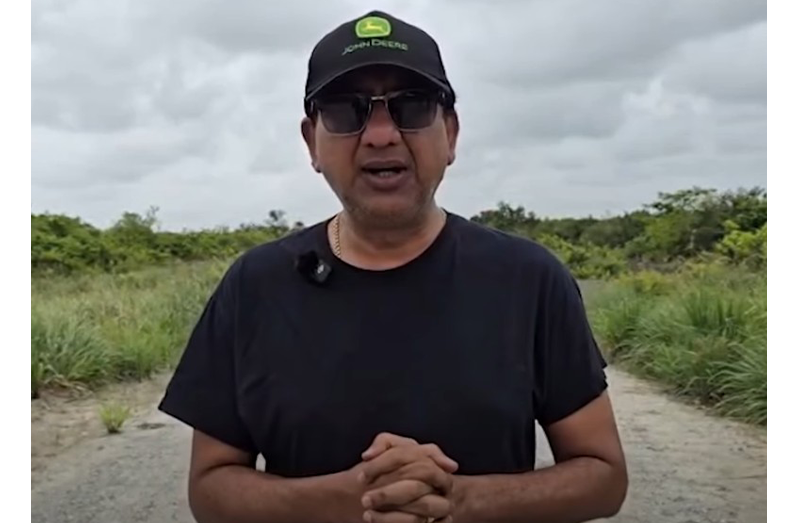
ATTORNEY-General and Minister of Legal Affairs Anil Nandlall has noted that a multi-billion-dollar utility corridor stretching close to 200 miles is being developed across Guyana’s coastline to modernise the country’s electricity and telecommunications infrastructure.
The AG, during a video broadcast, disclosed that the project, which runs through backland areas from Wales on the West Bank of Demerara to Moleson Creek in Region Six (East Berbice-Corentyne), will serve as a dedicated route for high-voltage transmission lines and telecommunications networks, marking a significant shift from the current roadside layout.
“This simple corridor at the back of what is currently nowhere is a multi-billion-dollar capital investment,” Nandlall said.
He explained that the corridor will accommodate transmission lines from the Guyana Power and Light (GPL), along with cables from the Guyana Telephone and Telegraph Company (GT&T) and other service providers, which consolidate key infrastructure into a single, purpose-built network.
“All the power lines and the utility lines that you’re seeing on the public roads of Guyana, at least on the East Coast Highway, will be removed from the current abode and will come here,” he said.
According to Nandlall, the corridor cuts through multiple regions, crossing the Demerara River at Garden of Eden, extending east along the backlands, turning north along the East Bank, and continuing along the East Coast into Mahaicony.
“This is a road that is nearly 200 miles long from one end of it when it concludes this corridor,” he said.
The route will then continue further east, crossing the Berbice River and extending to 53 Village, subsequently moving further along to Moleson Creek, effectively linking major sections of the country through a unified utility pathway.
Against this backdrop, he noted that the project is a critical component of the country’s broader energy transformation agenda, laying the groundwork for expanded generation and improved distribution.
“We have new transmission lines… and we have a gas-to-energy project that will generate electricity that will bring down your light bill to half what it is now,” he said.
Despite its scale, the minister acknowledged that much of the work remains largely unseen by the public due to its location in remote backlands, including areas that were once used for sugar cultivation.
“That is the type of development that you are not seeing, but that is taking place,” he added.
He stressed that greater effort is needed to highlight such transformative initiatives, noting that many Guyanese are unaware of the scale of some ongoing infrastructure works.




