






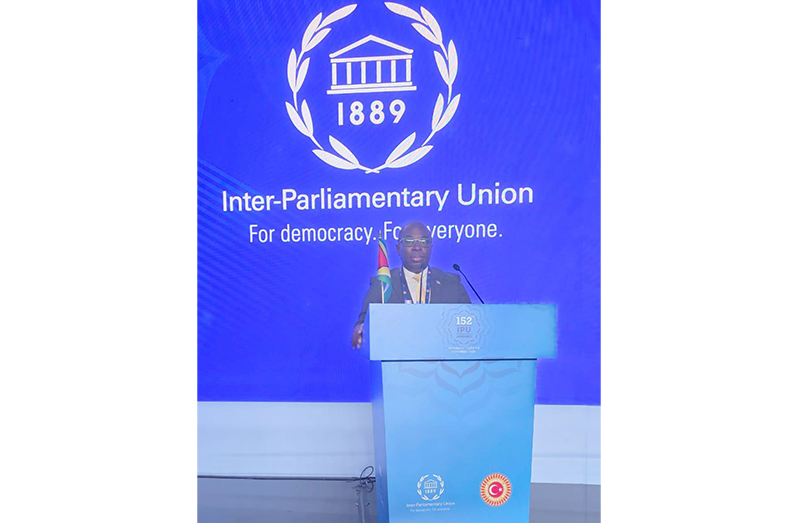
–Minister McCoy tells Inter-Parliamentary Union debate
GUYANA has reaffirmed its commitment to advancing the rights and empowerment of persons living with disabilities, outlining an ambitious national agenda that includes job creation, expanded social support, and inclusive infrastructural development.
Minister within the Office of the Prime Minister, Kwame McCoy, made this disclosure on Friday while addressing the Inter-Parliamentary Union (IPU) Standing Committee on Democracy and Human Rights preparatory debate.
The discussion focused on the resolution titled, “Inclusive Social Development for All: Parliamentary Strategies to Promote the Rights and Empowerment of Persons with Disabilities,” held in Istanbul, Türkiye.
In his presentation, Minister McCoy said Guyana remains firmly aligned with its international obligations, including the United Nations Convention on the Rights of Persons with Disabilities and the 2030 Agenda for Sustainable Development.
“Guyana reaffirms its steadfast commitment to the promotion, protection and full realisation of the rights of persons with disabilities,” the minister stated, adding that “disability inclusion is both a human-rights imperative and a prerequisite for inclusive, equitable and sustainable development.”
He pointed out that Guyana’s approach is underpinned by a strong legislative and institutional framework anchored in the Persons with Disabilities Act 2010 and supported by constitutional guarantees of equality and non-discrimination.
According to Minister McCoy, this framework is implemented through the National Commission on Disability and reflects a comprehensive, rights-based approach to governance.
“This architecture reflects a rights-based, whole-of-government approach, grounded in dignity, autonomy and equality of opportunity,” he explained.
The minister highlighted that as one of the world’s fastest-growing economies, Guyana is deliberately ensuring that economic gains are matched with social progress.
He noted a significant policy shift away from traditional welfare models towards empowerment and participation. “We are transitioning from a welfare-based paradigm to one centred on empowerment and participation,” the minister said.
Central to this strategy is a national employment target aimed at creating at least 5,000 jobs for persons with disabilities over the next five years. This, he said, will be supported by targeted investments in skills development, entrepreneurial financing, and the removal of structural barriers to employment.
To further drive inclusion, the government has operationalised the Centre for Equity, Opportunity and Innovation, which provides training and employment opportunities for persons living with disabilities, while plans are underway to establish similar business centres across the country.
“These initiatives are designed to facilitate economic independence and meaningful participation in national development,” he stated.
Minister McCoy also outlined sector-specific measures aimed at improving the quality of life for persons with disabilities. In housing, he said, priority is being given to this group in the allocation of house lots and homes, recognising the importance of secure living conditions.
In education, efforts are being made to strengthen inclusive systems through specialised programmes, dedicated facilities, and improved frameworks for Special Education Needs and Disabilities.
Guyana is also embedding accessibility into its national development agenda with a policy directive mandating that all new public infrastructures incorporate accessibility features.
“A clear policy directive now mandates the integration of accessibility features in all new public infrastructure, advancing universal design and ensuring that public spaces and services are inclusive by design, not by exception,” Minister McCoy added.
He further noted that persons with disabilities are being integrated into emerging sectors such as agriculture. Among the plans are targeted training and a model farm that will be managed by them.
“These efforts are aimed at fostering self-reliance, income generation and community participation,” the minister said.
At the same time, the government continues to strengthen its social-protection systems. Minister McCoy revealed that more than 27,000 individuals currently benefit from public assistance and direct financial transfers.
He added that for 2026, over $8 billion has been allocated to support citizens with permanent disabilities, alongside increases in monthly assistance.
“This reflects a deliberate effort to ensure that national growth translates into tangible benefits for vulnerable populations,” he noted.
However, the minister stressed that meaningful inclusion requires more than policies and programmes, pointing to the need for active participation by persons with disabilities in decision-making processes.
“Inclusion cannot be achieved without participation. Persons with disabilities must be meaningfully represented in decision-making processes at all levels,” he asserted.
He called on parliaments to play a leadership role in advancing inclusion, not only through legislation but also through oversight, financing, accountability, and evidence-based policymaking. “The shift required is from normative commitments to measurable, results-oriented implementation,” he said.
Concluding his address, the minister underscored the importance of inclusive development, warning that exclusion undermines national progress.
“Development that excludes is development that fails,” he declared.
He reaffirmed Guyana’s commitment to working with international partners to advance policies that are actionable and responsive to the needs of persons with disabilities.
“Guyana remains firmly committed to advancing an inclusive society in which all citizens are empowered as rights-holders and active contributors to national progress,” the minister said.




