






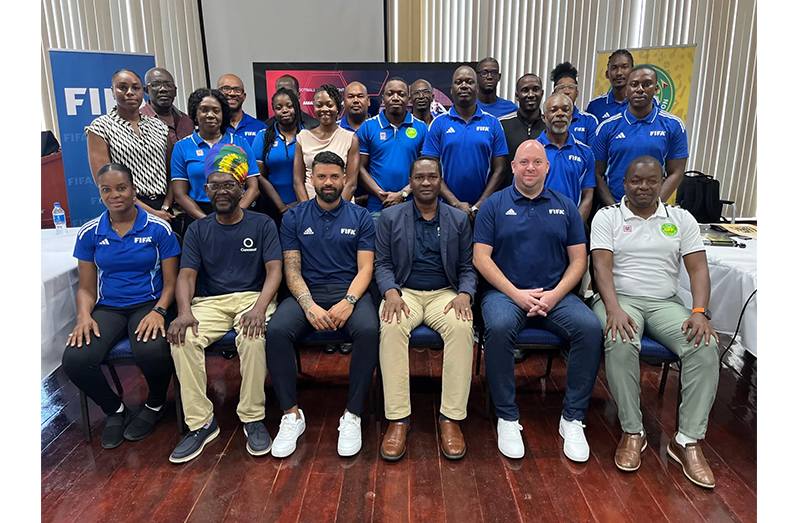
THE landscape of football in Guyana is set for a radical overhaul following the conclusion of a landmark two-day summit in Georgetown on Thursday.
The Guyana Football Federation (GFF), in direct partnership with FIFA’s Global Football Development Division, has officially released the findings of the Amateur Football Environment Analysis (AFEA), a comprehensive report designed to serve as the blueprint for the sport’s growth through 2030.
The presentation, held at the National Racquet Centre, saw FIFA Regional Technical Consultants, David Abdul and Ian Greenwood, hand over the global analysis to GFF President Wayne Forde.
This gesture marks the culmination of two years of intensive data collection and field research, transitioning from raw statistics into a definitive set of actionable priorities for the nation.
The report offers an uncompromising look at the current state of the game, evaluating everything from governance and club structures to competition frameworks and participation pathways.
Unlike previous development attempts, this roadmap is rooted in evidence-based insights, aimed at creating a sustainable ecosystem that reaches every region of the country.
Ian Greenwood emphasised that the analysis provides a “clear picture of the current reality on the ground.”
He noted that the next four years will focus on bridging the gap between grassroots’ interest and professional structures, ensuring that management resources and educational programmes align with international standards.
The GFF has been presented with several non-negotiable calls to action to ensure the project’s success.
At the forefront is the necessity to develop a robust organisational structure specifically for the amateur game.
This is paired with an ambitious mandate to implement season-round competition cycles for all age categories, ensuring that young players are no longer sidelined by long periods of inactivity.
Integration is also a major theme of the new strategy. The report explicitly calls for school football to be woven into the broader national football tapestry, alongside a push for elevated coaching standards through continuous professional development.
Furthermore, the GFF will look to modernise its administration by launching a comprehensive registration system to track participant growth and player retention more accurately.
President Wayne Forde hailed the partnership as a turning point for the federation, noting that both FIFA and the GFF are now “better positioned to make data-driven decisions.”
Forde expressed a commitment to transparency, confirming that the report will be shared with both internal and external stakeholders to foster a collaborative environment.
“These insights offer a practical roadmap for the sustainable growth of the game across Guyana,” Forde stated, adding that the ultimate goal is to ensure boys and girls nationwide benefit from an inclusive and structured environment.
Guyana is the latest stop in a broader regional push by FIFA. Similar environmental assessments have recently been delivered in Suriname, the Cayman Islands, and the Turks and Caicos, signalling a concerted effort by the world governing body to professionalise the amateur foundations of Caribbean football.




