
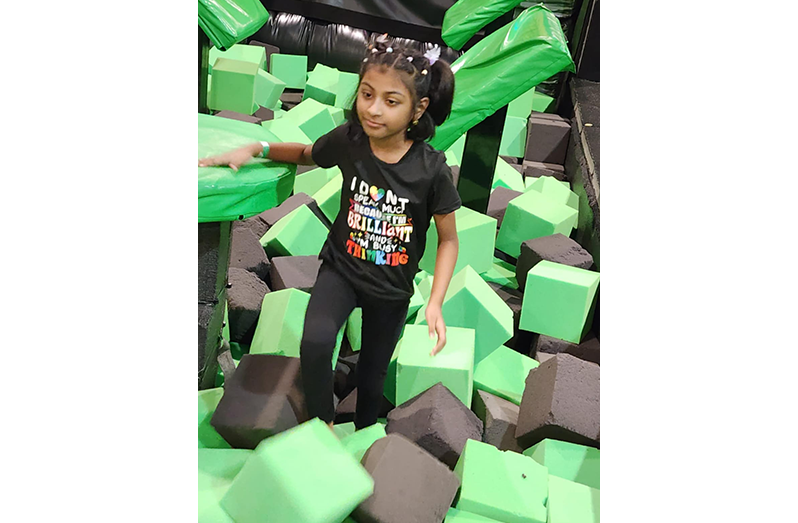
FAITH Athena Singh is eight years old and is diagnosed at Level Two on the autism spectrum.
She was nonverbal until age 3.5 and has echolalia and functional communication; however, she bangs her head when her world becomes too loud, too crowded, or too hot as a sensory response.
According to her mother, Shelly Bacchus, a strong advocate, she is still working on conversational skills.
She reported that certain things had concerned them since Faith was an infant, including her limited eye contact and the strange sounds she would make instead of cooing. She remembered her son even likening the sounds to those of aliens.
Bacchus said early on, they had noticed she would not respond to her name and would not follow sounds. This led them to suspect early on that she had a hearing impairment, but as tests concluded, she stated that her hearing was perfect.
Bacchus added that another red flag was that she took longer to meet certain milestones. For example, she never crawled but rather climbed, then moved on to walking.
“She would also try to eat things like chalk, crayons, and chipped paint. I had started researching online because I suspected something was wrong, and even before her diagnosis, I suspected she was on the spectrum,” Bacchus said.
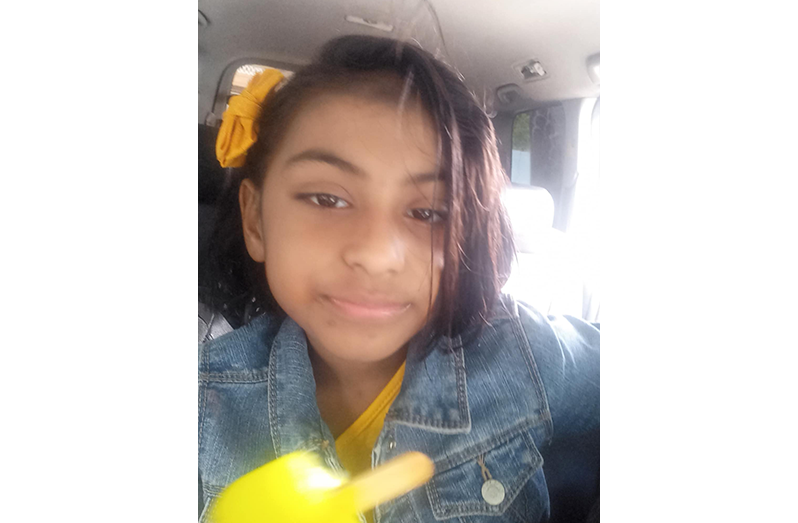
The mother of two told Pepperpot Magazine that, at 2 years old, she started her daughter on the “Gemini” programme, a course focused on speech development and autism.
She pointed out that after the first few months, Faith started repeating animal sounds and trying hard to form speech, which mostly sounded intelligible.
However, during this time, they faced the COVID-19 pandemic, and Faith was unable to attend preschool but attended her first year of nursery online.
Bacchus explained that she moved between schools trying to find one that would cater to her needs, even after Faith was hurt at a private school in the city, after which they quickly unenrolled her and homeschooled her for a year and a half.
Faith is currently back in the school system at the David Rose Special School.
She has moved from being a non-verbal, hyperactive child to one who can read, write, reason, and perform mental addition—one who is independent and can do chores like washing dishes and tidying up.
Faith loves swimming, climbing, puzzles, shopping, and long drives.
Bacchus related that while they suspected that Faith was on the spectrum, nothing truly prepared them—herself, her husband Tony Singh, and her son Timothy Singh—for such a revelation.
“I remember a therapist mentioning to us that Faith is low-functioning, and a long list of things that she would ‘never be able to do’, many of which she has already overcome. We are a very close-knit family—myself, my husband, Faith, and our sixteen-year-old son, Timothy. When we first started this journey, we realised that resources were scarce,” Bacchus said.
She noted that Faith had been receiving speech therapy at Ptolemy Reid for four years, during which she received only 22 hours of therapy, equivalent to 5.5 hours per year.
Bacchus told the Pepperpot Magazine that this amount is deeply inadequate for any meaningful development.
She stated that private therapy sessions cost between three and six thousand dollars per hour, and these, too, were scarce.
“I had to face the truth that if nothing were to be done, matters would have to be taken into my own hands. While bombarded with worry, I started to learn. I took many courses, such as RBT (Registered Behavioural Technician) training, ABA (Applied Behaviour Analysis) training, psychological disorder and treatment, and a diploma in special education,” she explained.
Bacchus said that, in addition, she participates in bi-weekly webinars with Champions for Our Children, attends several webinars and programmes for speech and occupational therapy training, and keeps up to date with autism-related newsletters.
She added that she was a teacher in the early 2000s, left in 2007 to move into the banking industry, and is now self-employed as a cake decorator.
Bacchus reported that she decided to continue with the Gemini programme, which focused on floor play, and to treat every opportunity as a learning one.
“We allowed her to express her interests and followed her lead. My husband and I schedule our work around Faith, so she is always accompanied by at least one of us. It became a family effort—everyone helped. Her brother would help her arrange puzzles, build with her, and paint with her,” she said.
Bacchus pointed out that, as the saying goes, “it takes a village to raise a child,” and her family became that village. She is thankful for the support, and that it is never just herself—it is her husband and her son.
Bacchus admitted that their little family had become a well-oiled machine, working to meet the demands of daily life, work, and Faith.
“I would work on academics, independence, behaviour, and speech. My husband and our son would participate in social activities, swim, and play outdoors. She even learnt to ride a stationary bike. This is where her father, Tony, would dominate,” she said.
Bacchus revealed that as an autism parent, she learned to survive on minimal sleep, to tolerate overscheduled days, to cook several different meals daily, clean the house every day, manage work, and make time for Faith.
She added that they became a team of three: “Teamwork makes the dream work.” Despite her diagnosis, they are dedicated to giving her the best life she can have and to helping her grow and develop into an independent adult.
Bacchus said to every parent with a child on the spectrum that she encourages them to take steps that haven’t yet been made, to learn as much as they can about their child’s diagnosis, and to seek out the necessary services.
She reported that from her own experience, you must become your child’s biggest advocate, learn as much as you can, and seek the services necessary to help your child improve.
Bacchus said with the right support, children can grow, learn, develop, and achieve far more than we often realise.
World Autism Awareness Day is observed annually on April 2 to increase understanding, acceptance, and inclusion of autistic people globally.
Designated by the UN in 2007, it marks the start of World Autism Month, focusing on advocating for neuroinclusive environments and recognising the rights of individuals on the autism spectrum.