






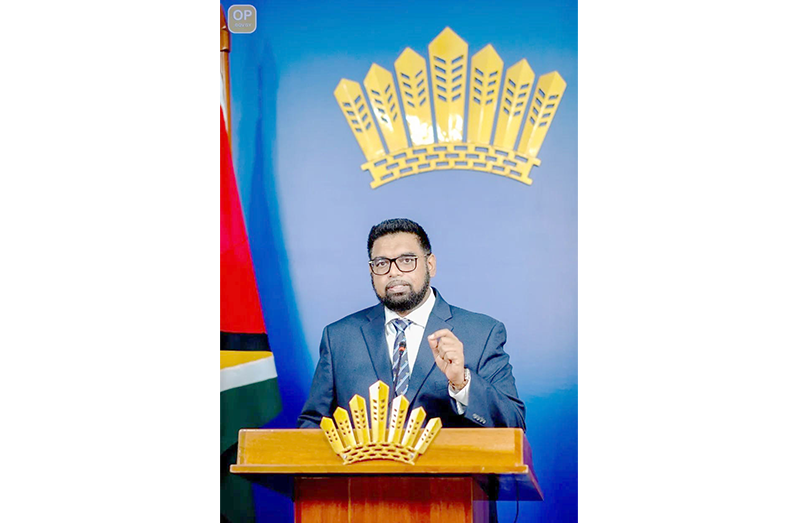
—President Ali says, highlights Guyana’s move to become regional energy, trade hub amid global crises
PRESIDENT, Dr Irfaan Ali has outlined an ambitious strategy to turn Guyana into a regional anchor of energy and fertiliser security, as the world grapples with severe disruptions to oil, gas and agricultural input supplies triggered by the closure of the Strait of Hormuz.
Recently addressing the global fallout from the conflict, President Ali stressed that Guyana is not immune to the shockwaves, but is acting early to shield its people and its neighbours.
“This is the reality. This is what farmers, the food ecosystem and governments will be faced with because of demand supply, just because of what is happening on the supply side, as a result of the challenges on the Hormuz trade,” he said.
The President contrasted Guyana’s domestic measures with steep increases at fuel pumps worldwide.
He noted that global fuel prices have risen sharply in every region as crude prices spiked from a pre‑conflict baseline of US$55–60 per barrel to peaks of US$119–120, now holding at around US$115 despite a ceasefire.
Against this backdrop, he emphasised that Guyana has taken an unusual step for a developing country.
“Here in Guyana, we are one of the few countries less than one per cent and maybe the only country in this region that has completely removed excise tax, taxes on fuel import refined products, “President Ali reminded.
This he noted was a deliberate move to cushion households and businesses from imported price shocks, while longer‑term projects come on stream.
Central to Guyana’s strategy is the rapid development of its own gas‑based energy system.
President Ali said investments now under way in a domestic gas plant and gas-bottling facility are designed to fundamentally change the cost structure of the economy.
“In Guyana, the long-term investments that we are making in our own gas plant, and gas-bottling plant will see us building up internal capacity to withstand certain shocks, because we’ll have our own natural gas,” the President said.
He added that by controlling inputs to power generation, Guyana aims to sharply reduce electricity prices.
“We’ll control the price of energy by managing through our own natural gas, the cost bringing down the cost of energy by half, so that it we will have stable fertiliser, stable gas, stable industrial and manufacturing opportunities, because we manage and we’ll be able to manage the cost of our own power,” President Ali said.
The President framed this as both an economic and security imperative, positioning domestic gas infrastructure as a buffer against external volatility.
Looking beyond national borders, President Ali said Guyana is working to become a reliable supplier of liquified natural gas (LNG) and fertiliser to its neighbours.
He pointed to the Gas‑to‑Energy (GTE) project as a cornerstone of this regional role.
“You have a responsible government, a government that is ahead of the planning cycle, and one that is ready and willing to make the necessary adjustment and to take the steps that will secure our economy, not only for today, but in the long term, ensuring resilience, sustainability and prosperity,” he stressed.




