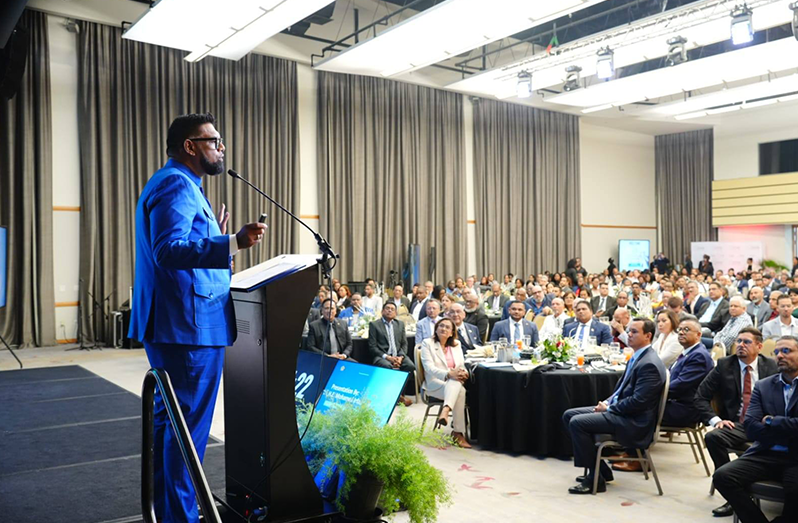
—says Caribbean must integrate strengths to unlock global competitiveness
PRESIDENT, Dr Irfaan Ali has issued a strong call for a fundamental reset in how Caribbean economies operate, urging a decisive shift from fragmented competition to structured collaboration as the region seeks to remain relevant in an increasingly competitive global landscape.
Delivering a feature address at the Trinidad and Tobago Chamber of Industry and Commerce’s Annual Business Meeting Outlook 2026/2027, the Head of State warned that long-standing protectionist tendencies and inward-looking policies are actively undermining the region’s ability to grow, innovate, and compete.
“We have not created enough systemic opportunities… we cannot be inward-looking. The world is changing. Every country is looking at its interest, and then the region’s interest,” President Ali said.
He made it clear that the Caribbean’s development trajectory will depend heavily on its ability to integrate production systems, align investment strategies, and build shared economic platforms capable of competing beyond regional borders.
“Protectionism cannot, cannot and will not allow any of us to be successful in the new world. The only formula is building our competitiveness, integrating our competitive advantage, and building a common platform,” he asserted.
BREAKING DOWN BARRIERS
Central to the President’s message was the need to dismantle bureaucratic and policy barriers that continue to restrict trade, investment, and the free movement of goods and services across the region.
He pointed to persistent inefficiencies in areas such as customs, logistics, and regulatory frameworks, arguing that these constraints are incompatible with the level of integration required to drive modern economic growth.
“We cannot talk about partnership and coming together if we can’t fix these problems,” he said, calling for frank engagement between governments and the private sector to identify and eliminate obstacles.
President Ali even proposed an intensive, results-driven approach to reform, suggesting that key stakeholders should be brought together to resolve critical issues within a defined timeframe.
“Let’s get in that room, lock ourselves up for 72 hours and fix the problem,” he urged.
The Guyanese leader stressed that regional economies must move beyond operating in silos and instead embrace a model that pools resources, capital, and expertise to generate scale.
He highlighted the importance of building consortiums and joint ventures that can leverage the region’s combined strengths, particularly in sectors such as energy, agriculture, manufacturing, and logistics.
“Are we better off fighting alone or fighting together? The time is now for us to reimagine our business structures… partnership and consortiums are what the future requires,” he said.
According to President Ali, integration is not simply a policy ambition but a practical necessity, especially as global markets demand higher levels of efficiency, reliability, and production capacity.
GLOBAL COMPETITIVENESS THE END GOAL
President Ali underscored that the ultimate objective of deeper collaboration must be to position Caribbean products and services competitively on the global stage.
“The goal is to build a common platform through which our products in the region can first be competitive within the region and then extra-regionally,” he explained.
He warned that without such alignment, individual economies will continue to face limitations in scale, market access, and investment attraction.
While acknowledging that the concept of regional integration is not new, the President challenged both policymakers and business leaders to move beyond rhetoric and deliver tangible outcomes.
“This is not about talking partnership… this is about fixing what is broken and building what is necessary for the future,” he said.
His remarks form part of a broader push by the Guyana government to deepen regional cooperation, expand economic linkages, and position Guyana as a catalyst for a more integrated and competitive Caribbean economy.